6 Types of Marmots in North America: Range, Habitat & Facts
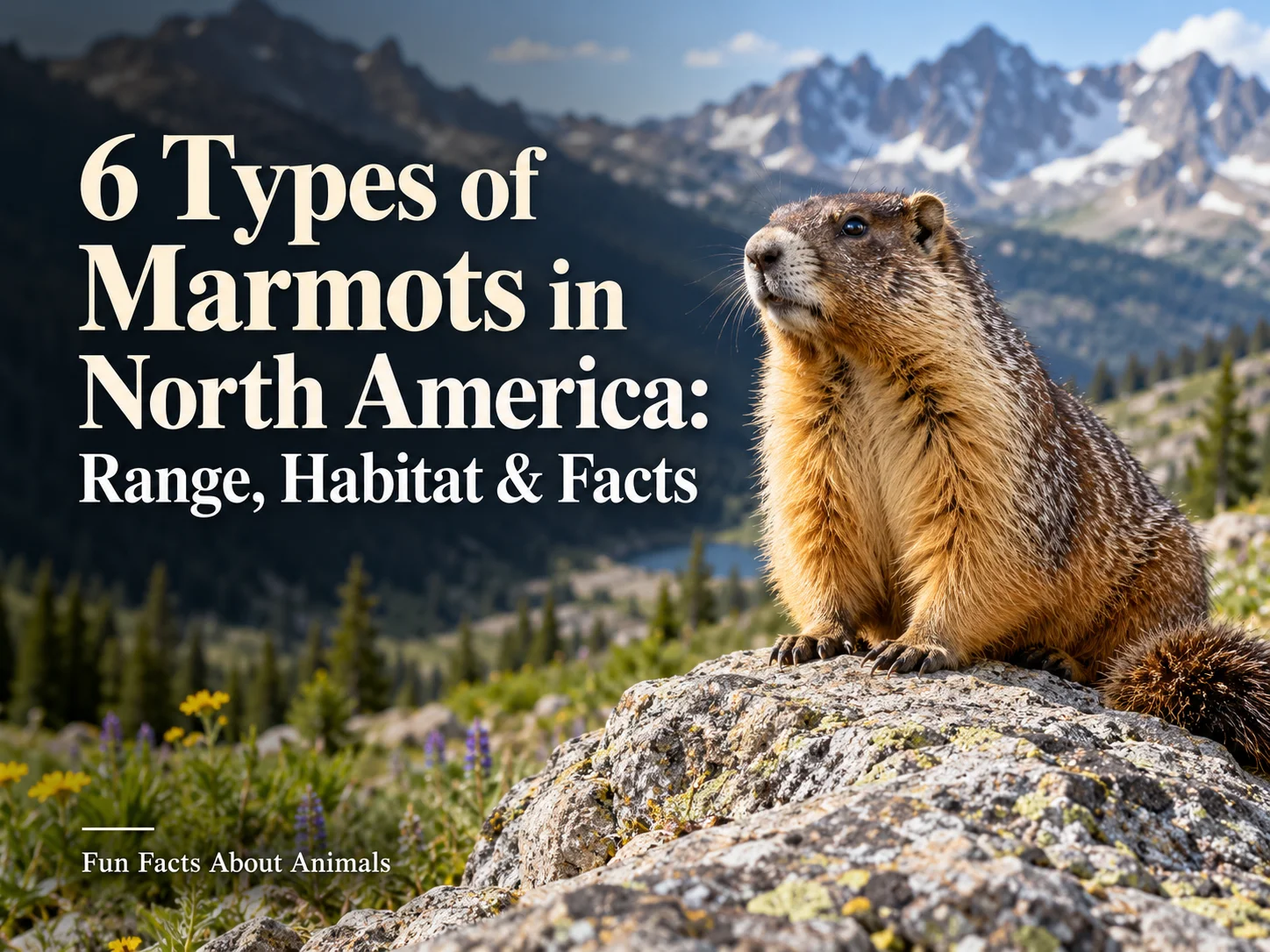
Marmots in North America include six species, from familiar groundhogs in fields and woodland edges to highly specialized marmots living in remote alpine meadows. Although they all belong to the genus Marmota, their ranges, coloration, social systems, and preferred habitats can differ considerably. Some occur across large parts of the continent, while species such as the Olympic and Vancouver Island marmots are restricted to remarkably small areas. Geography is therefore one of the best clues for identifying these large ground squirrels.
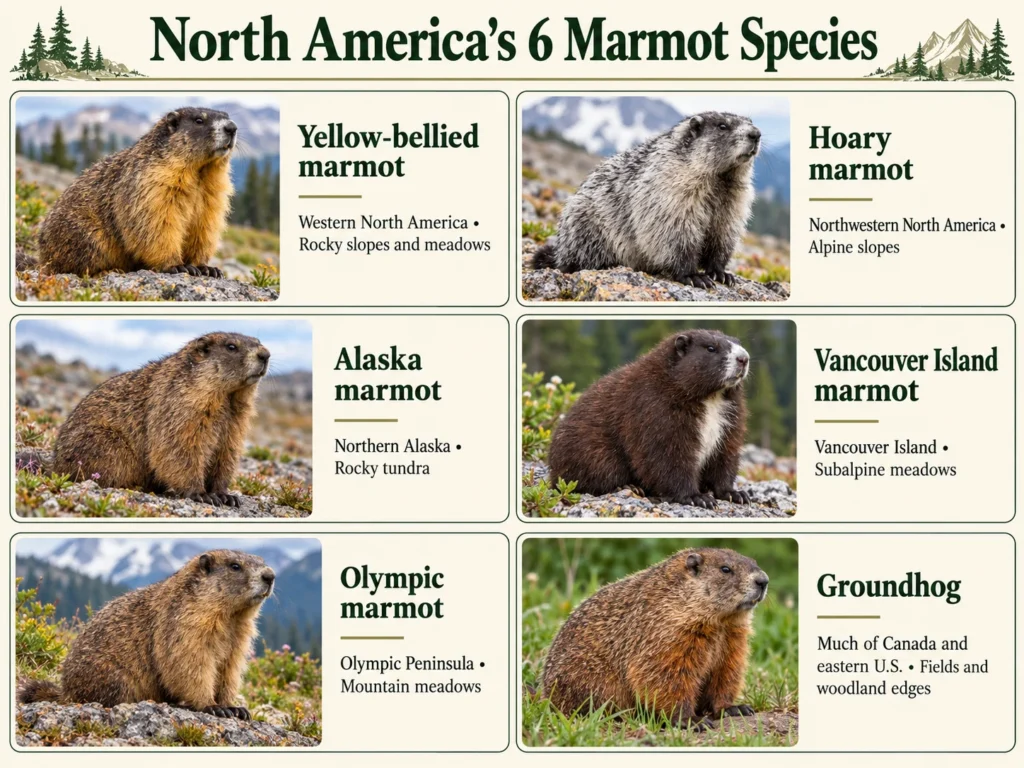
The six marmots in North America are the yellow-bellied marmot, hoary marmot, Alaska or Brewer’s marmot, Olympic marmot, Vancouver Island marmot, and groundhog or woodchuck. Most western species favor rocky mountain habitats, while groundhogs are widespread in lower-elevation landscapes. All are large members of the squirrel family and undergo seasonal hibernation.
North American Marmots at a Glance
| Marmot | Main North American Range | Typical Habitat | Useful Identification Clue |
|---|---|---|---|
| Yellow-bellied marmot | Western U.S. and southwestern Canada | Meadows, rocky slopes | Yellowish-buff underside |
| Hoary marmot | Northwestern U.S., western Canada, Alaska | Alpine tundra and talus | Pale face and silvery shoulders |
| Alaska marmot | Northern Alaska | Rocky tundra and mountains | Dark face and northern range |
| Olympic marmot | Olympic Peninsula, Washington | Alpine and subalpine meadows | Restricted Olympic range |
| Vancouver Island marmot | Vancouver Island, British Columbia | Mountain meadows | Dark chocolate-brown coat |
| Groundhog | Much of eastern and central North America | Fields, pastures, forest edges | Lowland habitat and stocky build |
1. Yellow-Bellied Marmot
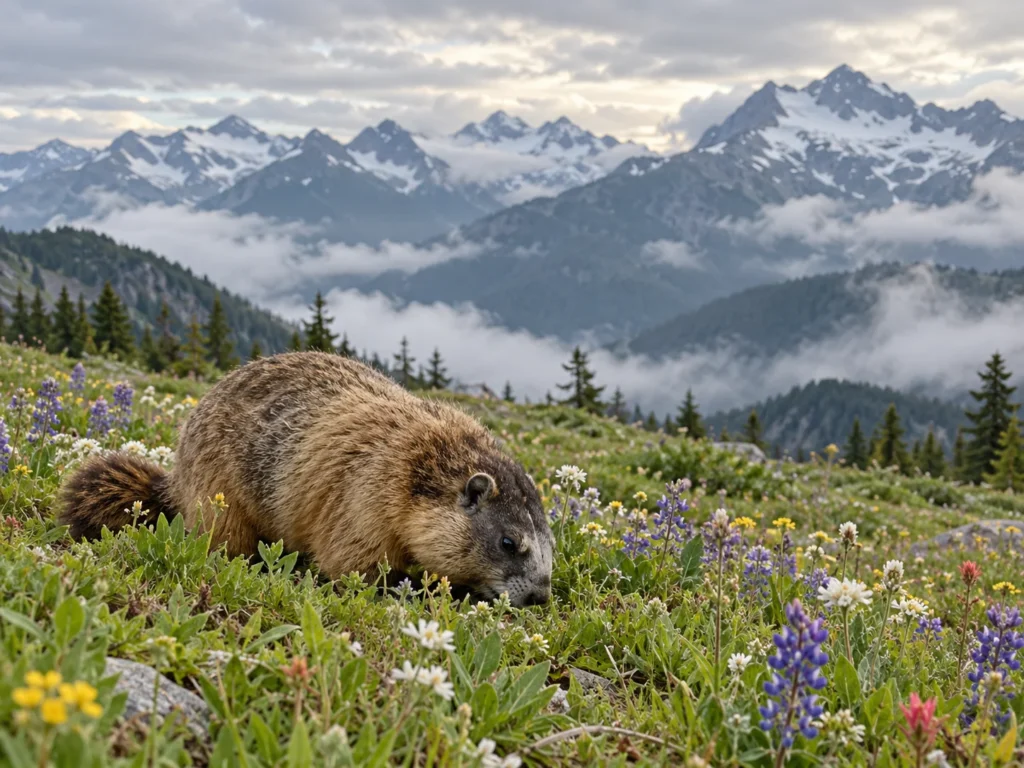
The yellow-bellied marmot (Marmota flaviventris) is one of the most familiar marmots in North America, especially across the western part of the continent. Its range extends through large parts of the western United States and into southwestern Canada. Depending on location, it may occur from valleys to alpine environments, although open grassy areas near rocks are particularly characteristic habitat. As the name suggests, the underside often has yellowish or buff coloration. The upper body is generally brownish, and the animals have compact ears, powerful digging legs, and a well-furred tail.
Yellow-bellied marmots commonly build burrows beneath rocky slopes or meadows. These underground systems provide shelter from predators, a place to raise young, and secure chambers for winter hibernation. They are relatively social compared with groundhogs. Several animals may occupy a colony, and alarm whistles warn nearby marmots when predators approach. During the short growing season, they feed intensively on grasses, flowering plants, seeds, and other vegetation before spending months underground during winter.
2. Hoary Marmot
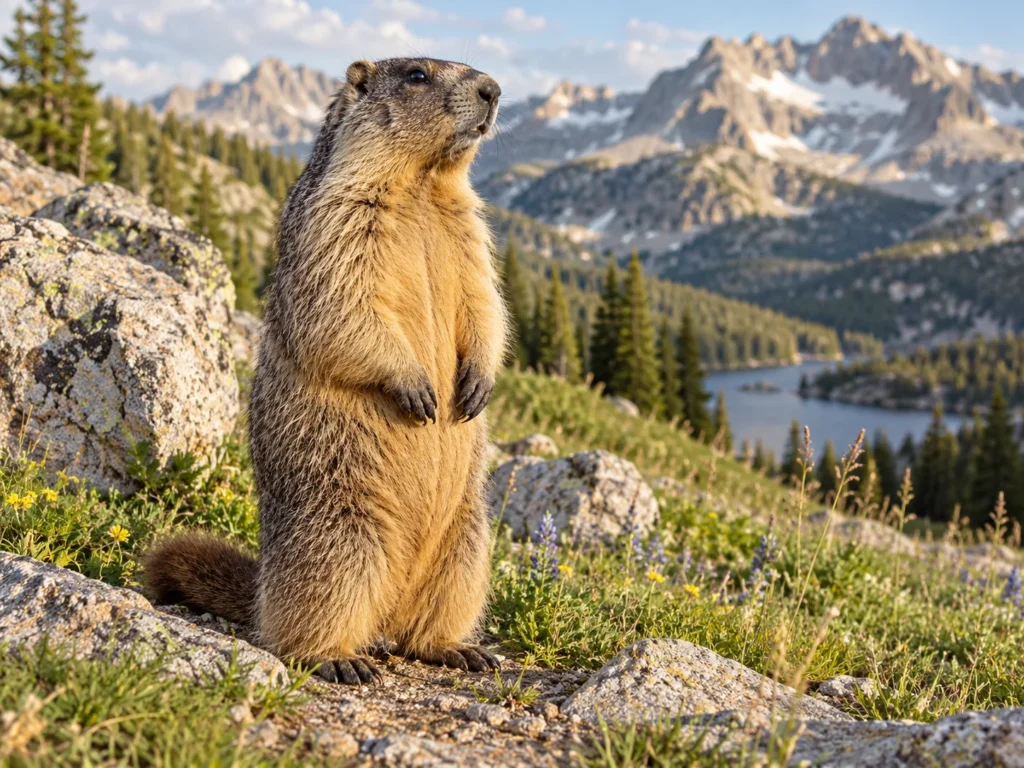
Hoary marmots (Marmota caligata) are among the large mountain-dwelling marmots in North America, especially in the northwest. Their range stretches through portions of the northwestern United States, western Canada, and Alaska. They are strongly associated with alpine and subalpine landscapes containing rocky outcrops, talus slopes, and nearby vegetation for feeding. Their name comes from their frosted or “hoary” appearance. Pale gray or silver coloration across the shoulders and upper back contrasts with darker parts of the body, while the face often has conspicuous pale markings.
Hoary marmots are sometimes called whistle pigs because of the sharp alarm calls they produce when danger is detected. A marmot standing upright on a rock is often acting as a lookout while other members of the group feed nearby. This vigilance helps them respond quickly to Dangerous Animals such as large predators that may enter their mountain habitat. Hoary marmots are social and can live in colonies containing adults and young of several ages. Winter conditions in their mountain habitats are severe, so hibernation is a major part of their annual cycle. They retreat underground and survive largely on fat accumulated during the brief summer.
3. Alaska Marmot
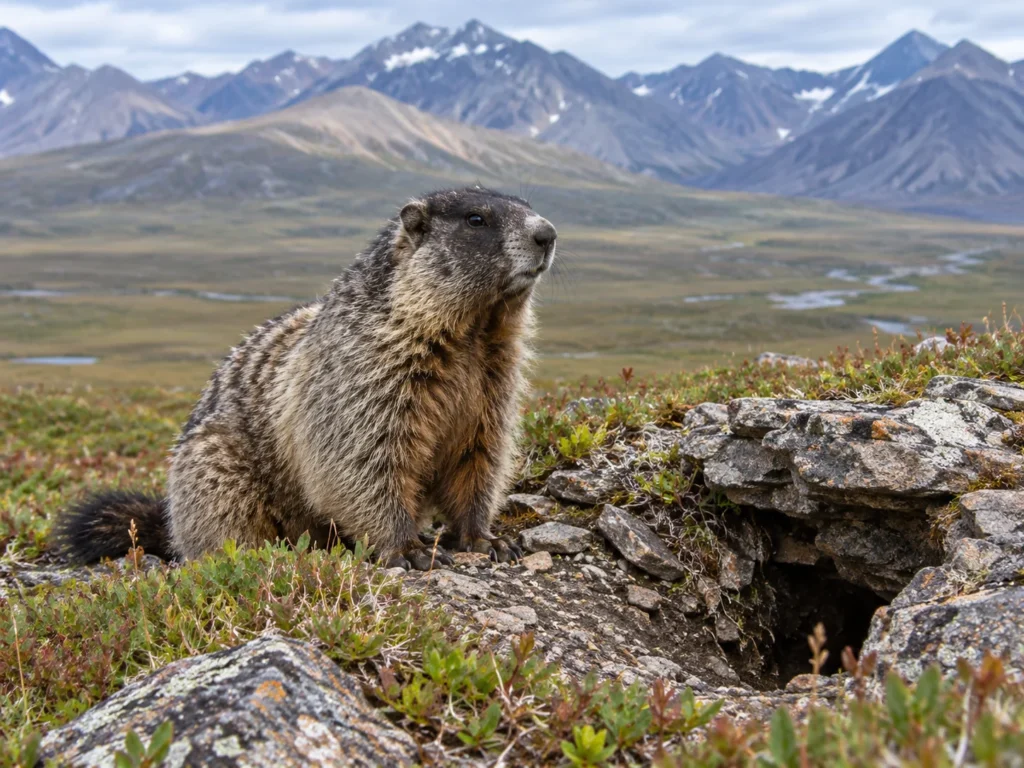
The Alaska marmot (Marmota broweri) is one of the northernmost marmots in North America and is also known as Brower’s marmot. Those names refer to the same species, not two separate types of North American marmot. Its distribution is much more northern than that of most marmots on the continent. The species is associated primarily with northern Alaska, particularly the Brooks Range and other mountainous areas north of the Yukon River, although records also occur somewhat farther south in suitable northern mountain systems.
Alaska marmots usually inhabit rocky tundra, boulder fields, talus slopes, and outcrops situated close to areas where grasses, flowering plants, roots, berries, mosses, and other vegetation are available. They can be distinguished from hoary marmots partly by their darker coloration. Alaska marmots generally lack the conspicuous pale snout characteristic of the hoary marmot and have a darker head and rump. They are highly social, and colonies may share extensive burrow systems. Family members can remain together for multiple years, including during hibernation. Their remote distribution means they are encountered far less frequently than yellow-bellied marmots or groundhogs.
4. Olympic Marmot
The Olympic marmot (Marmota olympus) has one of the most restricted ranges among marmots in North America. It occurs naturally only on Washington State’s Olympic Peninsula, particularly in alpine and subalpine meadows within the Olympic Mountains. Its isolation from other marmot populations over thousands of years helped produce a distinct species. Olympic marmots are generally brownish and can change noticeably in appearance as their coats age through the summer. They live in social family groups and excavate burrows beneath mountain meadows.
These burrows protect them from predators and harsh weather while also serving as hibernation sites. During the short snow-free season, Olympic marmots feed heavily on grasses, sedges, flowering plants, roots, and other available vegetation. Hibernation can occupy roughly seven to eight months of the year. This leaves only a short summer period in which the animals must feed, reproduce, raise young, and accumulate enough fat to survive another winter. Because the entire species occurs within such a restricted geographic area, monitoring its population and habitat remains particularly important.
5. Vancouver Island Marmot
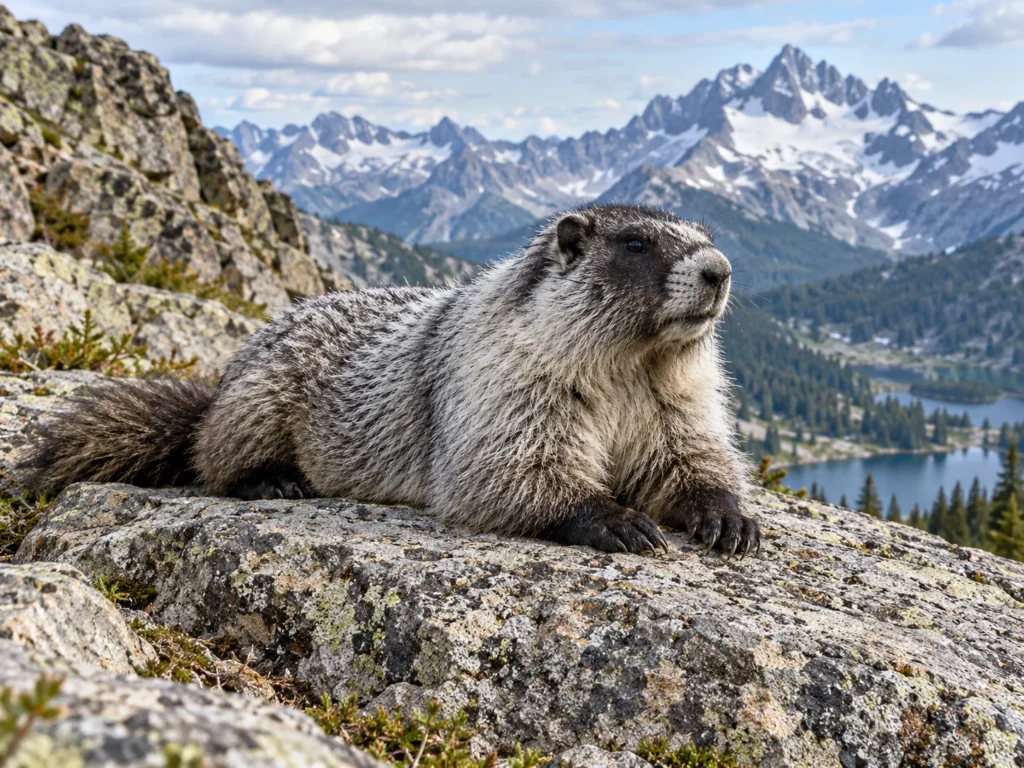
The Vancouver Island marmot (Marmota vancouverensis) is one of the most geographically restricted marmots in North America and is found naturally only on Vancouver Island in British Columbia, Canada. Its tiny natural range makes it one of the most geographically restricted mammals on the continent. Adults have rich dark brown fur, often with contrasting pale areas around the nose, chin, chest, or forehead. This darker appearance helps distinguish them from several other western marmots. Their traditional habitat consists largely of open subalpine and alpine meadows where suitable soil and terrain allow burrow construction. Like other mountain marmots, they use these burrows for shelter, reproduction, predator avoidance, and prolonged winter hibernation.
Vancouver Island marmots are social animals and communicate through vocalizations and scent. They feed primarily on grasses, flowering plants, and other vegetation during their relatively short active season. Their conservation story is very different from topics such as Porcupines in Georgia, which focus more on regional wildlife presence and distribution. The Vancouver Island marmot experienced a severe population decline and remains the focus of an intensive recovery program involving captive breeding, releases, habitat work, and monitoring. Recovery efforts have substantially increased the number of wild marmots from historic lows, but the species remains conservation-dependent and geographically restricted.
6. Groundhog or Woodchuck
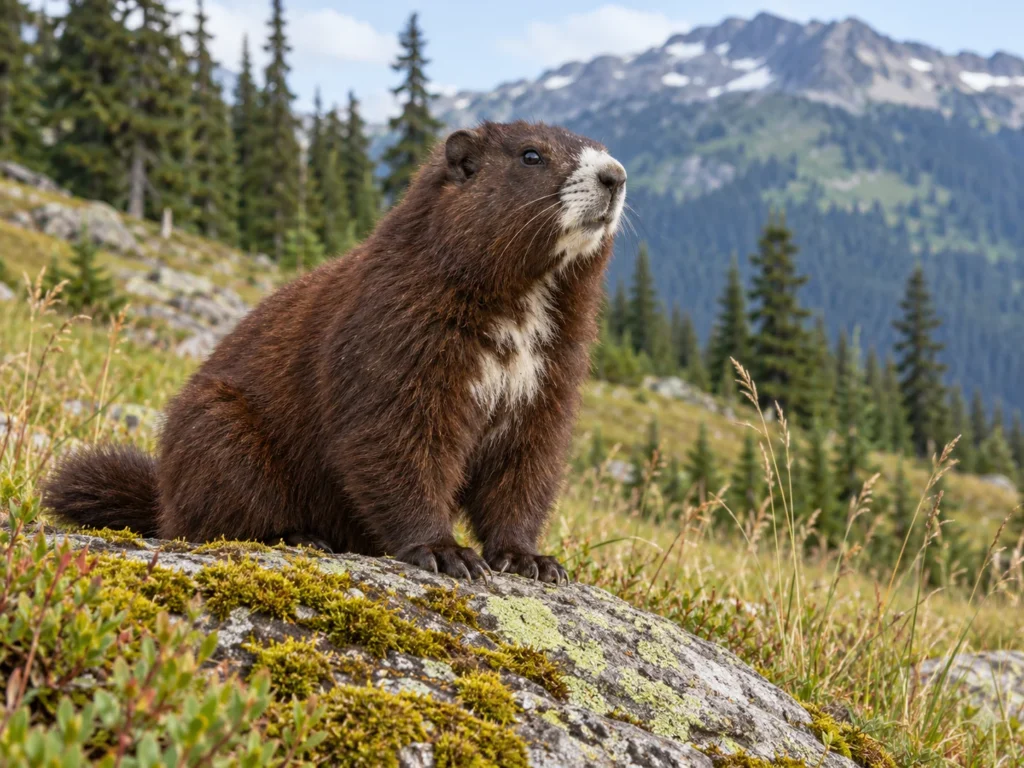
The groundhog (Marmota monax), also called the woodchuck, is one of the best-known marmots in North America and is a true marmot. It is not simply an animal that resembles one. In fact, it belongs to the same genus as the mountain marmots listed above. Groundhogs have the broadest distribution of the six North American species. They occur across much of eastern and central North America and extend into parts of Canada and Alaska. Their habitat is also noticeably different. Rather than depending primarily on alpine meadows and rocky mountain slopes, groundhogs thrive in fields, pastures, roadsides, woodland edges, farms, and other relatively open lowland landscapes.
Groundhogs are powerful excavators that construct extensive burrows containing sleeping chambers and multiple entrances. They feed mostly on grasses, leaves, flowers, and other vegetation. Compared with several social mountain marmots, adult groundhogs are generally more solitary. They still share the defining seasonal adaptation of the group: true hibernation. During winter, metabolism, body temperature, and heart rate fall dramatically as the animal survives on stored fat.
Where Do Marmots Live in North America?
The distribution of marmots in North America has a strong geographic pattern. The western half of the continent contains most of the mountain specialists, while the groundhog dominates much of the east and center. Yellow-bellied marmots occupy a large western range, including many areas of the Rocky Mountains. Hoary marmots occur farther north and west, extending through western Canada into Alaska. North of the Yukon River, the Alaska marmot becomes the characteristic high-latitude species.
The Pacific Northwest also contains two unusually localized marmots. Olympic marmots are endemic to Washington’s Olympic Peninsula, while Vancouver Island marmots occur naturally only on their namesake Canadian island. Their habitats differ greatly from those of Animals That Live in Rivers, which depend more directly on flowing freshwater systems and riverbanks. Groundhogs break the mountain-marmot pattern completely. They are well adapted to lower elevations and frequently live surprisingly close to human-modified landscapes.
Are Groundhogs Really Marmots?
Yes. A groundhog is a marmot and is one of the most widespread marmots in North America. The scientific name Marmota monax places the groundhog within the same genus as yellow-bellied, hoary, Olympic, and other marmots. The confusion largely comes from common names rather than biology.
Groundhogs simply represent a different ecological strategy. Instead of specializing in cold alpine meadows, they commonly inhabit lower-elevation fields, pastures, forest edges, and agricultural landscapes. So, every groundhog is a marmot, but not every marmot is a groundhog.
Marmot vs. Groundhog: What’s the Difference?
| Feature | Many Mountain Marmots | Groundhog |
|---|---|---|
| Biological group | Genus Marmota | Genus Marmota |
| Habitat | Often alpine or subalpine | Mostly lowland/open landscapes |
| Distribution | Often western or localized | Broad eastern/central range |
| Social structure | Several species form colonies | Generally more solitary |
| Hibernation | Yes | Yes |
| Burrowing | Extensive | Extensive |
When comparing marmots in North America, the distinction is ecological and linguistic rather than a separation into unrelated types of animals. “Marmot” describes the broader group; “groundhog” identifies one particular marmot species.
Why Do North American Marmots Hibernate?
Most marmots in North America experience great seasonal changes in food availability. During winter, snow can bury mountain vegetation for months, while freezing temperatures make remaining active extremely costly. Hibernation solves this problem by dramatically reducing energy use. Marmots retreat into protected underground chambers, lower their body temperature, and slow major physiological processes. Stored body fat then becomes their main energy source.
The length of hibernation differs by species, elevation, latitude, and local conditions. Olympic and other high-mountain marmots may remain underground for much of the year, while groundhogs living in milder regions can experience shorter winters. This makes summer feeding critical. A marmot that appears to spend much of the warm season eating is preparing for a period when feeding may stop for months.
What Do Marmots Eat?
Marmots in North America are predominantly herbivorous. Their diets commonly include grasses, sedges, leaves, flowering plants, shoots, seeds, and other tender vegetation.
Exactly what they eat depends on habitat and season. Yellow-bellied marmots may shift toward seeds as summer vegetation dries, while Olympic marmots make heavy use of fresh mountain flowers and other herbaceous plants. Because hibernating species rely on stored fat, summer is a period of intense feeding. Marmots can gain substantial weight before returning underground.
How Can You Identify a Marmot?
To identify marmots in North America, start with location and habitat, then examine coloration and markings. A pale, silver-shouldered marmot in northwestern alpine terrain could be a hoary marmot, while a brown marmot with a yellowish underside in the western mountains is more likely to be yellow-bellied. This habitat-based identification approach is also useful when researching regional wildlife topics such as Badgers in Maine, where geographic range is essential for distinguishing likely species. In northern Alaska, a dark-faced marmot north of the Yukon River points toward the Alaska marmot.
On Vancouver Island or the Olympic Peninsula, geography becomes particularly powerful because each region contains its own endemic marmot. A chunky burrowing marmot standing beside an eastern pasture or woodland edge is far more likely to be a groundhog than one of the western mountain species.
Which North American Marmots Have the Smallest Ranges?
Among marmots in North America, the Olympic marmot and Vancouver Island marmot have exceptionally restricted distributions. Each is endemic to a relatively small geographic region and occurs nowhere else naturally. The Alaska marmot also has a limited range compared with widespread yellow-bellied marmots, hoary marmots, and groundhogs. It is concentrated in remote northern Alaska rather than extending broadly across the continent. Restricted range does not automatically mean two species face identical conservation threats, but it does make local habitat conditions particularly important.
FAQs
How many marmot species live in North America?
There are six recognized marmots in North America: yellow-bellied, hoary, Alaska/Brower’s, Olympic, Vancouver Island, and the groundhog or woodchuck.
Are groundhogs marmots?
Yes. The groundhog, Marmota monax, is a genuine member of the marmot genus. It differs from many other marmots mainly in its broad distribution and preference for lower-elevation habitats.
Where are marmots found in the United States?
Marmots occur across many parts of the United States. Several species inhabit western mountains; Alaska has multiple marmot species, Olympic marmots occur in Washington, and groundhogs range widely across the eastern and central portions of the country.
Do marmots live in Canada?
Yes. Canada supports several marmot species, including hoary, yellow-bellied, groundhog, and Vancouver Island marmots. Their distributions vary considerably by province and habitat.
Do all North American marmots hibernate?
The six North American marmot species are hibernators, although the length and timing of hibernation vary with species, elevation, latitude, and local climate.
What is the rarest marmot in North America?
The Vancouver Island marmot is among North America’s rarest and most conservation-dependent mammals. It survives naturally only on Vancouver Island and has required intensive recovery efforts after a severe historical decline.
Final Thoughts
Marmots in North America range from widespread groundhogs to mountain specialists found nowhere outside a single island or peninsula. Understanding their location, habitat, coloration, and social behavior makes these closely related rodents much easier to identify and shows just how diverse the marmot group really is.