
Animals With No Tails: 15 Tailless Animals Explained
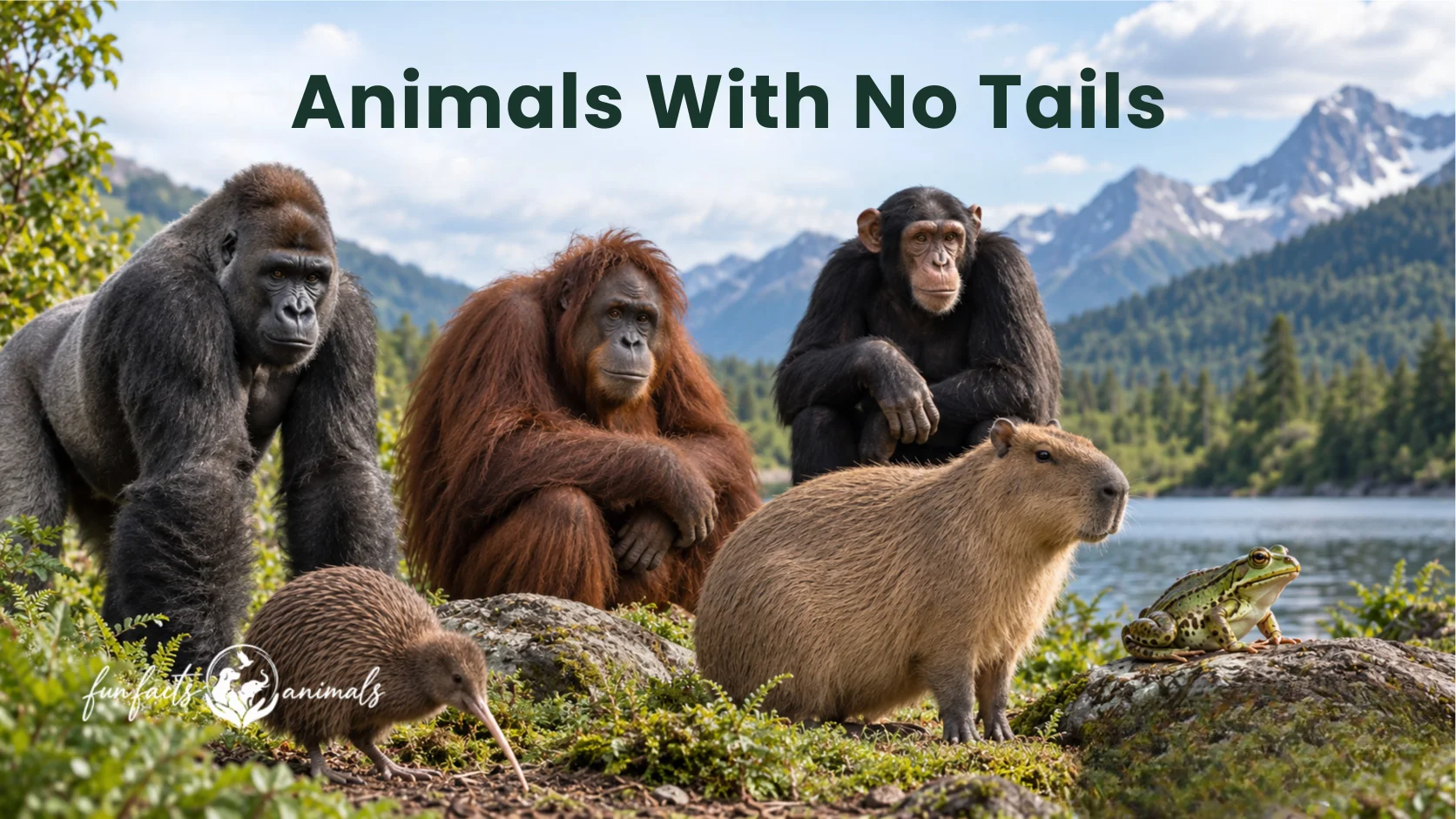
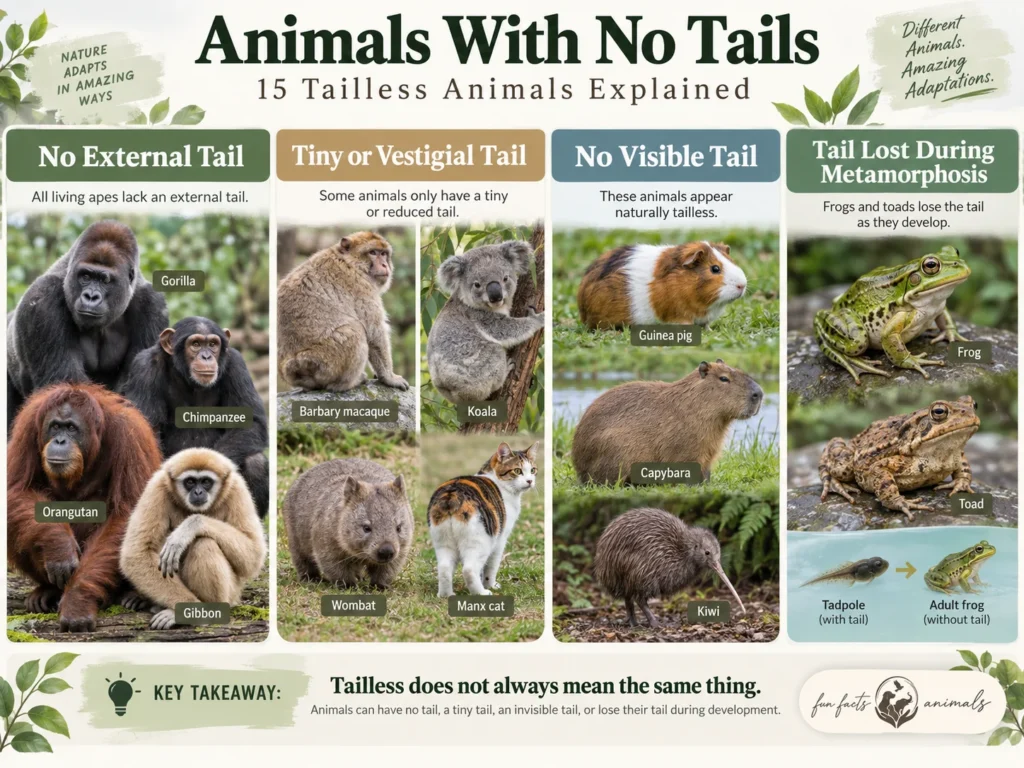
Animals with no tails are more varied than they first appear. Some species, including all living apes, genuinely lack an external tail. Others have such a tiny or vestigial tail that it is almost invisible, while frogs and toads lose their tails as they develop from tadpoles into adults. These differences show why “tailless” does not always mean the same thing and how animals can climb, swim, run, or jump without relying on a long tail.
Animals with no tails include gorillas, chimpanzees, bonobos, orangutans, gibbons, guinea pigs, capybaras, kiwi, and adult frogs. Some genuinely lack an external tail, while others have a tiny vestigial structure or lose their tail during development. Each group has different anatomical and movement adaptations that make a long tail unnecessary.
What Does “No Tail” Actually Mean?
Calling an animal tailless can describe several different situations. Living apes have no external tail, while animals such as Barbary macaques and wombats retain only a tiny structure that may be difficult to see. A vestigial tail is a reduced structure inherited from ancestors in which the tail was more developed.
Frogs provide another case entirely. Tadpoles have functional tails for swimming, but these disappear during metamorphosis as the animals develop their adult bodies. Understanding these differences helps prevent reduced or hidden tails from being mistaken for complete anatomical absence.
| Animal | Tail Status |
| Gorilla | No external tail |
| Barbary macaque | Very short vestigial tail |
| Capybara | No visible external tail |
| Wombat | Tiny tail hidden by fur |
| Frog | Tail lost during metamorphosis |
15 Animals With No Tails or Almost No Visible Tail
1. Gorilla
Gorillas are great apes, and like all living apes, they lack an external tail. They spend much of their time on the ground and commonly move by knuckle-walking rather than relying on a long tail for stability. Gorillas eat a lot of food and love enjoying their company.
Their powerful arms, legs, shoulders, and trunk provide the support they need to move. The absence of a tail is simply part of the ape body plan rather than a limitation gorillas have to overcome.
2. Chimpanzee
Chimpanzees are also tailless great apes. They are capable climbers but spend considerable time on the ground, combining climbing with knuckle-walking and other forms of movement.
Strong limbs, flexible shoulders, grasping hands and feet, and careful body positioning allow chimpanzees to move effectively without a tail. They show that even animals that spend significant time in trees do not always need a long balancing structure.
3. Bonobo
Bonobos are close relatives of chimpanzees and share the ape characteristic of having no external tail. Their relatively long legs, flexible bodies, and strong limbs help them move both through trees and across the ground.
The absence of a tail is not unique to bonobos but reflects the evolutionary history shared by living apes. They are another example of primates whose movement depends on whole-body coordination rather than a tail.
4. Orangutan
Orangutans are highly adapted for life in trees despite having no external tail. Their exceptionally long arms, flexible joints, strong hands, and powerful grip allow them to move carefully between branches.
They frequently distribute their weight across several supports before changing position. This deliberate climbing style shows that an arboreal mammal can remain highly effective in the canopy without using a tail for balance.
5. Gibbon
Gibbons are lesser apes famous for brachiation, the arm-swinging movement they use to travel rapidly between branches. Like all apes, they have no external tail.
Their very long arms, mobile shoulder joints, strong hands, and precise body control make this movement possible. Gibbons are among the clearest examples of tree-dwelling animals that achieve remarkable balance and agility without a tail.
6. Siamang
The siamang is the largest member of the gibbon family and is also tailless. It uses its long arms to swing through trees but can also climb or move along branches using other forms of locomotion.
Its body is specialized around strong shoulders, gripping hands, and coordinated movement. Siamangs therefore reinforce an important point: a long external tail is not essential even for primates that spend much of their lives above the ground.
7. Barbary Macaque
The Barbary macaque is particularly interesting because it is a monkey, not an ape. It often appears completely tailless, but it actually has an extremely short vestigial tail.
This makes it an exception to the simple idea that apes lack tails while monkeys always have them. Describing the Barbary macaque as having a highly reduced tail is more anatomically accurate than saying no tail structure exists at all.
8. Guinea Pig
Guinea pigs are compact rodents with no visible projecting tail. This gives them a very different appearance from familiar long-tailed rodents such as rats and mice.
Their tail region is extremely reduced, and their everyday movement does not depend on a balancing tail. Instead, their low body position and short limbs suit a mainly ground-dwelling lifestyle. Guinea pigs are among the most familiar mammals that appear naturally tailless.
9. Capybara
Capybaras, the world’s largest living rodents, also have no visible external tail. Their large, barrel-shaped bodies and sturdy limbs suit them for moving on land as well as swimming.
Unlike many rodents with obvious tails, capybaras do not rely on a projecting tail as a major part of locomotion. Their appearance shows how dramatically external traits can differ even among animals belonging to the same broad mammalian order.
10. Koala
Koalas appear tailless because they lack an obvious external tail. The tail region is reduced and vestigial rather than forming a long structure like those seen in many other tree-dwelling mammals.
Instead, their climbing ability depends on strong limbs, curved claws, and gripping hands and feet. These features let koalas move securely along trunks and branches without a prominent tail for balance.
11. Wombat
Wombats often appear on lists of tailless animals, but they are not completely tailless. They have a very short tail that is often difficult to notice because it is small and partly hidden by thick fur.
Their stocky bodies and strong legs are far more noticeable features. The wombat is therefore a useful example of the difference between an animal that looks tailless and one in which an external tail is completely absent.
12. Kiwi
Kiwi are unusual birds with no obvious external tail. Their rounded bodies, reduced wings, strong legs, and ground-dwelling lifestyle make them look very different from many familiar flying birds.
They also lack the prominent external tail feathers people normally associate with birds. The kiwi shows that tailless animals are not limited to mammals and that the visible form of a tail can differ greatly among vertebrate groups.
13. Frog
Adult frogs are tailless, but they begin life very differently. Most frog larvae, called tadpoles, have a muscular tail that helps propel them through water.
During metamorphosis, legs develop, and the animal’s body is reorganized for adult life. The larval tail is gradually resorbed until it disappears. Many adult frogs then rely heavily on their powerful hind limbs for jumping and swimming instead of using a tail.
14. Toad
Adult toads are also tailless members of the frog order Anura, a name associated with the absence of an adult tail. Like other frogs, they generally begin life as tadpoles with tails.
As metamorphosis progresses, the tail is resorbed while the limbs and adult body develop. Toads therefore become tailless through development rather than being born in the same adult body form they will retain throughout life.
15. Manx Cat
The Manx cat is well known for naturally reduced tail length caused by a genetic mutation affecting development of the tail vertebrae. Some Manx cats have no visible tail, while others are born with a short stump or a longer tail.
For that reason, not every Manx cat is truly tailless. The breed is still an interesting example because the trait varies among individuals instead of being shared in the same form by every member.
Why Do Some Animals Have No Tails?
No single reason explains every animal on this list. In living apes, external tail loss reflects their shared evolutionary history and body structure. Barbary macaques, koalas, and wombats illustrate different degrees of tail reduction rather than the same condition.
Frogs and toads reach adulthood without tails through metamorphosis, while the Manx cat’s variable tail length results from a genetic mutation. These examples show why it is inaccurate to say animals stopped using their tails and eventually lost them. Evolution, development, and genetics can all produce different forms of apparent taillessness.
How Do Animals Balance Without Tails?
Tails perform important functions in many species, including balance, steering, swimming, communication, and even grasping. However, balance involves the whole body, so animals without tails can rely on other anatomical features and movement patterns.
Gibbons use long arms and flexible shoulders while swinging through trees. Orangutans rely on powerful limbs and carefully controlled climbing, while gorillas use strong limbs and body posture when moving on the ground. Koalas grip branches with strong claws, and adult frogs use specialized hind limbs for jumping and swimming.
Therefore, no single structure replaces a tail in every tailless animal.
Are Apes the Only Primates Without Tails?
All living apes lack external tails. This includes gorillas, chimpanzees, bonobos, orangutans, gibbons, and siamangs. Most monkeys have tails, although the length and function can vary substantially between species. The Barbary macaque is the important exception to the simple rule. It is a genuine monkey but possesses only a tiny vestigial tail that is often almost impossible to see. So the common statement “apes have no tails, monkeys have tails” is useful, but it is not completely absolute.
No Tail vs Short Tail vs Vestigial Tail
An animal with no external tail has no obvious tail projecting from the body. A short tail is still present but noticeably smaller than those of many related species. A vestigial tail is an evolutionarily reduced structure that may retain little of the function associated with a larger ancestral tail. These descriptions can overlap in everyday language. A Barbary macaque or wombat may be casually called tailless because almost nothing is visible, while anatomically a reduced structure remains. Adult frogs represent another category because their larval tail disappears during development.
Key Takeaways
Animals with no tails are not one uniform biological group. Living apes lack external tails, while Barbary macaques, koalas, and wombats retain reduced or vestigial structures. Guinea pigs, capybaras, and kiwi also appear naturally tailless. Frogs and toads lose their larval tails during metamorphosis, while tail length in Manx cats varies because of a genetic mutation. Each case reflects a different combination of anatomy, evolution, development, and lifestyle.
FAQs
What animals have no tails?
Examples include gorillas, chimpanzees, bonobos, orangutans, gibbons, siamangs, guinea pigs, capybaras, kiwi, and adult frogs and toads. Other animals, such as Barbary macaques, koalas, and wombats, appear tailless but retain very short or vestigial tail structures.
Do all apes have no tails?
Yes. All living apes lack externally visible tails. This includes great apes such as gorillas, chimpanzees, bonobos, and orangutans, as well as lesser apes such as gibbons and siamangs.
Are there monkeys with no tails?
The Barbary macaque is the best-known example of a monkey that appears tailless. It actually possesses a very short vestigial tail, so describing it as having a highly reduced tail is more anatomically accurate.
Do guinea pigs have tails?
Guinea pigs have no visible projecting tail. Their tail region is extremely reduced, giving them the rounded, naturally tailless appearance most people recognise.
Why do frogs have tails as tadpoles but not as adults?
Tadpoles use their muscular tails to swim. During metamorphosis, the body changes as limbs develop and the animal prepares for adult life. The larval tail is gradually resorbed, leaving the adult frog or toad without an external tail. You can also check out animals with flippers along with their swimming facts.
Final Thoughts
Animals with no tails reach that condition in several different ways. Apes lack external tails as part of their shared body plan, some mammals retain tiny or vestigial structures, and adult frogs lose their tails during metamorphosis. The interesting part is not simply that these animals look tailless. Their anatomy, movement, development, and evolutionary history show that although tails are useful for many species, animals can thrive without a long external tail in remarkably different ways.
4 Comments