
Animals with Spots: 16 Species and Their Unique Patterns
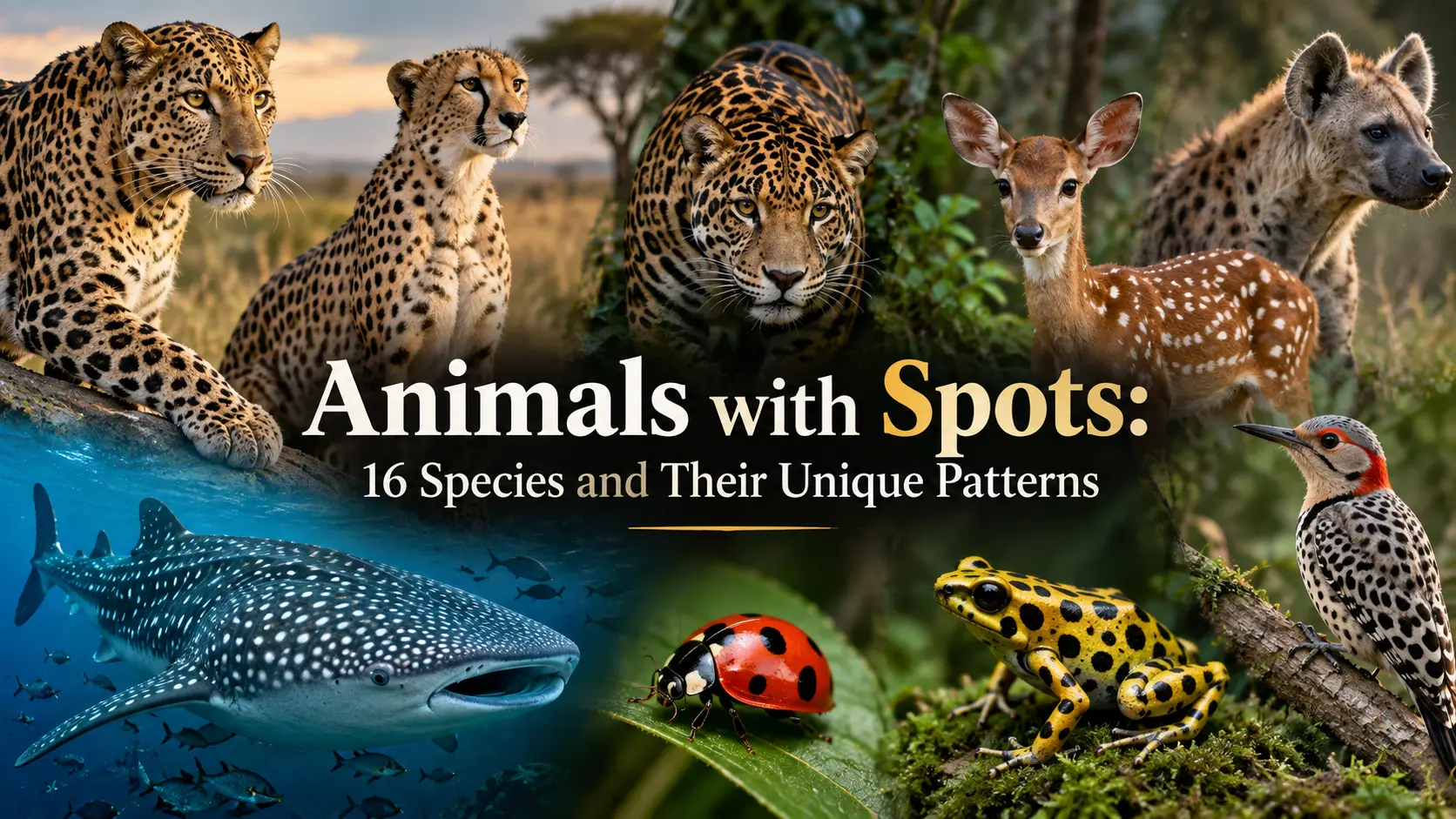
Spots are among the most recognizable patterns in the animal world, but not every spotted-looking coat is made of simple dots. Some animals have solid spots, while others have rosettes, blotches, rings, or large patches. These markings can support camouflage, warning, recognition, or identification, depending on the species. From cheetahs and ocelots to whale sharks and salamanders, spotted patterns appear across very different groups of animals. Their shapes can also help people distinguish similar-looking species.
Animals with spots include cheetahs, leopards, jaguars, servals, spotted deer, giraffes, whale sharks, spotted dolphins, salamanders, and ladybirds. Their markings range from solid dots and ring-shaped rosettes to irregular patches. Depending on the species, these patterns can help with camouflage, warning coloration, individual recognition, or scientific identification.
What Counts as a Spotted Animal?
A true spot is usually a distinct area of color that contrasts with the surrounding skin, scales, feathers, or fur. Cheetahs are a clear example because their coats are covered with small, solid dark spots. Leopards and jaguars look spotted too, but their markings are rosettes, ring-like groups of dark color rather than filled-in dots. Some animals have blotches or large patches instead. Giraffes, for example, are commonly described as spotted, although their coats are better characterized by large, irregular patches separated by lighter lines. All of these patterns fit the broad idea of “spotted,” but recognizing the differences makes identification easier.
Why Do Some Animals Have Spots?
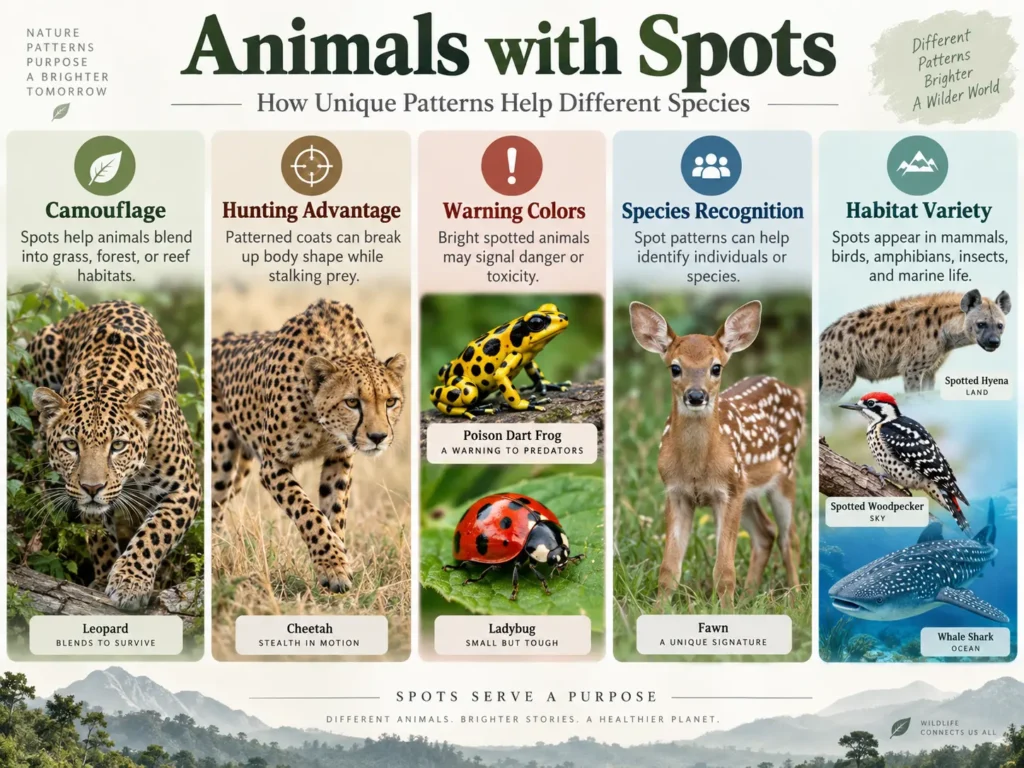
Spots can serve different functions, and there is no single explanation for every species. In many wild cats, spotted or rosette-patterned coats help break up the body outline against grass, leaves, shadows, and uneven backgrounds. This disruptive coloration can make an animal less obvious to prey or predators. Other species use contrasting markings differently. Brightly colored ladybirds use conspicuous coloration as a warning to potential predators. Whale sharks have spot-and-stripe patterns along with flippers that researchers can use to identify individuals in photographs. Some animals also change their markings as they mature, showing that spotting can be linked with development as well as camouflage or signaling.
Spotted Big Cats and Wild Cats
1. Cheetah
Cheetahs have small, solid black spots spread across a tan or golden coat. Unlike leopards and jaguars, their body markings are not rosettes. The simple spots help break up the cheetah’s outline in grasslands and open habitats. Cubs are already spotted at birth, although young cheetahs also have a long mantle of pale fur along the back.
2. Leopard
Leopards are covered in dark rosettes, especially across the back, sides, and flanks. A rosette looks like an open ring or cluster rather than a solid dot. These markings help leopards blend into complex backgrounds. The absence of small central spots in most body rosettes is also a useful clue when comparing leopards with jaguars.
3. Jaguar
Jaguars have large, bold rosettes that are usually more widely spaced than those of leopards. Many rosettes contain one or more small dark spots inside them, producing a more complex pattern. This feature is one of the easiest ways to distinguish a jaguar coat from a leopard coat when only the animal’s sides or back are visible.
4. Serval
The serval has a golden-yellow coat marked with dark spots, with some markings merging into stripes around the neck and shoulders. Its pattern is less ring-like than a leopard’s and more like a mixture of solid spots and short lines. Against tall grasses and uneven light, these markings can make the body outline harder to follow.
5. Ocelot
Ocelots have some of the most complex markings among smaller wild cats. Their coats combine spots, open rosettes, stripes, and elongated blotches that can form chain-like patterns along the sides. Rather than looking evenly dotted, an ocelot appears richly patterned, which helps separate it visually from cats with simpler solid spotting.
Other Mammals with Spots and Patches
6. Spotted Hyena
Spotted hyenas usually have dark brown or blackish spots scattered across a yellowish, sandy, or gray-brown coat. The markings are irregular rather than arranged in neat rows, and their visibility can vary among individuals. Older animals may also appear less sharply marked as coat color and contrast change.
7. Giraffe
Giraffes are often included among spotted animals, but their markings are better described as large patches. Darker areas are separated by lighter lines, producing the familiar mosaic-like coat. The shapes and arrangement vary between individuals, and researchers can use coat patterns to help recognize particular giraffes.
8. Chital
Chital, also called spotted deer or axis deer, have a reddish-brown coat covered with rows of white spots. Unlike many deer that are most strongly spotted as fawns, chital retain their characteristic markings throughout life. A dark stripe along the back adds further contrast, making this species a clear example of a permanently spotted adult deer.
9. Fallow Deer
Fallow deer show considerable coat variation. In the common coloration, the summer coat is light brown with visible white spots across the back and sides, while the winter coat becomes darker and the spots may look less striking. Other color forms can be much paler or darker, so not every fallow deer appears equally spotted.
Marine Animals with Spots
10. Whale Shark
Whale sharks have pale spots and stripes arranged across a dark gray or bluish back. The pattern is useful for more than appearance: researchers can use it to distinguish individual sharks in photographs. Comparing images from different places and times can help track repeated sightings and movements of particular whale sharks.
11. Atlantic Spotted Dolphin
Atlantic spotted dolphins show how markings can change with age. Young calves are born without the dense spotting seen in adults and may resemble slender bottlenose dolphins at first glance. Spots begin to appear as they grow and become darker and more widespread with maturity, making age-related pattern development one of the species’ most noticeable traits.
12. Spotted Eagle Ray
The spotted eagle ray has a dark upper surface covered with many small white or pale spots. The strong contrast makes the species easy to recognize from above. Its broad, wing-like pectoral fins and long tail add to its distinctive appearance, while the spotted back provides the feature reflected directly in its common name.
13. Spotted Wobbegong
Spotted wobbegongs are bottom-dwelling sharks with brown, gray, and pale markings that include spots and light ring-like shapes. Combined with a flattened body and fleshy projections around the head, the pattern breaks up the shark’s outline on rocky or coral-covered seabeds. When resting motionless, it can blend remarkably well with the surrounding terrain.
Spotted Reptiles, Amphibians, and Insects
14. Leopard Gecko
Wild-type leopard geckos are usually yellowish with irregular dark spots, giving them the leopard-like appearance behind their common name. Young animals can look more strongly banded before an adult pattern develops. Captive breeding has produced many color and pattern forms, so pet leopard geckos do not always show the classic spotted appearance.
15. Spotted Salamander
The spotted salamander has a dark black, gray, or brown body marked by two uneven rows of yellow to orange spots running from near the head toward the tail. The contrast makes adults easy to identify. Despite their bright markings, these salamanders spend much of their time hidden underground or beneath cover in moist woodlands.
16. Ladybird or Ladybug
Many ladybirds, called ladybugs in North America, have dark spots on red, orange, yellow, or black wing covers. Spot number and arrangement vary among species, so the number of spots is not a universal guide to age. Their bright coloration can act as a warning, helping discourage predators after unpleasant encounters with their defensive chemicals.
Cheetah vs Leopard vs Jaguar Spots
Cheetahs, leopards, and jaguars are often confused because all three can look spotted from a distance. Their coat patterns are quite different when viewed closely.
| Animal | Main Pattern | Easy Identification Clue |
| Cheetah | Solid dark spots | Small filled-in spots with no rosettes |
| Leopard | Open rosettes | Ring-like markings usually without central dots |
| Jaguar | Larger rosettes | Rosettes often contain one or more dark dots |
Cheetahs are easiest to separate because their bodies are mostly covered in simple solid spots. Leopards and jaguars require closer attention, but the jaguar’s larger, more widely spaced rosettes and frequent central dots provide a useful visual clue.
Do Animal Spots Change With Age?
Yes. Atlantic spotted dolphins are a clear example: young animals lack the heavy spotting of adults and become progressively more spotted with maturity. Leopard geckos can also shift from juvenile bands toward a more spotted adult pattern. Deer show another kind of change. Many deer species have spotted fawns that become plainer as they mature, while chital retain white spots throughout adulthood. Fallow deer may remain spotted, but the strength of the pattern can vary with coat color and season. Spotting is therefore not always fixed from birth to adulthood.
Common Misconceptions About Spotted Animals
One common mistake is treating every marking as the same type of spot. A cheetah has mostly solid spots, while leopards and jaguars have rosettes. Giraffes have large patches, and wobbegongs combine spots with rings and mottling. Using the correct terms makes comparisons more accurate. It is also misleading to assume that every spotted pattern exists only for camouflage. Camouflage is important for many species, but warning coloration, individual identification, developmental changes, and other biological factors can also be involved. A pattern should not be called unique to each individual unless that has been established for the species.
Frequently Asked Questions
What animals have spots?
Animals with spots include cheetahs, leopards, jaguars, servals, ocelots, spotted hyenas, chital, fallow deer, whale sharks, Atlantic spotted dolphins, spotted eagle rays, spotted wobbegongs, leopard geckos, spotted salamanders, and many species of ladybirds.
Why do some animals have spots?
The function varies by species. Spots and similar markings can break up an animal’s outline for camouflage, create warning coloration, or serve as recognizable individual patterns. In some animals, spotting also changes during growth, linking the pattern with age and development.
What is the difference between spots and rosettes?
A spot is generally a solid area of contrasting color. A rosette is a ring-like or clustered marking with a lighter center. Cheetahs mostly have solid spots, while leopards and jaguars are known for rosettes, making the distinction useful for identification.
How are cheetah, leopard, and jaguar markings different?
Cheetahs have small solid dark spots. Leopards have open rosettes that usually lack dots in their centers. Jaguars have larger, more widely spaced rosettes, and many contain one or more small dark spots inside. These differences make coat patterns useful identification clues.
Do giraffes have spots or patches?
Giraffes are commonly described as spotted, but “patches” is usually the more accurate visual term. Their coats contain large, irregular areas of darker color separated by lighter lines. The shapes and arrangement vary between individuals and can also differ among giraffe populations.
Final Thoughts
Animals with spots show how one broad visual trait can take many forms. A cheetah’s solid dots, a jaguar’s complex rosettes, a giraffe’s patches, and a whale shark’s pale markings all look different and may serve different biological roles. Understanding those differences makes spotted animals easier to identify and avoids assuming that every pattern has the same purpose. Across mammals, sharks, rays, amphibians, reptiles, and insects, spots are part of a wider story of animal coloration and adaptation.


3 Comments