
Energetic Animals: 16 Highly Active Species Explained
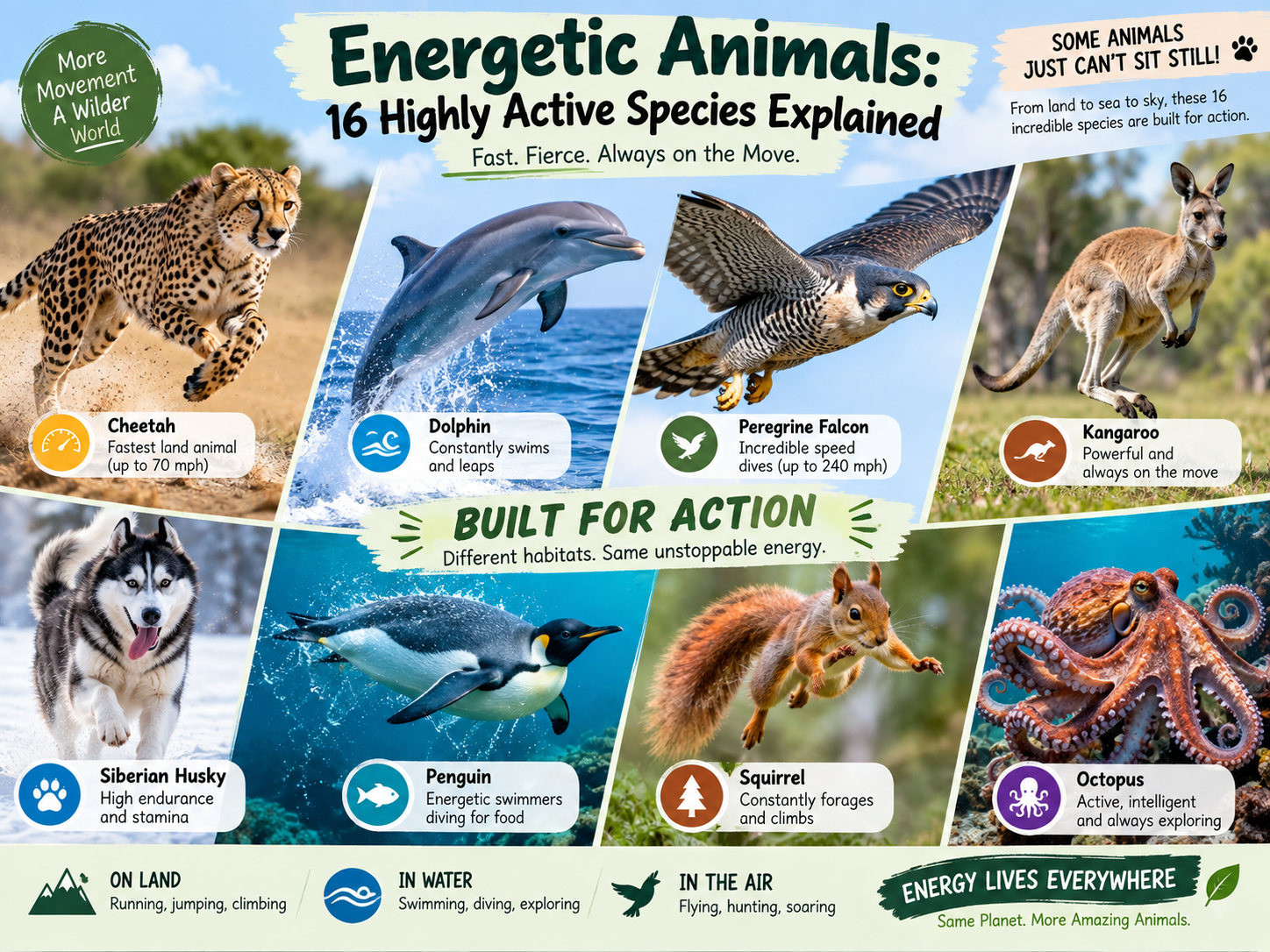
Some animals seem to be in constant motion, but being energetic is more complicated than simply running fast. An animal may spend large amounts of energy on hovering, foraging, migration, long-distance travel, social activity, or short bursts of intense movement. Others combine high metabolic demands with carefully timed periods of rest. The energetic animals below show how different species use and conserve energy in ways that suit their bodies, habitats, and daily survival needs.
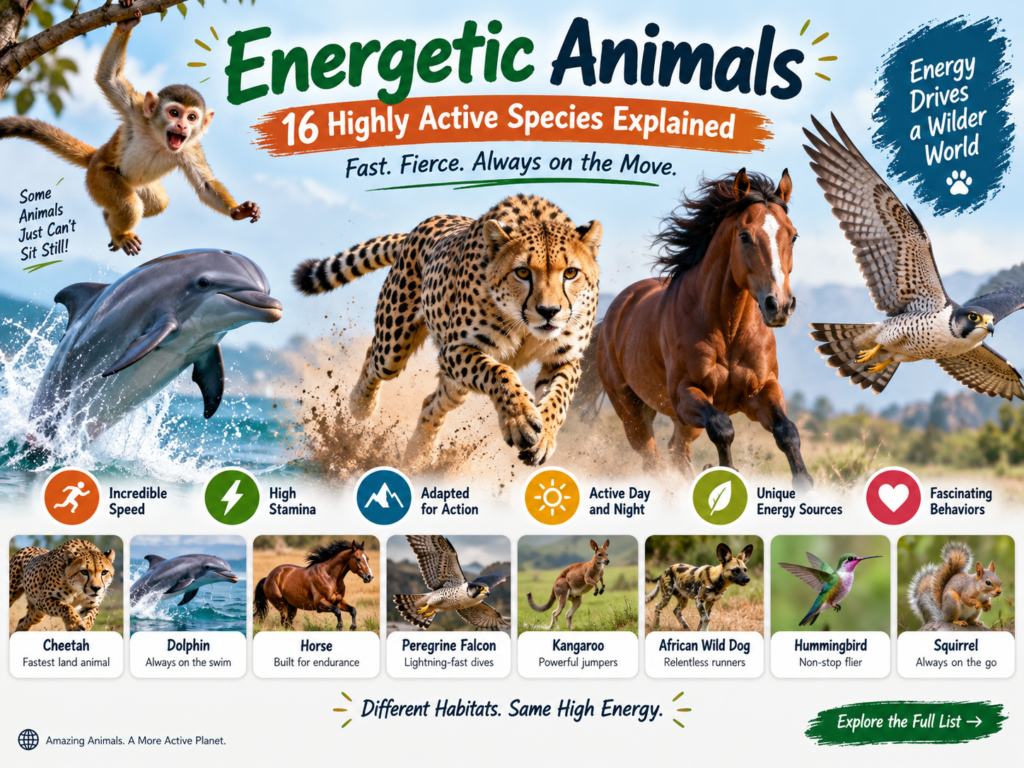
Energetic animals include hummingbirds, shrews, honeybees, cheetahs, pronghorn, African wild dogs, wolves, Arctic terns, dolphins, monkeys, sea otters, squirrels, ants, and dragonflies. Their activity takes different forms, including rapid metabolism, repeated foraging, burst speed, endurance, migration, social exploration, and sustained movement. High energy use does not mean an animal is active without rest.
What Makes an Animal Energetic?
“Energetic” is a useful everyday description, but it is not a single scientific measurement that allows every species to be ranked on one scale. A hummingbird may stand out because hovering flight demands enormous metabolic effort, while a wolf may be notable for covering large areas as it searches for prey. A cheetah relies on short, explosive effort, whereas a migrating bird can sustain movement over much longer periods. Activity also has a cost. Animals must obtain enough food, recover from demanding movement, and sometimes reduce energy use when conditions are difficult. Torpor, resting, efficient locomotion, and seasonal changes can all be part of an energetic lifestyle. For that reason, the most useful comparison is not “which animal has the most energy?” but “how does each animal use energy?”
Animals with High Metabolic Demands
1. Hummingbird
Hummingbirds combine tiny body size with remarkably demanding flight. Their ability to hover requires continuous wing movement, and feeding flights may be repeated many times through the day. Yet they are not literally in motion all the time. Hummingbirds also perch and can enter torpor, a temporary state in which metabolism drops sharply, helping them conserve energy when food or warmth is limited.
2. Shrew
Shrews are small mammals with very high metabolic requirements. Many species must feed frequently because their bodies use energy rapidly, so much of their activity revolves around searching for insects and other small prey. Their energetic reputation comes less from spectacular speed than from the need to keep finding food. Rest still occurs, but long periods without feeding can be difficult for some species.
3. Honeybee
Worker honeybees spend substantial energy flying between their colony and flower patches. A foraging bee may visit many flowers while collecting nectar or pollen, then return to the hive before setting out again. That repeated flight makes foraging one of the clearest examples of energy-demanding insect behavior. Colony life also divides work among individuals, so activity changes with a bee’s role and age.
Animals Built for Burst Activity
4. Cheetah
Cheetahs are famous for explosive acceleration and short high-speed pursuits. Their hunting strategy depends on getting close enough to prey before launching a rapid chase, rather than maintaining maximum speed over long distances. Such efforts are physically demanding, so a cheetah normally needs time to recover afterward. This makes it a classic example of intense burst activity rather than nonstop high-energy movement.
5. Kangaroo
Kangaroos can travel efficiently by hopping, a form of locomotion that uses elastic structures in the legs to store and return energy between bounds. At suitable speeds, this makes repeated hopping surprisingly economical for covering ground. Kangaroos therefore illustrate an important point: an animal can be highly mobile without wasting energy. Efficient movement is just as important as producing powerful movement.
Energetic Animals Known for Endurance
6. Pronghorn
Pronghorn are exceptional runners because they combine high speed with the ability to sustain fast movement longer than a typical short-distance sprinter. Their large respiratory and cardiovascular capacity supports rapid travel across open landscapes. This separates them from the cheetah: both can move extremely quickly, but the pronghorn is especially notable for maintaining impressive speed over greater distances.
7. African Wild Dog
African wild dogs use teamwork and endurance during hunts. Packs can coordinate movement, pursue prey across considerable distances, and adjust their direction as the chase develops. Their hunting style depends less on one explosive sprint than on sustained movement and cooperation. This combination of stamina and social coordination makes them a strong example of energetic behavior at the group level. These African dogs are famous for their greediness.
8. Wolf
Wolves may cover large areas while patrolling territories, searching for prey, or dispersing into new regions. They typically travel at an efficient trot and can keep moving for long periods when necessary. Their energy strategy is therefore closely tied to endurance rather than constant sprinting. Long-range movement allows packs to exploit widely scattered food resources and defend extensive territories.
Energetic Migrators
9. Arctic Tern
Arctic terns are famous for their extraordinary seasonal migrations between high northern breeding areas and southern ocean regions. Tracking studies have shown that some individuals can cover immense annual distances. Their energetic achievement is not based on being hyperactive every minute; it comes from sustaining repeated long-distance flight, finding food along the way, and managing energy over a migration cycle that spans much of the globe.
Social and Exploratory Energetic Animals
10. Dolphin
Dolphins are highly mobile marine mammals that combine swimming with social interaction, exploration, play, and hunting. Their activity varies by species and situation, but many spend substantial time traveling and interacting with group members. Playful behavior can include chasing, object manipulation, and body movements at the surface. These behaviors make dolphins energetic in a social as well as a physical sense.
11. Capuchin Monkey
Capuchin monkeys are active, manipulative foragers. They move through trees and across branches while searching for fruit, insects, nuts, and other foods, and some species spend much of the day investigating potential feeding sites. Their hands allow them to pull apart vegetation and handle objects. Social interactions add another layer of activity, making capuchins energetic explorers rather than simple distance travelers.
12. Squirrel Monkey
Squirrel monkeys are agile, social primates that spend much of their day moving through the forest canopy and searching for food. Groups can spread out while looking for fruit and insects, then regroup as they travel. Their small size and quick movements make them appear especially lively, but their energy is closely connected to foraging, group movement, and navigating a complex three-dimensional habitat.
13. Sea Otter
Sea otters face unusually high energetic demands because they live in cold water without the thick blubber layer used by many other marine mammals. They rely on dense fur and a high metabolism to maintain body temperature. As a result, they spend considerable time foraging, diving, eating, and grooming. Keeping their fur clean is also essential because trapped air helps preserve its insulating ability.
Small Animals with High Activity Levels
14. Squirrel
Squirrels combine climbing, jumping, foraging, and food storage in a busy daily routine. Many species move repeatedly between feeding areas, trees, nests, and caching sites, especially when preparing for periods when food will be harder to find. Their quick changes of direction make them look constantly energetic, although periods of resting and sheltering remain an important part of their day.
15. Ant
An individual worker ant may spend much of its active period walking, carrying food, maintaining the nest, caring for young, or following foraging trails. The apparent energy of an ant colony comes from thousands of small tasks being performed by different workers. Activity varies among species and roles, but coordinated labor allows colonies to move resources and respond quickly to changing conditions.
16. Dragonfly
Dragonflies are agile aerial predators capable of rapid acceleration, sharp turns, hovering, and interception of flying prey. Their large eyes and highly controlled wings support an active hunting style. Some species add another demanding behavior: migration. The common green darner, for example, has migratory generations that travel hundreds of kilometres, showing that dragonfly energy can involve both hunting and seasonal movement.
Burst Speed vs Endurance vs Migration
Different energetic animals are impressive for different reasons, so one “most energetic” ranking would hide important biological differences.
| Energy Type | Example Animal | Main Behavior |
| Burst activity | Cheetah | Short, intense sprinting |
| Sustained speed | Pronghorn | Fast movement over longer distances |
| Endurance hunting | African wild dog | Coordinated pursuit |
| Long-range movement | Wolf | Territorial travel and searching |
| Migration | Arctic tern | Seasonal long-distance flight |
| High metabolic demand | Hummingbird | Hovering and repeated feeding |
A cheetah may produce a more intense burst than a wolf, while a wolf can keep traveling for far longer. An Arctic tern faces a different challenge again: managing energy across an enormous migration. Comparing the behavior behind the energy is therefore more meaningful than comparing speed alone.
Do Energetic Animals Need Less Rest?
Energetic animals still need recovery. High activity increases the importance of balancing energy expenditure with feeding, sleep, and other forms of conservation. A cheetah cannot maintain its hunting sprint indefinitely, while hummingbirds may use torpor when conditions make normal metabolic demands difficult to support.
Migratory animals also alternate intense travel with opportunities to feed and recover. Even animals that seem constantly busy, such as squirrels or social primates, have periods of reduced activity. Rest is not the opposite of an energetic lifestyle; it is one of the mechanisms that makes repeated activity possible.
Common Misconceptions About Energetic Animals
The fastest animal is not automatically the most energetic. Speed describes one aspect of movement, while energy use also includes metabolism, endurance, migration, foraging, thermoregulation, and social activity. A cheetah and an Arctic tern are both energetic, but their bodies are solving very different physical challenges. It is also incorrect to assume that high-energy animals never sleep or rest. Even species with demanding metabolisms must conserve resources. Small size can increase metabolic demands in many animals, but it does not create one universal rule for activity. Energetic behavior is best understood in the context of each species.
Frequently Asked Questions
What are some of the most energetic animals?
Examples include hummingbirds, shrews, cheetahs, pronghorn, African wild dogs, wolves, Arctic terns, dolphins, sea otters, squirrels, ants, and dragonflies. They are energetic in different ways, including high metabolism, sustained travel, rapid movement, migration, foraging, and social activity.
What makes an animal energetic?
An animal may seem energetic because it moves frequently, has high metabolic demands, travels long distances, forages intensively, hunts actively, or performs repeated bursts of movement. There is no single scientific measurement that ranks all animals by “energy,” so the reason differs from species to species.
Are fast animals always energetic?
No. Speed is only one form of physical performance. Cheetahs specialize in short, intense sprints, while wolves and pronghorn are notable for sustained movement. Migratory birds can expend enormous energy without being extreme sprinters, so fast and energetic are not interchangeable descriptions.
Which animals have high metabolic demands?
Hummingbirds, shrews, and sea otters are useful examples. Hummingbirds support energy-intensive flight, many shrews require frequent feeding because of rapid metabolism, and sea otters use a high metabolic rate to help maintain body temperature in cold water. Their energy demands arise for different reasons.
Do energetic animals sleep less?
Not necessarily. Energetic animals still need rest and recovery, although sleep and activity patterns vary greatly among species. Hummingbirds can use torpor to reduce energy expenditure, and animals performing demanding hunts or migrations must balance intense activity with opportunities to feed, recover, and conserve energy.
Final Thoughts
Energetic animals demonstrate that activity cannot be reduced to speed alone. Hummingbirds support demanding flight, cheetahs specialize in explosive sprints, pronghorn combine speed with endurance, wolves travel widely, and Arctic terns invest heavily in long-distance migration. The same principle applies to smaller animals such as shrews, bees, ants, and dragonflies. Each species balances movement with feeding, recovery, and energy conservation, creating a different solution to the challenge of staying active while surviving in its environment.

4 Comments