Animals With Stripes: 15 Species and Why Patterns Matter
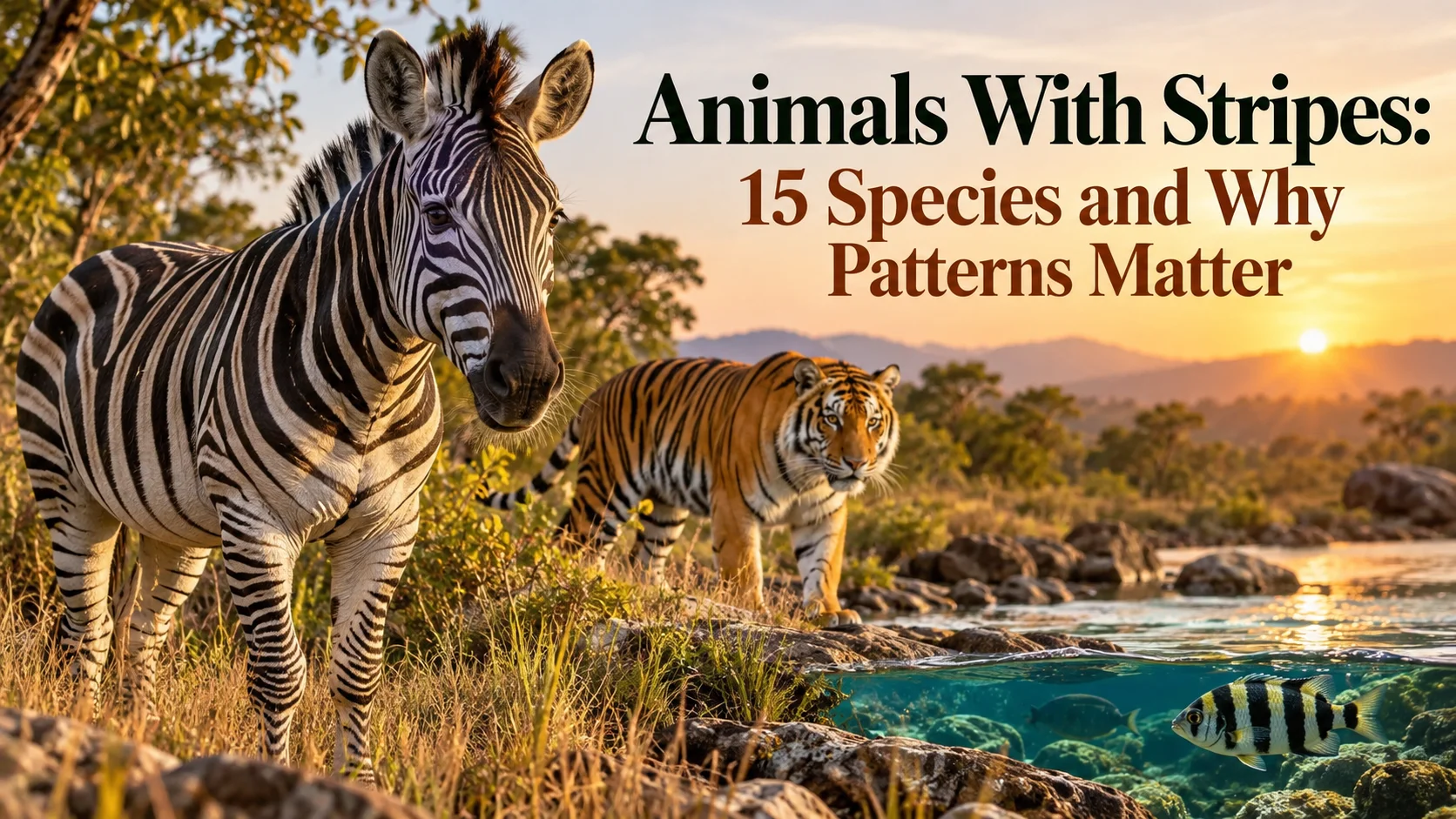
Animals with stripes appear across forests, grasslands, deserts, reefs, and even city gardens. Their markings may run vertically, lengthwise, or around the body as bands, and they occur on fur, skin, scales, and exoskeletons. Stripes are not merely decorative. Depending on the species, they may reduce biting-fly attacks, conceal an animal, warn predators, or form a distinctive pattern whose exact evolutionary function remains uncertain. These 15 examples show how varied striped animals can be.
Animals with stripes include zebras, tigers, okapis, striped skunks, striped hyenas, chipmunks, numbats, coral snakes, clownfish, striped dolphins, bumblebees, and zebra spiders. Their markings do not all serve the same purpose. Depending on the species, stripes or bands may support camouflage, warning coloration, biting-fly deterrence, identification, or other specialized visual functions.
What Counts as a Striped Animal?
A striped animal has repeated linear markings that contrast with the surrounding body color. Among Animals with stripes, these lines may run vertically, horizontally, or lengthwise depending on the species. Tigers have dark vertical stripes, while eastern chipmunks carry long dorsal stripes that follow the back. Not every pattern called a “stripe” is technically the same. Coral snakes and clownfish are more accurately described as banded because their markings cross or partly encircle the body. Banded mongooses have transverse markings, while striped dolphins have long lateral lines. Recognizing the difference between stripes, bands, bars, and blotches makes descriptions of Animals with stripes more precise.
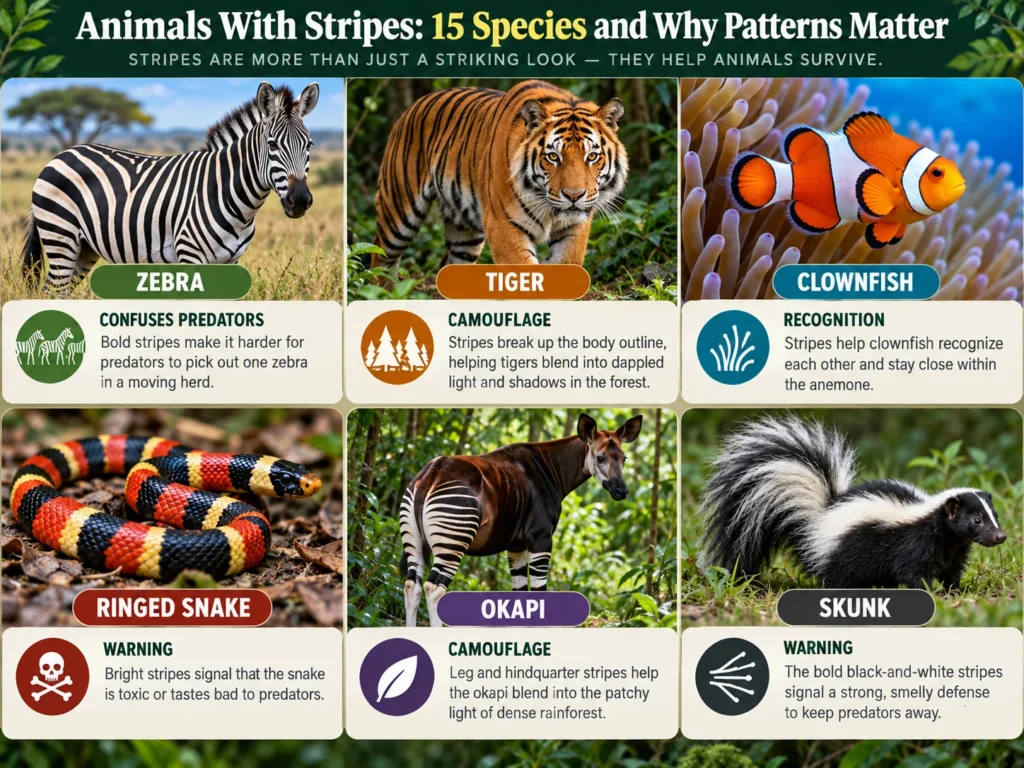
Famous Mammals With Stripes
1. Zebra
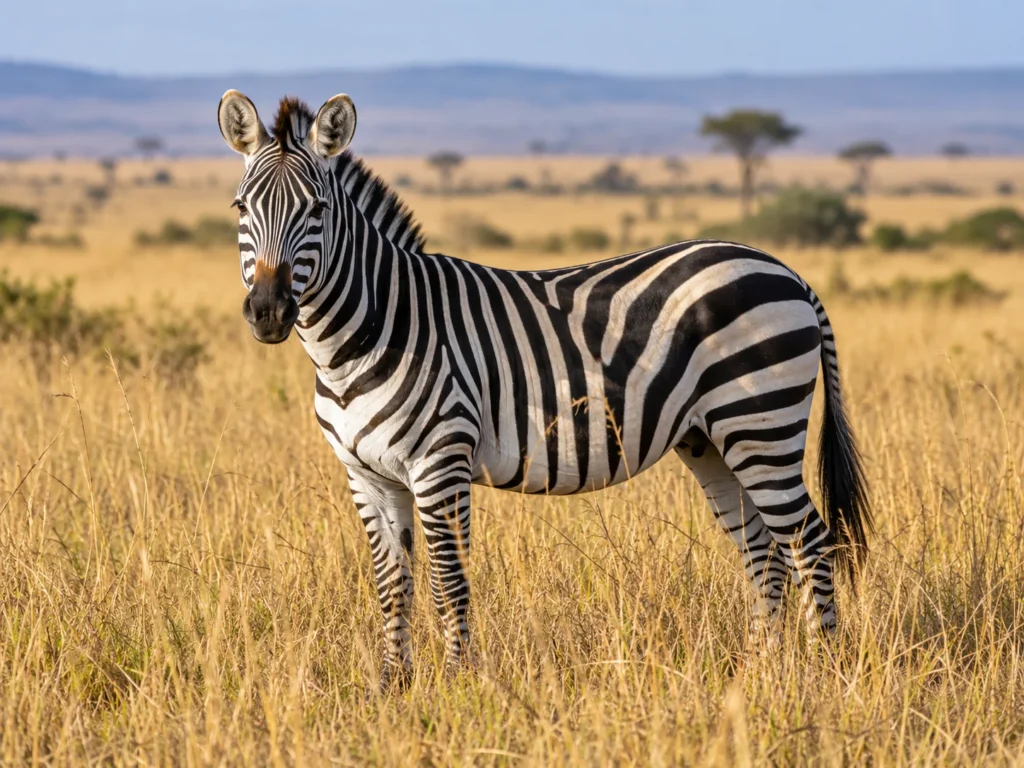
Zebras are probably the world’s best-known striped animals. Each carries a bold black-and-white pattern that varies between individuals. Several explanations for zebra striping have been proposed, but experimental research provides especially strong support for biting-fly deterrence. Horseflies have greater difficulty making controlled landings on striped surfaces, which can reduce successful attacks.
2. Tiger
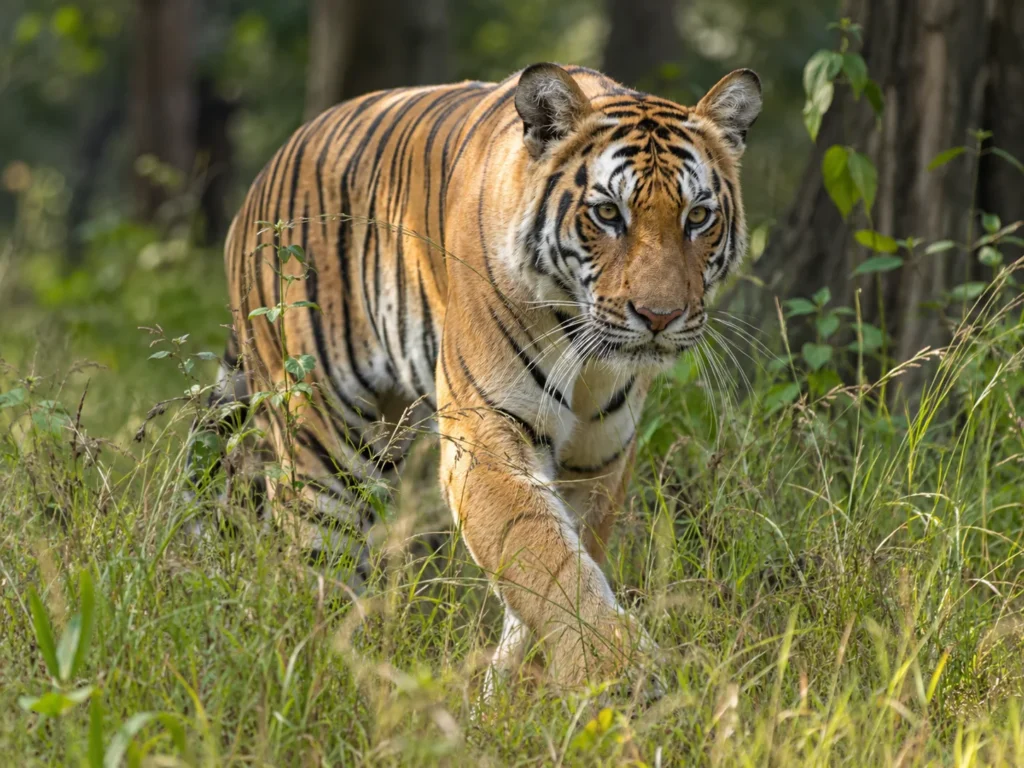
A tiger’s dark vertical stripes break up the outline of its orange or pale coat against complex vegetation and broken light. Tigers are also among the most recognizable Animals with sharp claws, using their powerful retractable claws for gripping prey, climbing, and defense. The arrangement of their stripes differs between individuals, so researchers can use photographs of stripe patterns to recognize particular tigers in the wild, making the markings useful for both concealment and field identification.
3. Okapi
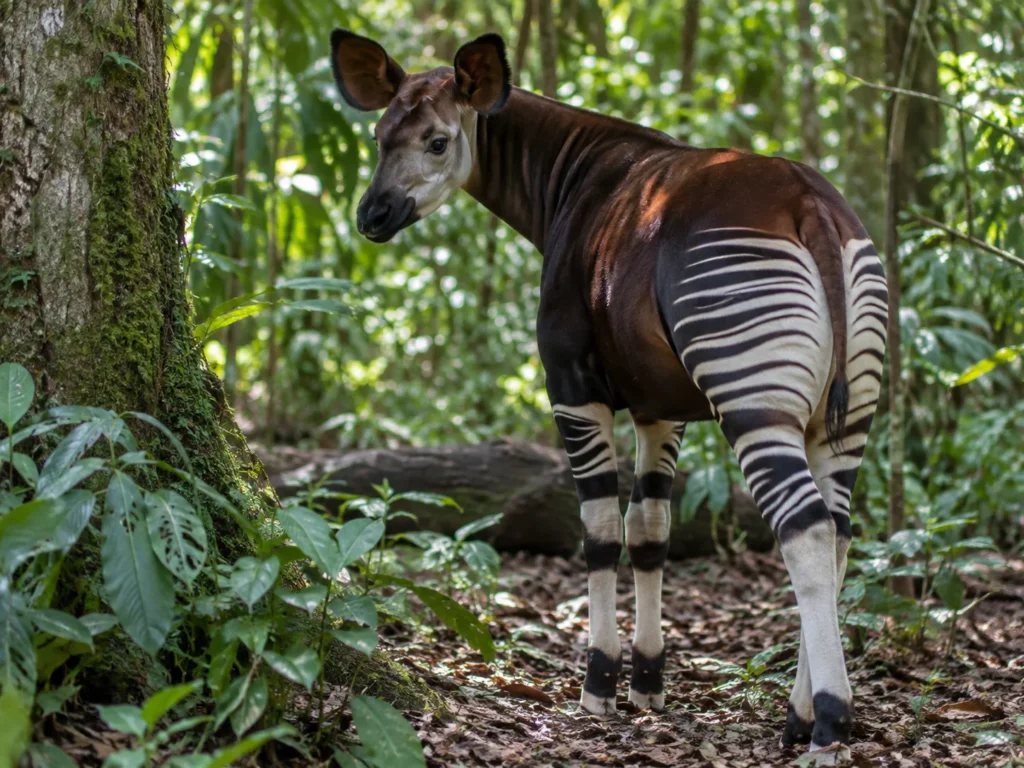
The okapi has a mostly dark brown body, but its hindquarters and upper legs carry striking pale horizontal stripes. These zebra-like markings contrast sharply with the rest of the coat. In the dim, visually complex rainforest, the pattern is commonly associated with camouflage that helps disrupt the animal’s outline.
4. Striped Skunk
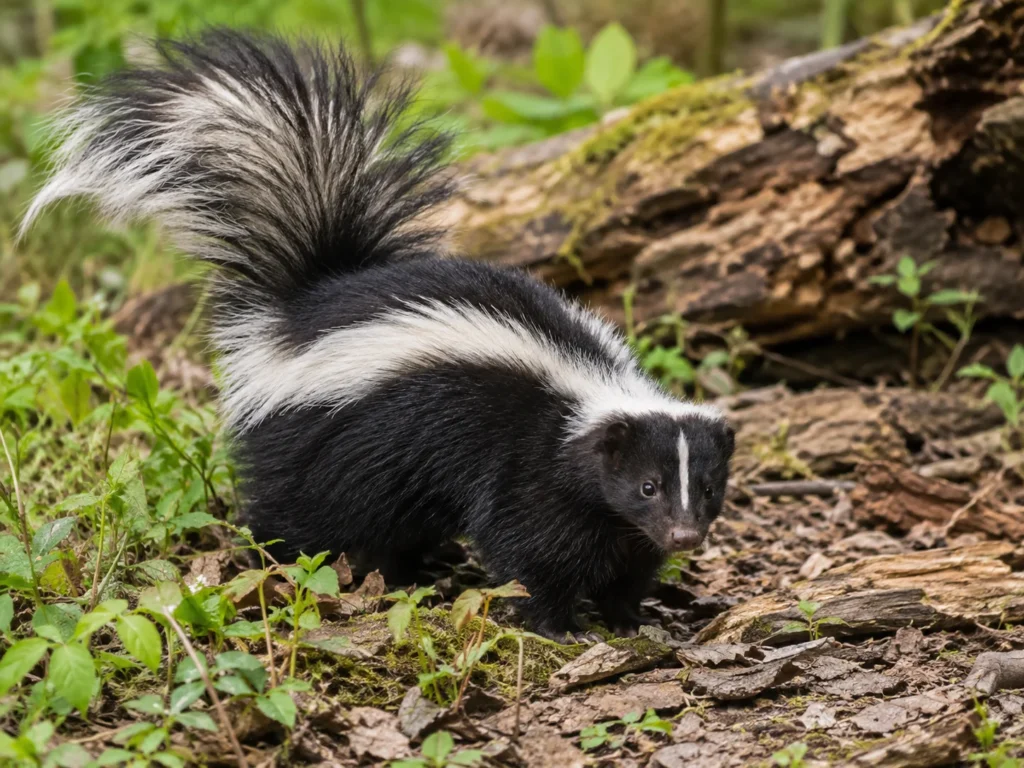
Striped skunks usually have glossy black fur crossed by broad white markings that begin near the head and continue along the back. The pattern is conspicuous rather than subtle. Research on skunk coloration supports its role as a warning signal associated with the animal’s powerful scent defense.
5. Striped Hyena
The striped hyena has a pale gray or sandy coat crossed by dark vertical stripes on the body and legs, making it one of the more distinctive Animals with stripes. Its mane can also stand erect when the animal is threatened. The markings are an obvious identification feature, but their evolutionary function should not be reduced to a simple camouflage explanation without stronger species-specific evidence.
6. Banded Mongoose
Banded mongooses are named for the dark transverse bands that cross their backs. These markings stand out against a grizzled brown or gray coat and help distinguish the species from other mongooses. Their pattern also shows why “striped” can describe several related types of body marking.
7. Eastern Chipmunk
Eastern chipmunks carry alternating dark and light stripes from the head along the back toward the rump. Unlike a tiger’s vertical pattern, these markings are longitudinal and follow the length of the body. The high-contrast design makes chipmunks easy to recognize, although its exact adaptive value should not be assumed without direct evidence.
8. Numbat
The numbat is a small Australian marsupial with a reddish-brown coat crossed by several pale stripes over the back and rump. The transverse markings become especially obvious toward the hindquarters. Combined with its dark eye stripe and bushy tail, they give the numbat a distinctive appearance.
Striped Reptiles and Amphibians
9. Coral Snake
Many New World coral snakes display vivid red, black, and yellow or pale bands. These high-contrast patterns form part of a well-known warning and mimicry system, and field studies have shown avoidance of coral-snake-like banding by some predators. As Animals with scales, coral snakes also show how striking coloration can appear directly across a reptile’s scaled body. Coloration varies greatly among species, so simple color rhymes are unreliable for identification.
10. Tiger Salamander
The name “tiger salamander” suggests clean stripes, but adults often have much more variable patterns. Depending on species, population, and individual, a dark body may carry yellow spots, blotches, bars, or irregular lines. Barred tiger salamanders can show clearer yellow bars, illustrating the natural variation hidden behind common names.
Striped Fish and Marine Animals
11. Clownfish
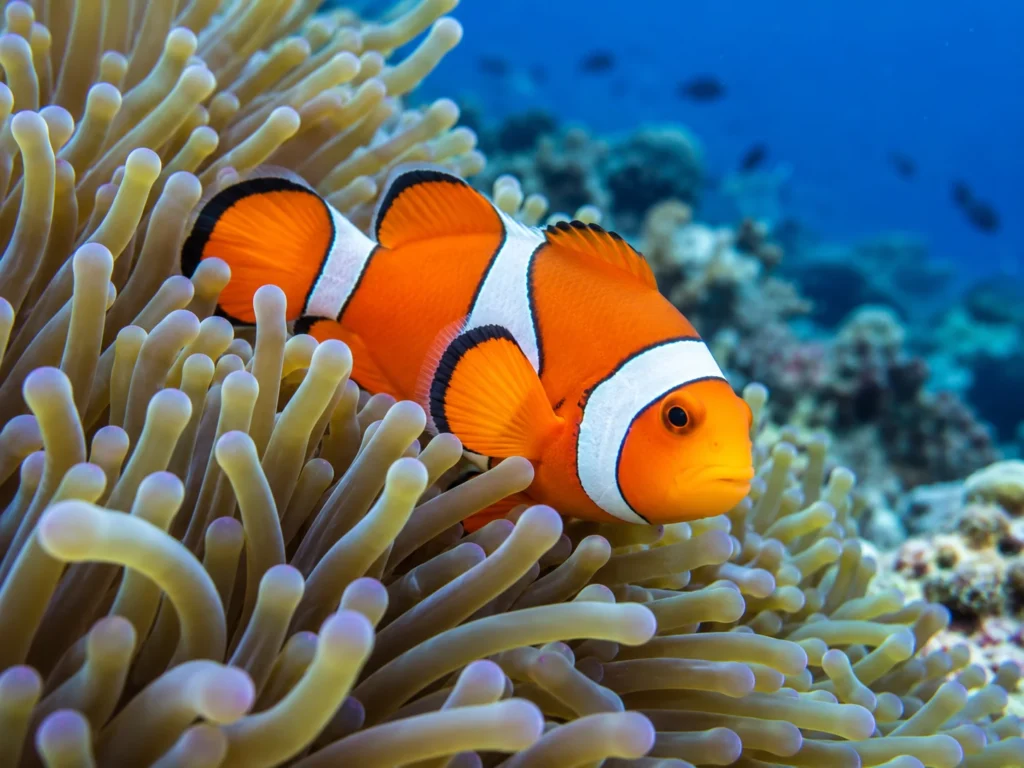
Clownfish are recognizable by bright body colors and contrasting pale bands. The familiar orange clownfish usually has three broad white bars edged in black. These markings are better called bands because they cross the body. Their bold appearance makes clownfish easy to identify without requiring an unsupported claim about what the bands evolved to do.
12. Convict Tang
The convict tang has a pale body crossed by narrow black vertical bars, producing the prison-uniform appearance that inspired its common name. Its laterally compressed body can make it appear slender from certain angles, a trait seen in some skinny animals adapted for efficient movement through their environments. The bars extend across much of the body and contrast strongly with the lighter background, making this reef fish a clear example of repeated vertical markings.
13. Striped Dolphin
Striped dolphins do not have zebra-like bands. Instead, thin dark lines extend from the eye toward the flipper and along the side of the body. Together with the darker back and lighter underside, these markings create the distinctive pattern behind the species’ common name and help distinguish it from similar dolphins.
Striped Invertebrates
14. Bumblebee
Many bumblebee species display contrasting dark and yellow, orange, red, or pale bands across their hairy bodies. The arrangement varies among species and regions. Bumblebee color patterns are well-known examples of aposematic, or warning, signaling, helping predators associate conspicuous appearance with the insect’s ability to sting and defend itself.
15. Zebra Spider
The zebra spider is a small jumping spider marked with contrasting pale and dark bands across its body. Its common name comes directly from this zebra-like appearance. Unlike the well-studied warning colors of bumblebees or fly-deterring stripes of zebras, the exact adaptive role of its pattern should not be overstated.
Why Do Zebras Have Stripes?
Scientists have proposed several explanations for zebra stripes, including camouflage, social recognition, temperature regulation, predator confusion, and defense against biting insects. These hypotheses can be tested rather than accepted simply because they sound plausible.
Some of the strongest experimental evidence concerns biting flies. Studies comparing zebras with horses, and animals given zebra-like striping, found that striped surfaces reduced successful fly landings. Flies may approach but struggle with the final stage of landing. This does not make every other proposed benefit impossible, but biting-fly deterrence is among the best-supported explanations.
How Do Tiger Stripes Help With Camouflage?
Tiger stripes work very differently from zebra stripes. A tiger moves through habitats filled with grasses, stems, shadows, and patches of light. Dark vertical markings can break up the cat’s outline, making its body harder to separate from a complex background while it stalks.
Camouflage does not make a tiger invisible. Instead, disruptive coloration can delay detection by preventing the full body shape from standing out immediately. Individual patterns are also distinctive enough for researchers to identify specific tigers from photographs.
Which Striped Animals Use Warning Coloration?
Warning coloration, or aposematism, uses conspicuous signals to advertise an effective defense. Striped skunks are a strong mammalian example: their black-and-white coats accompany the threat of an unpleasant chemical spray.
Brightly banded coral snakes form part of another famous defensive signaling and mimicry system, while bumblebees display conspicuous patterns associated with sting defense. These examples do not create a universal rule. A high-contrast striped animal is not automatically warning predators; the function must be evaluated species by species.
Do All Animal Stripes Serve the Same Purpose?
No. Similar-looking patterns can evolve under very different ecological pressures. Zebra stripes are strongly associated with reducing successful biting-fly landings, while tiger stripes contribute to concealment. Striped skunks and bumblebees use conspicuous coloration in defensive signaling, and coral-snake bands participate in a complex warning and mimicry system.
Other species have patterns whose main function is less certain. In those cases, describing the markings is more accurate than inventing an explanation. Evolution does not have one universal reason for producing stripes.
Stripes vs Bands: What Is the Difference?
The terms overlap in everyday speech, but they can describe different pattern shapes.
| Pattern Type | Example Animal | Description |
| Vertical stripes | Tiger | Dark lines crossing the body vertically |
| Longitudinal stripes | Eastern chipmunk | Lines running along the back |
| Transverse bands | Banded mongoose | Dark markings crossing the back |
| Colored body bands | Coral snake | Contrasting bands around the body |
| Broad body bars | Clownfish | Pale bands crossing the body |
A tiger, coral snake, and clownfish therefore do not share exactly the same pattern anatomy even if all appear “striped” at first glance. Precise terminology makes comparisons clearer without changing the basic visual idea.
Common Misconceptions About Striped Animals
One major misconception is that every stripe exists for camouflage. Zebra research shows why that assumption can be misleading, while skunks and bumblebees demonstrate that conspicuous stripes can advertise defense instead of hiding an animal. This is one reason Animals with stripes can display such different patterns and serve very different purposes.
Another mistake is assuming that every pattern is uniform within a species. Tiger markings vary among individuals, while tiger salamanders may appear spotted, blotched, barred, or irregularly marked. Coral-snake coloration also varies enough that simple color rhymes cannot safely identify every species, showing why Animals with stripes should not all be understood through the same pattern or function.
Frequently Asked Questions
What animals have stripes?
Striped animals include zebras, tigers, okapis, striped skunks, striped hyenas, chipmunks, numbats, coral snakes, clownfish, convict tangs, striped dolphins, bumblebees, and zebra spiders. Some technically have bands or bars rather than narrow stripes.
Why do zebras have black and white stripes?
Several explanations have been proposed for why zebras and other Animals with stripes display such distinctive patterns, but experiments strongly support biting-fly deterrence in zebras. Horseflies have difficulty making controlled landings on zebra-like striped surfaces, which can reduce successful bites. Other possible functions for striped patterns have also been studied, but they are not all supported by equally strong evidence.
Why do tigers have stripes?
Tiger stripes contribute to disruptive camouflage by breaking up the cat’s outline among vegetation, shadows, and vertical background features. Their stripe arrangements also differ among individuals, allowing researchers to identify particular tigers from photographs.
Which striped animals use warning coloration?
Striped skunks, many brightly banded coral snakes, and bumblebees are strong examples of animals with stripes whose conspicuous patterns are associated with defenses such as chemical spray, venom, or stings. These bold markings can act as warning signals to potential predators. However, not every animal with contrasting stripes should automatically be classified as warning-colored, since striped patterns can also serve camouflage, recognition, or other functions.
Are stripes and bands the same thing?
Not exactly. Stripes are generally elongated lines, while bands commonly cross or wrap around part of the body. Among Animals with stripes, tigers show clear elongated markings, whereas clownfish and many coral snakes are more accurately described as banded. Everyday descriptions often use the terms loosely, but distinguishing stripes from bands makes animal pattern descriptions more precise.
Final Thoughts
Animals with stripes show that similar visual patterns can have very different biological meanings. Zebra stripes are strongly linked with biting-fly deterrence, tiger stripes help disrupt the body outline, while skunks, coral snakes, and bumblebees demonstrate how conspicuous markings can accompany powerful defenses. Other species remind us not to force every pattern into one explanation. Whether markings occur as stripes, bars, or bands, the best interpretation combines careful description with evidence about how each animal actually lives.