Stubborn Animals: 15 Species and What Their Behavior Means
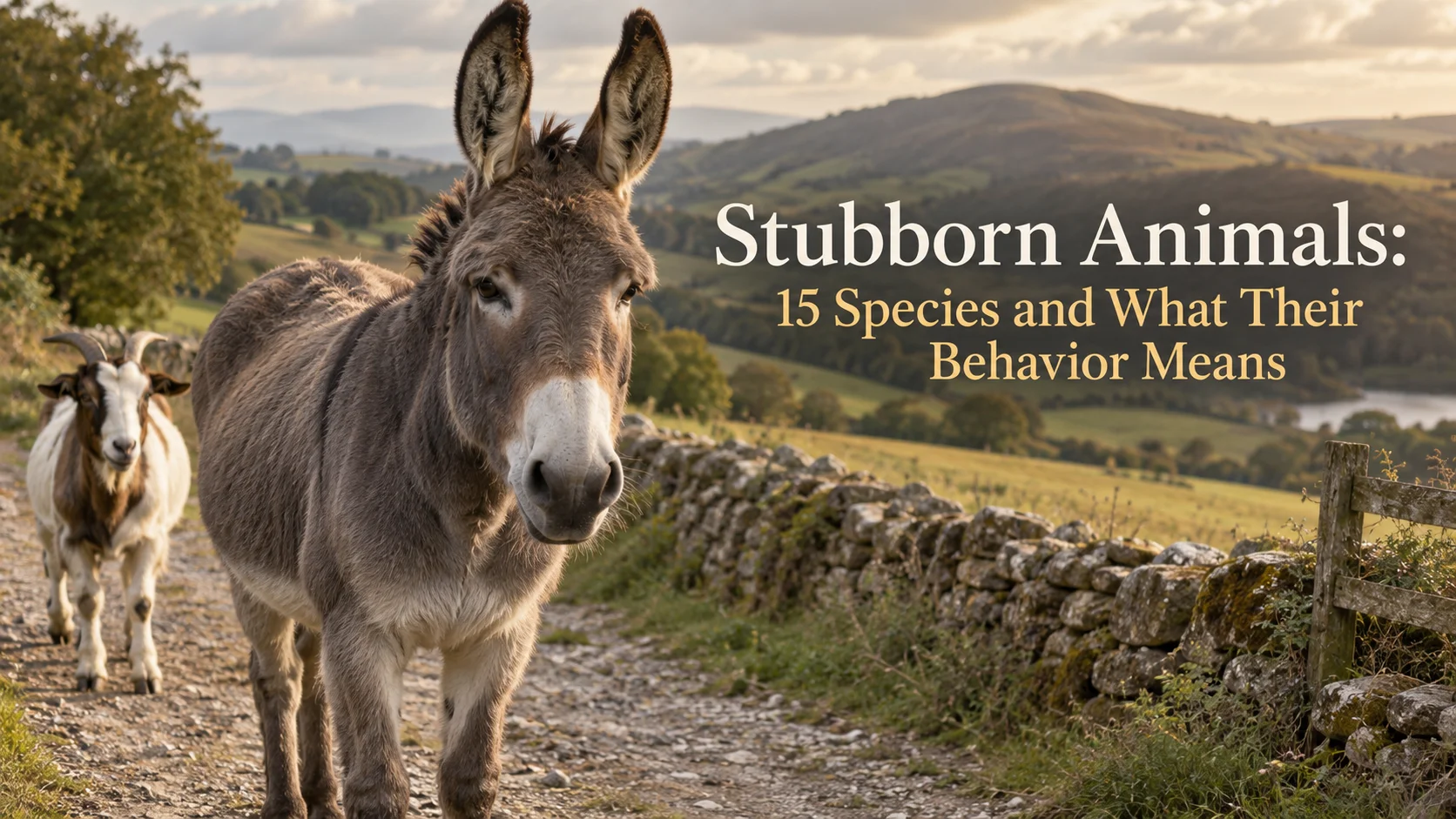
Donkeys, goats, mules, pigs, and several wild species are often described as stubborn, but animals do not necessarily refuse, resist, or persist for human-like reasons. What appears to be stubborn behavior may actually reflect caution, fear, previous experience, motivation, defensive responses, or persistent problem-solving. Looking at the behavior behind the label gives a more accurate picture. These stubborn animals provide useful examples of why apparent defiance often makes sense when viewed from the animal’s perspective.
Stubborn animals commonly include donkeys, mules, goats, horses, pigs, cats, camels, llamas, raccoons, cattle, African buffalo, badgers, honey badgers, tortoises, and elephants. However, stubbornness is a human label rather than a scientific category. Apparent refusal can result from caution, persistence, fear, learning, individual motivation, or defensive behavior.
What Does “Stubborn” Mean in Animals?
Stubbornness is not a precise zoological trait that researchers can use to rank species. Humans usually apply the word when an animal refuses to move, keeps repeating an action, resists pressure, or does something different from what a person expects. The observable behavior is real, but the assumed motive may not be. A donkey may stop because it perceives danger, while a pig may continue working at a problem because a reward is available. A horse might avoid something associated with a frightening experience, and a cat may simply have little motivation to respond to a particular cue. Caution, persistence, learning, fear, and motivation can therefore produce behaviors that look similar from a human perspective.
Animals Known for Cautious Resistance
1. Donkey
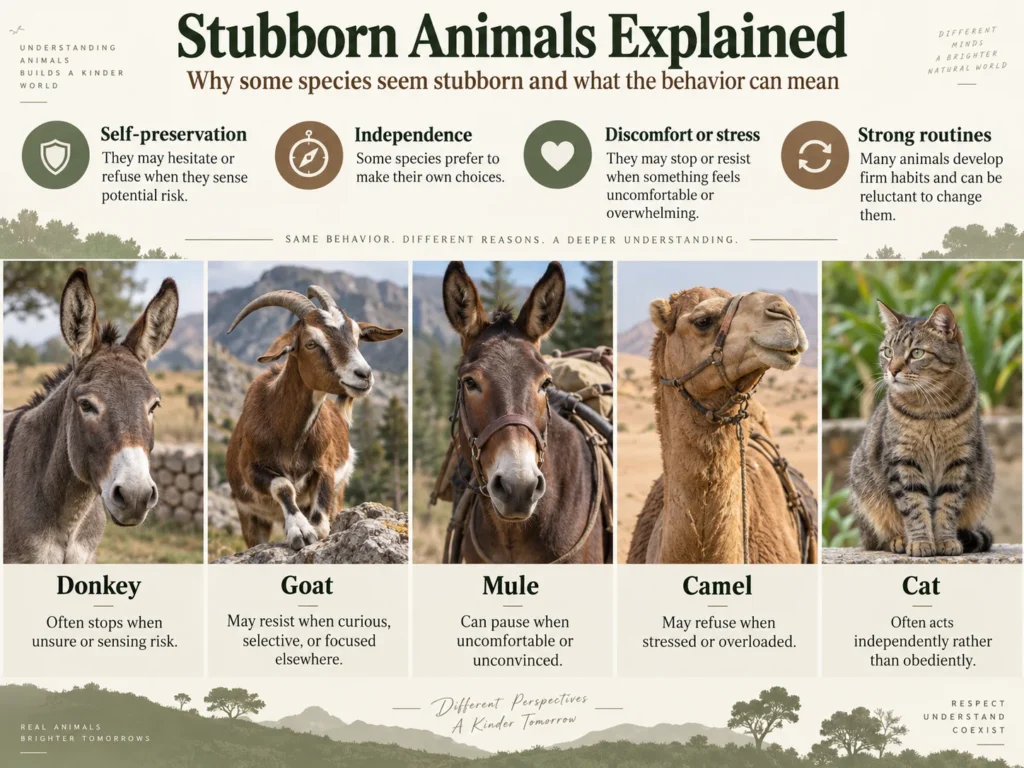
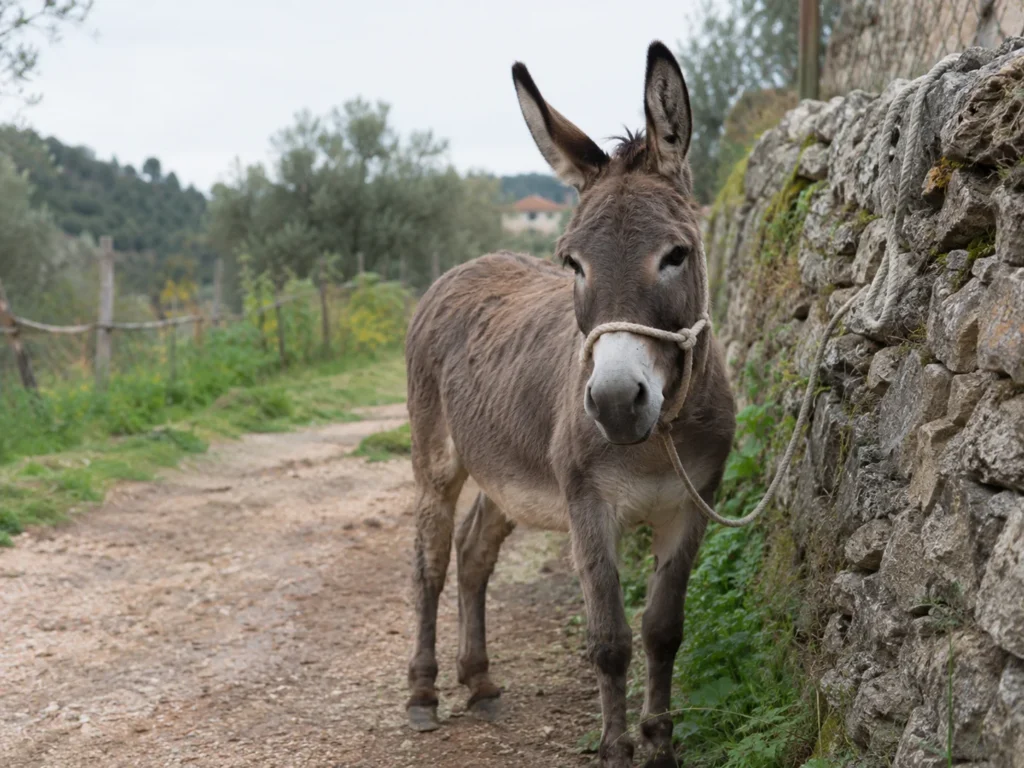
Donkeys are probably the animals most closely associated with stubbornness. Yet their reputation has a strong connection with caution. When something appears threatening or unfamiliar, a donkey may stop and assess the situation instead of immediately moving forward. That refusal can frustrate a person expecting instant cooperation, but from the donkey’s perspective it may be a sensible response to possible danger.
2. Mule
Mules are also famous for supposedly being hard-headed. As hybrids of donkeys and horses, they can show careful responses to unfamiliar situations and may become reluctant when uncertain about what is being asked. Previous experience also matters. A mule that has learned to associate a situation with discomfort may resist repeating it, making learned avoidance look like simple stubbornness.
3. Horse
Horses can refuse jumps, hesitate at unfamiliar objects, or resist entering particular spaces. Those behaviors are sometimes called stubborn, but fear, confusion, discomfort, and previous learning may all be involved. Horses are highly responsive to potential threats, so hesitation can be part of assessing an uncertain situation rather than an attempt to challenge the person handling them.
Persistent and Independent Animals
4. Goat
Goats can appear stubborn animals because they are curious, exploratory, and willing to persist when something interests them. Research has shown that goats can perform learning and memory tasks and solve relatively complex problems. A goat repeatedly investigating a gate, object, or potential food source may therefore be displaying persistence and problem-solving rather than deliberately refusing to cooperate.
5. Pig
Pigs are capable learners with good memory abilities, and those qualities can produce impressive persistence. Once a pig discovers that a particular action leads to food or another reward, it may return to that strategy repeatedly. From a human viewpoint, this persistence can seem stubborn, especially when the animal keeps trying to reach something despite barriers, but learning and motivation provide a better explanation.
6. Cat
Cats often gain a stubborn reputation when they fail to respond to requests as reliably as people expect. Yet behavior depends heavily on motivation, context, previous learning, and whether a reward is meaningful to the individual animal. A cat that walks away from an unrewarding interaction is not necessarily acting out of spite; its immediate priorities may simply differ from those of the person.
7. Raccoon
Raccoons are persistent explorers that use their sensitive front paws to investigate objects and potential food sources. When one approach fails, they may continue examining a problem or return to a promising location later. This persistence can make them difficult to discourage around human food or containers, but the behavior is better understood as adaptable foraging and problem-solving than ordinary stubbornness.
Animals That May Resist Pressure
8. Camel
Camels have long worked alongside people, yet they are sometimes stereotyped as difficult or stubborn. Resistance may occur when an animal is uncomfortable, stressed, frightened, or responding to previous handling experiences. Camels are large animals capable of strong defensive behavior, so reluctance should not automatically be interpreted as a bad attitude. Individual temperament and the immediate situation can make a major difference.
9. Llama
Llamas may stop, pull away, refuse pressure, or use defensive behavior when they feel threatened or uncomfortable. Humans can interpret this as stubbornness because the animal does not immediately comply. However, llamas are social animals with individual temperaments and learned responses. Their behavior makes more sense when the surrounding circumstances and the animal’s previous experiences are considered.
10. Cattle
Cattle may hesitate, stop, turn away, or resist when pressured through unfamiliar environments. Their responses are strongly influenced by fear, herd movement, visual surroundings, and how closely a person approaches. A cow that refuses to enter an unfamiliar area is not necessarily being intentionally difficult. It may be responding to something that humans have overlooked or simply trying to maintain distance from perceived pressure.
11. African Buffalo
African buffalo have a reputation for standing their ground, particularly when threatened or cornered. That should be described as defensive behavior rather than evidence of a stubborn animals personality. A large wild herbivore gains little from following human expectations, and its decisions are shaped by survival pressures. Resistance in a dangerous encounter may therefore reflect defense, protection, or risk assessment rather than stubbornness.
Wild Animals Known for Persistence
12. Honey Badger
Honey badgers have become famous online as animals that supposedly fear nothing, but that description exaggerates their behavior. They are capable diggers and persistent foragers, and they can defend themselves forcefully when necessary. Persistence while searching for food or responding to threats can look like extreme stubbornness, but even honey badgers change their behavior according to risk and circumstances.
13. Badger
Badgers are powerful diggers that can spend considerable effort excavating soil while searching for food or maintaining underground shelters. They may also defend themselves strongly when threatened. These behaviors contribute to their reputation for persistence. However, digging repeatedly toward a goal or resisting a threat is different from possessing a human-like desire to refuse cooperation.
14. Tortoise
Tortoises sometimes appear stubborn because their movement can be slow and deliberate, and an individual may continue heading in one direction despite an obstacle. When frightened, many can withdraw into the protection of their shell rather than immediately moving away. Neither slowness nor defensive withdrawal proves stubbornness; these behaviors are better understood through the tortoise’s anatomy, motivation, and response to danger.
15. Elephant
Elephants have sophisticated social lives and can use experience and environmental information when making decisions. Their memory is important, but the popular claim that elephants “never forget” is too absolute. An elephant that avoids a location, person, route, or situation may be responding to previous experience, social information, or current conditions. Such selective decision-making should not automatically be labeled stubbornness.
Caution vs Persistence vs Independence
Several very different behaviors can appear stubborn animals when judged only by whether an animal follows human expectations.
| Behavior Type | Example Animal | What Humans May Interpret |
| Caution | Donkey | Refusing to move |
| Learned avoidance | Mule or horse | Resisting a familiar situation |
| Persistence | Pig | Repeating an action |
| Exploration | Goat | Continuing to investigate |
| Independent motivation | Cat | Ignoring an unrewarding cue |
| Defensive resistance | African buffalo | Standing its ground |
The key difference is the likely cause. Caution involves assessing risk, while persistence involves continuing toward a goal. Learned avoidance depends on previous experience, and defensive resistance occurs when an animal responds to a perceived threat. Calling all of these behaviors “stubbornness” hides important differences.
Is Stubbornness a Sign of Intelligence?
Not necessarily. Some animals commonly described as stubborn, including goats, pigs, raccoons, and elephants, do have notable learning or problem-solving abilities. Being able to remember previous outcomes or explore alternative solutions may make an animal more selective about what it does, which humans can sometimes interpret as resistance. However, intelligence does not automatically produce stubbornness. A highly capable animal may cooperate readily when motivated, while a frightened animal may refuse despite the situation having little to do with complex cognition. Learning, memory, motivation, personality, and emotional state can all influence behavior, so there is no scientific rule that smarter animals are more stubborn.
Can Fear or Experience Look Like Stubbornness?
Yes. Fear is one of the clearest reasons apparent stubbornness can be misunderstood. A horse that hesitates at an unfamiliar object or a donkey that stops when approaching something threatening may be trying to avoid danger rather than refusing simply because it does not want to cooperate. Previous experience matters too. If an animal has learned that a location, object, or situation predicts discomfort, it may resist encountering it again. Motivation can create a similar effect: an animal may respond poorly when there is little reason for it to perform the requested behavior. Understanding the trigger gives more useful information than applying a stubborn label.
Common Misconceptions About Stubborn Animals
Donkeys are not scientifically ranked as the world’s most stubborn animals, and refusal is not automatically evidence of disobedience. Persistence is also different from stubbornness. A raccoon repeatedly investigating a food source or a pig working at a problem may simply be continuing a behavior that has previously produced results. Defensive behavior should not be confused with personality either. An African buffalo standing its ground and a tortoise withdrawing into its shell are responding to threats in species-appropriate ways. Individual differences matter as well, so members of the same species should not all be assumed to behave identically.
Frequently Asked Questions
What are some animals known for being stubborn?
Animals commonly described as stubborn include donkeys, mules, goats, pigs, cats, camels, llamas, horses, raccoons, cattle, buffalo, badgers, tortoises, and elephants. The label usually refers to refusal, persistence, independence, or defensive behavior rather than a scientifically defined personality type.
Why are donkeys considered stubborn?
Donkeys tend to be cautious when something appears threatening or unfamiliar. Instead of immediately fleeing or moving forward, they may stop and assess the situation. Humans can interpret that hesitation as stubbornness, even though risk assessment and self-protection offer a more useful behavioral explanation.
Are goats stubborn or intelligent?
Goats can certainly behave persistently, but research also demonstrates learning, memory, and problem-solving abilities. Their curiosity and strong motivation to explore may make them appear stubborn in some situations. It is therefore more accurate to describe the specific behavior than simply label goats as stubborn.
Is stubbornness a sign of intelligence in animals?
No direct rule connects stubbornness with intelligence. Learning and memory may allow an animal to make more selective decisions or persist with successful strategies, but refusal can also result from fear, discomfort, motivation, or defensive behavior. Intelligence alone does not explain apparent stubbornness.
Can fear make an animal seem stubborn?
Yes. An animal that perceives danger may stop, retreat, resist movement, or refuse to approach something unfamiliar. These responses can look stubborn to a person expecting cooperation. Horses, donkeys, mules, and other animals may show such behavior when uncertain or influenced by previous negative experiences.
Final Thoughts
Stubborn animals are better understood by looking beyond the label. A donkey may be cautious, a goat persistent, a pig motivated by previous learning, and an African buffalo defensive. Similar-looking resistance can therefore come from very different behavioral processes. Recognizing caution, motivation, learning, fear, and persistence produces a more accurate picture of animal behavior. Instead of assuming an animal is deliberately difficult, it is more useful to ask what the animal is responding to and why that response may make sense.