
Small Monkey Breeds: 17 Tiny Species and Key Facts
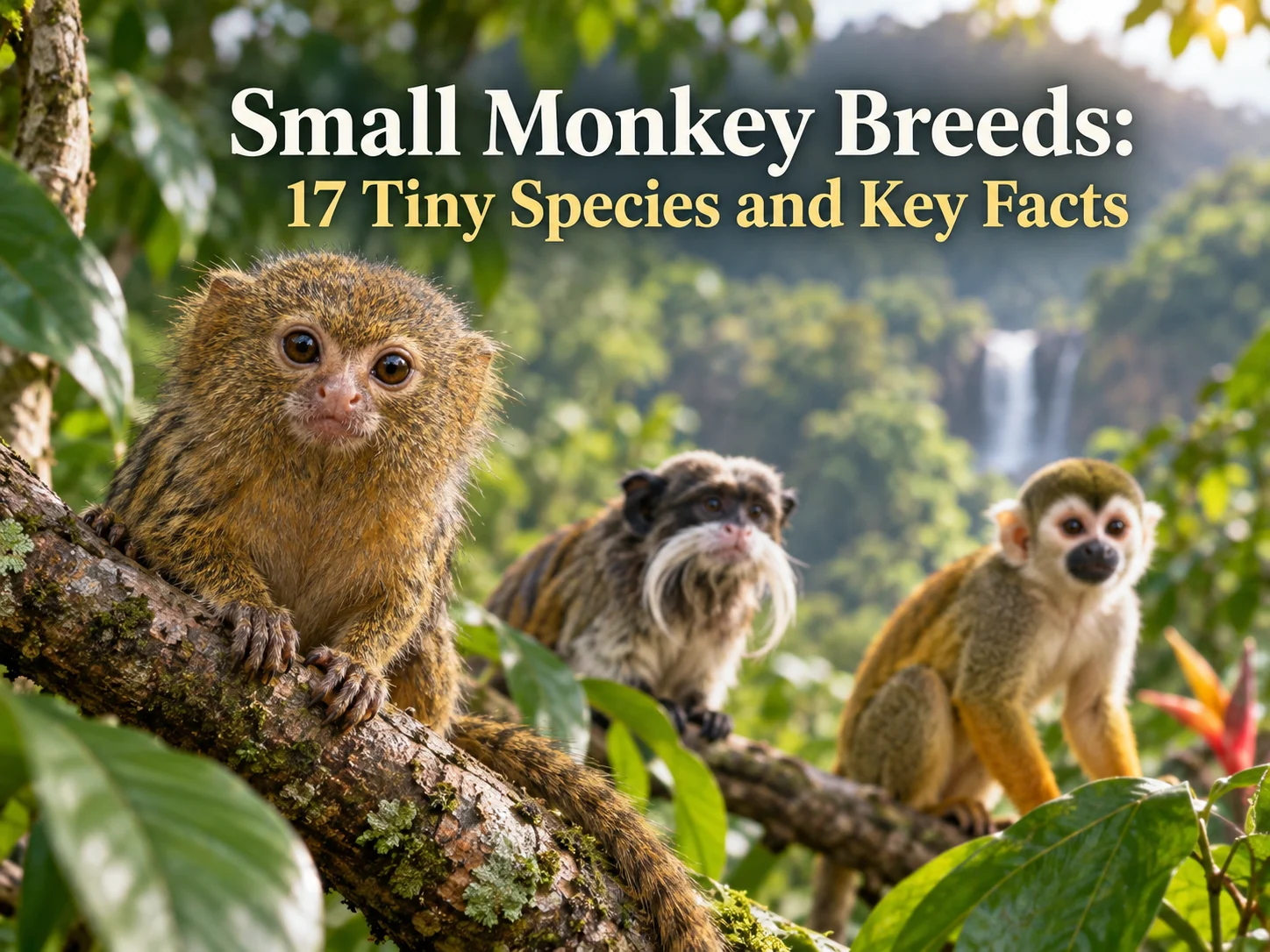
Small monkey breeds are popular with readers because some monkeys remain remarkably tiny even when fully grown. Scientifically, however, species is the correct term for these wild primates rather than breeds. Most of the smallest monkeys belong to the marmoset and tamarin groups of Central and South America, although squirrel monkeys also have relatively compact bodies. Below are 17 genuine small monkey species, with their size, appearance, habitat, and most distinctive traits explained.
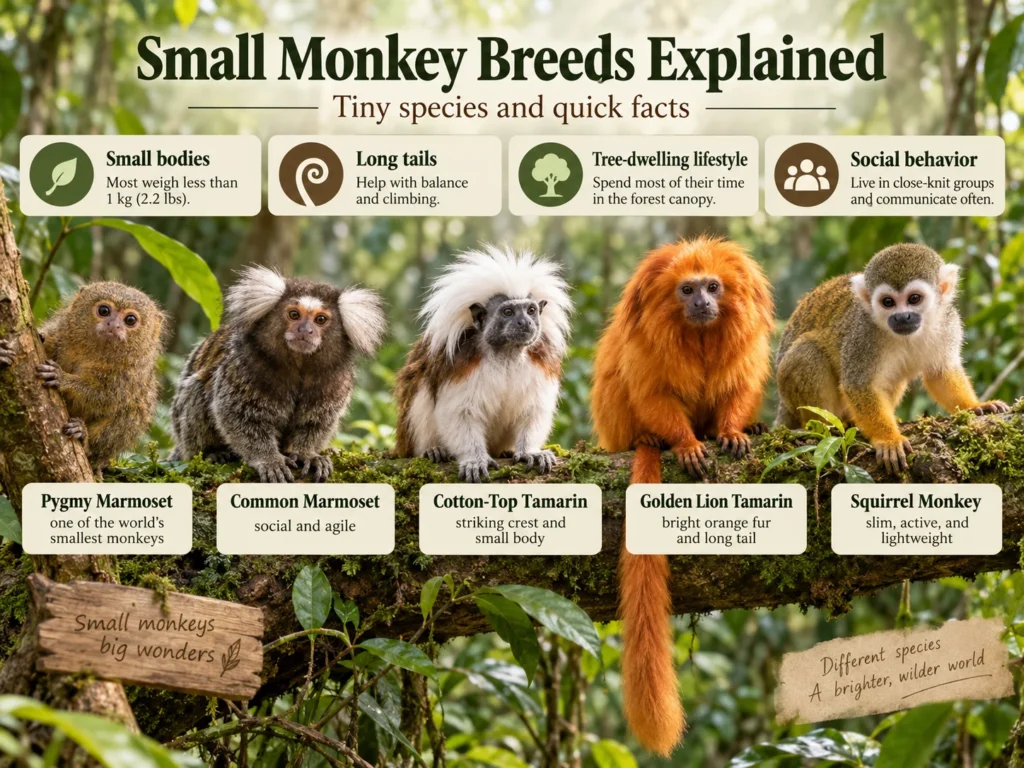
The smallest monkeys include pygmy marmosets, other marmosets, tamarins, lion tamarins, and squirrel monkeys. The pygmy marmoset is widely recognized as the world’s smallest monkey. Most small species are arboreal New World monkeys with long tails, lightweight bodies, and diets based on fruit, insects, nectar, or tree gums.
Small Monkey Species at a Glance
| Small Monkey Species | Group | Native Region |
| Pygmy marmoset | Marmoset | Western Amazon |
| Common marmoset | Marmoset | Brazil |
| Geoffroy’s marmoset | Marmoset | Southeastern Brazil |
| Black-tufted marmoset | Marmoset | Brazil |
| Silvery marmoset | Marmoset | Eastern Amazon |
| Cotton-top tamarin | Tamarin | Colombia |
| Emperor tamarin | Tamarin | Southwestern Amazon |
| Red-handed tamarin | Tamarin | Northern South America |
| Moustached tamarin | Tamarin | Western Amazon |
| Saddleback tamarin | Tamarin | Western Amazon |
| Golden lion tamarin | Lion tamarin | Brazil |
| Golden-headed lion tamarin | Lion tamarin | Bahia, Brazil |
| Black lion tamarin | Lion tamarin | São Paulo, Brazil |
| Central American squirrel monkey | Squirrel monkey | Costa Rica and Panama |
| Common squirrel monkey | Squirrel monkey | Northern South America |
| Black squirrel monkey | Squirrel monkey | Brazilian Amazon |
| White-lipped tamarin | Tamarin | Southwestern Amazon |
What Does “Small Monkey Breeds” Mean?
People frequently use the phrase small monkey breeds, but zoologists normally describe wild monkeys by species. A breed is usually a distinct variety produced through selective breeding within a domesticated species, such as a dog or horse breed. This distinction also prevents unrelated primates from being placed on monkey lists. Tarsiers, lemurs, and lorises may be small primates, but they are not monkeys. The 17 animals below are all genuine monkey species.
1. Pygmy Marmoset
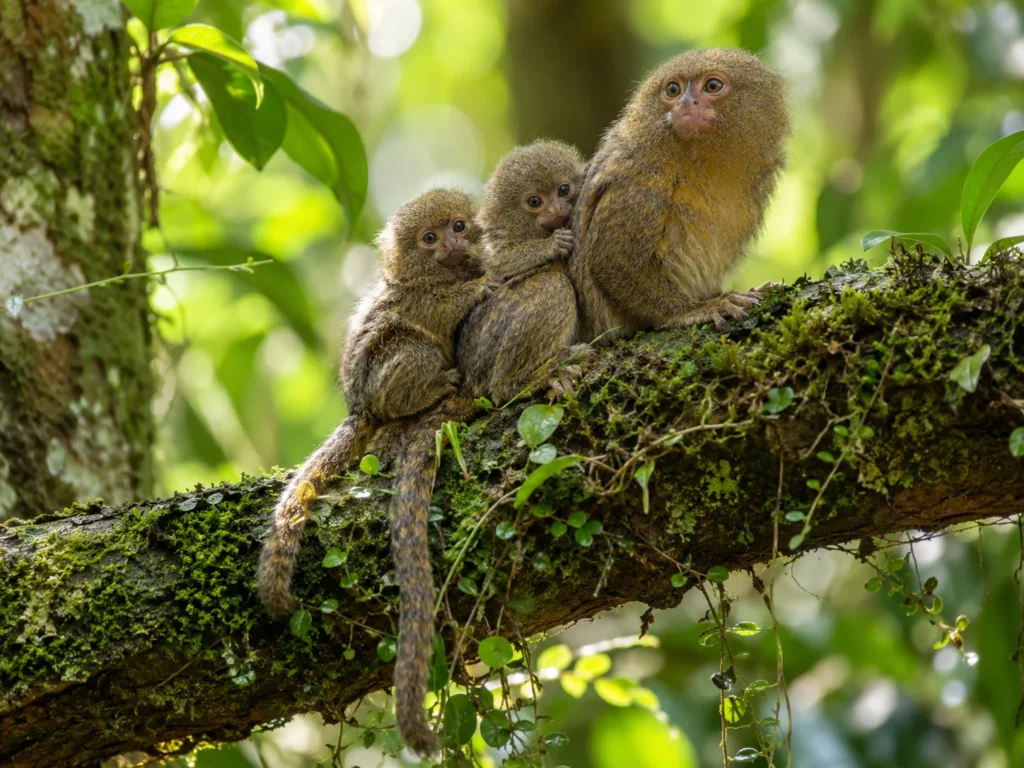
The pygmy marmoset is widely recognized as the smallest monkey in the world. Its head-and-body length is only around 13 to 15 cm (5 to 6 inches), and an adult commonly weighs a little over 100 grams. Native to the western Amazon Basin, pygmy marmosets are expert tree climbers. Their specialized teeth help them make holes in bark to obtain tree gums and other plant exudates.
2. Common Marmoset
Common marmosets are compact Brazilian monkeys known for their prominent white ear tufts. Their bodies are usually under 20 cm long, although their long tails make their total length considerably greater. But, some animals like Chimpanzees comes in Tailless Animals. They have claw-like nails on most digits that provide excellent grip on tree trunks. Fruit, insects, and plant gums all contribute to their diet, and family members commonly cooperate in caring for young.
3. Geoffroy’s Marmoset
Geoffroy’s marmoset has a body around 20 cm (8 inches) long and generally weighs only a few hundred grams. Its white forehead and face contrast with dark ear tufts and a banded tail. Native to southeastern Brazil, it spends most of its life in trees. Like other marmosets, Geoffroy’s marmoset combines fruit and insects with tree gums and other plant exudates.
4. Black-Tufted Marmoset
The black-tufted marmoset gets its name from the dark hair projecting from both sides of its head. It has a compact body, long balancing tail, and claw-like nails suited to climbing. This species occurs naturally in Brazil and can use several woodland environments. Its flexible diet includes fruit, insects, and tree gums, helping it exploit different food sources throughout the year.
5. Silvery Marmoset
Silvery marmosets are small Amazonian monkeys with pale silver-gray fur, dark tails, and relatively small-looking ears. Their head-and-body length averages only a little over 20 cm. They are highly arboreal and move quickly along trunks and branches. Their jaws and teeth help them obtain plant exudates, while fruit and insects provide additional nutrition.
6. Cotton-Top Tamarin
Cotton-top tamarins are instantly recognizable by the dramatic white crest extending from the forehead toward the shoulders. Their bodies measure roughly 18 to 23 cm (7 to 9 inches), and adults weigh around half a kilogram. These monkeys are native to northwestern Colombia. They live in social groups and use numerous calls to communicate while moving through tropical forest vegetation.
7. Emperor Tamarin
The emperor tamarin may be small, but its long white moustache makes it one of the most distinctive monkeys. Its body is roughly 23 to 26 cm long, with a tail considerably longer than the torso. Emperor tamarins inhabit southwestern Amazonian forests. They move through trees searching for fruit, insects, and other foods and may associate with other small tamarin species.
8. Red-Handed Tamarin
Red-handed tamarins have predominantly dark coats with striking reddish or orange hands and feet. They are lightweight, agile monkeys native to northern parts of South America. They spend most of their time above ground, moving quickly between branches while searching for fruit, insects, nectar, and other foods. Their brightly colored extremities provide an easy identification feature.
9. Moustached Tamarin
The moustached tamarin is named for the contrasting white hair around its upper lip. Adults generally weigh around half a kilogram, making the species much smaller than many familiar Old World monkeys. These Amazonian tamarins forage for fruit and insects and sometimes travel alongside other tamarin species. Different foraging strategies can allow several small monkeys to use the same forest without competing for the same resources.
10. Saddleback Tamarin
Saddleback tamarins are compact forest monkeys known for mottled or saddle-like coloring across the back. Their classification has been revised over time, so older references may use different scientific groupings for some populations. These monkeys occur in western Amazonia. Their slender hands are particularly useful for investigating small openings, vegetation, and tree surfaces while searching for insects and other food.
11. Golden Lion Tamarin
Golden lion tamarins have vivid golden-orange coats and long hair around the face that resembles a miniature mane. Despite the impressive appearance, adults generally weigh well under one kilogram. They are native to Brazil’s Atlantic Forest. Long fingers help them search crevices and vegetation for insects and small animal prey, while fruit forms another important part of their diet.
12. Golden-Headed Lion Tamarin
The golden-headed lion tamarin combines a dark body with golden hair around the head and other areas. Adults typically weigh around 500 to 700 grams, while body length is roughly 20 to 34 cm. This species occurs naturally in the Atlantic Forest of Bahia, Brazil. It is an active tree-dweller that searches for fruit, insects, and small prey using its long fingers.
13. Black Lion Tamarin
Black lion tamarins have predominantly dark fur, sometimes contrasted by golden or reddish coloring. Their small bodies are paired with long tails used for balance as they move through the trees. They are native to parts of São Paulo state in Brazil. Habitat fragmentation has made conservation particularly important for this species because much of its original Atlantic Forest environment has been altered.
14. Central American Squirrel Monkey
Central American squirrel monkeys are larger than most marmosets and tamarins but remain relatively small monkeys. Their bodies are approximately 23 to 30 cm long, and adults usually weigh from around half a kilogram to just over one kilogram. They occur in Costa Rica and Panama. These energetic monkeys are highly social and often travel in groups while searching for insects and fruit.
15. Common Squirrel Monkey
Common squirrel monkeys have compact bodies, pale facial markings, yellowish limbs, and long non-prehensile tails. They are larger than pygmy marmosets but considerably smaller than many medium and large monkey species. Native to northern South America, squirrel monkeys spend much of their day actively foraging. Fruit and insects are important foods, and their lightweight bodies allow quick movement through forest branches.
16. Black Squirrel Monkey
The black squirrel monkey is associated with a relatively restricted part of the Brazilian Amazon. Like other squirrel monkeys, it has a compact torso, expressive face, slender limbs, and a tail much longer than its body. Adults are roughly 30 cm in body length and generally weigh around or below one kilogram. The species demonstrates how closely related small monkey breeds can occupy highly specific habitats and geographic ranges.
17. White-Lipped Tamarin
White-lipped tamarins are small dark monkeys with noticeable pale hair around the mouth and reddish coloration across the chest or belly. Adults measure approximately 23 to 29 cm in body length and usually weigh well under one kilogram. They inhabit southwestern Amazonian forests and are strongly arboreal. Their varied diet includes fruit, insects, and other food gathered while travelling through forest vegetation.
Marmosets vs. Tamarins vs. Squirrel Monkeys
| Trait | Marmosets | Tamarins | Squirrel Monkeys |
| General size | Usually extremely small | Small and slender | Small but generally heavier |
| Tail | Long, non-prehensile | Long, non-prehensile | Long, non-prehensile |
| Common foods | Gums, fruit, insects | Fruit, insects, nectar | Fruit and insects |
| Notable feature | Specialized gum feeding in many species | Diverse facial hair and coloration | Very active social groups |
| Distribution | Central and South America | Central and South America | Central and South America |
Marmosets and tamarins are closely related and share features such as claw-like nails on most digits. Squirrel monkeys belong to another New World monkey lineage and are generally larger, although their adult body size still makes them relatively small primates.
Which Is the Smallest Monkey in the World?
The pygmy marmoset is the clearest answer. Its adult body is roughly the length of a human hand, and its weight is only slightly above 100 grams in many individuals. That title should not be confused with “smallest primate.” Monkeys are only one branch of the primate order, so records involving tiny non-monkey primates belong to a different comparison.
Why Are Many Small Monkeys Found in the Americas?
Most animals on this list are New World monkeys, especially marmosets and tamarins. Many are adapted for arboreal life, where a compact body allows them to move along relatively narrow branches and search small spaces for insects or plant foods. Small size does not make them biologically identical. Some species specialize more heavily in tree gums, others rely extensively on fruit and insects, and different monkeys occupy particular forest layers or geographic regions.
Common Misconceptions About Small Monkeys
A tiny monkey is not necessarily a baby. Pygmy marmosets, tamarins, and other species remain small after reaching adulthood. Long tails can also create misleading size comparisons. Many small monkey breeds have tails longer than their head-and-body length, so measurements should specify whether the tail is included. Finally, tarsiers, lemurs, and lorises are not monkeys, even though they are small primates.
FAQs
What is the smallest monkey in the world?
The pygmy marmoset is widely recognized as the smallest monkey species. Adults have bodies approximately 13 to 15 cm long and generally weigh only a little over 100 grams.
Are marmosets actually monkeys?
Yes. Marmosets are New World monkeys and close relatives of tamarins. This group contains several of the smallest monkey species alive today.
Are tarsiers small monkeys?
No. Tarsiers are primates, but they are not monkeys. They belong to a separate evolutionary branch and should not be included in scientifically accurate lists of monkey species.
Do squirrel monkeys stay small?
Yes. Squirrel monkeys remain relatively small as adults, although they are generally larger and heavier than most marmosets and tamarins.
Where do most small monkeys live?
Many small monkey species are native to Central and South America. Important regions include the Amazon Basin, Brazil’s Atlantic Forest, Colombia, Costa Rica, and Panama.
Is “small monkey breeds” scientifically correct?
Not exactly. It is a commonly searched phrase, but small monkey species is scientifically more accurate. “Breed” normally refers to distinct varieties developed within domesticated animals.
Final Thoughts
Small monkeys are far more diverse than their size might suggest. The hand-sized pygmy marmoset, moustached tamarins, colorful lion tamarins, and active squirrel monkeys each have different habitats, diets, appearances, and adaptations despite sharing relatively compact bodies. While “small monkey breeds” is the familiar search term, these animals are separate species rather than breeds. Looking at genuine monkey taxonomy, verified adult size, and natural biology gives a much more accurate picture of the world’s smallest monkeys.



3 Comments