
Badgers in Maine: Do They Live There and What to Know
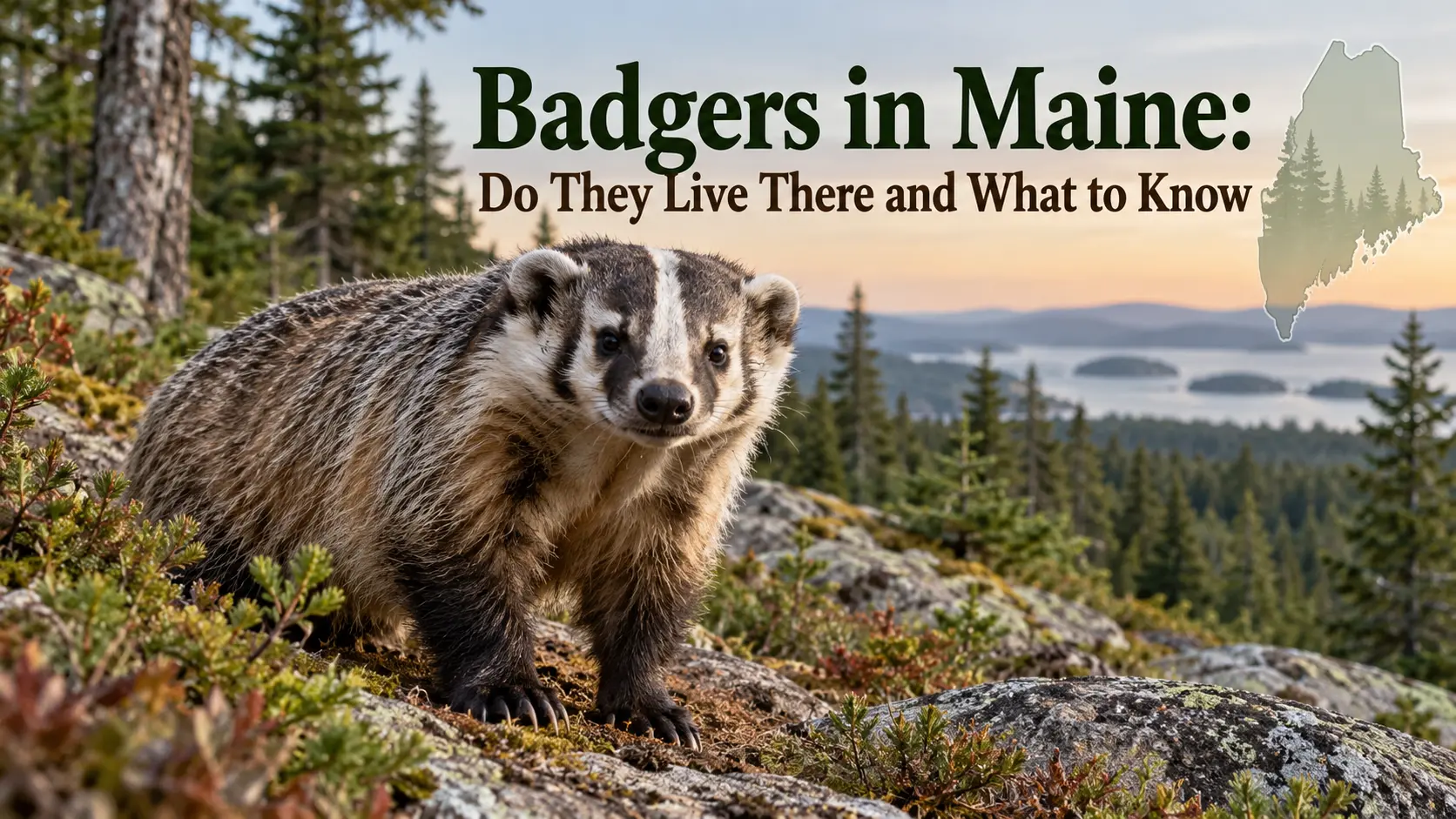
Badgers are powerful digging mammals found across large parts of North America, but their presence in Maine is a different story. The American badger is not considered an established resident mammal in the state, despite occasional questions and reports about possible sightings. Understanding its normal range, preferred habitat, and distinctive appearance can help explain why seeing one in Maine would be unusual, and which local mammals might be mistaken for a badger.
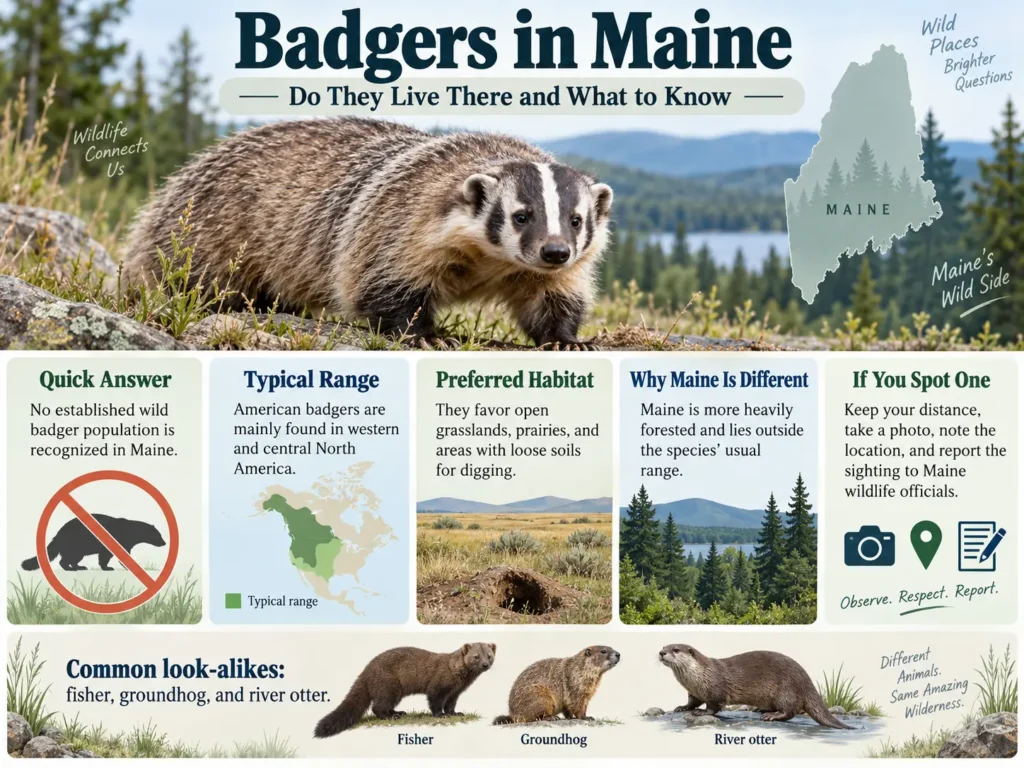
American badgers are not considered established resident mammals in Maine. Their recognized range is concentrated mainly farther west and across central parts of North America. If someone reports seeing a badger in Maine, check the identification carefully because fishers, striped skunks, woodchucks, and other local mammals can sometimes cause confusion from a distance.
Are There Badgers in Maine?
The American badger (Taxidea taxus) is a North American member of the mustelid family, the same broader mammal family that includes weasels, otters, fishers, and wolverines. However, it is not currently considered part of Maine’s established resident mammal fauna. Maine supports a diverse mammal community that includes black bears, Canada lynx, bobcats, fishers, martens, mink, raccoons, striped skunks, porcupines, woodchucks, and several weasel species. American badgers are notably absent from the state’s recognized mammal list.
That does not mean it would be biologically impossible for an individual badger ever to appear outside its usual range. Wildlife can disperse, and ranges may change over time. However, an unusual or reported sighting is very different from having an established population. For badgers to be considered resident wildlife in Maine, there would need to be reliable evidence of regular occurrence rather than a single anecdotal observation.
Where Do American Badgers Normally Live?
American badgers occur primarily across central and western portions of North America. Their distribution includes much of the Great Plains, western United States, parts of the Midwest and Great Lakes region, southern Canada, and areas extending south into Mexico. They are especially associated with landscapes where they can easily dig and where burrowing mammals provide abundant prey. This makes prairie regions and other open environments particularly suitable for them.
Why Is Maine Outside Their Main Range?
Maine lies well east of the core distribution normally associated with American badgers. The state also differs considerably from classic badger landscapes such as the broad prairies and open grasslands of the Great Plains. This should not be simplified to “Maine has forests, so badgers cannot live there.” American badgers can use more than one habitat type and have been documented in some woodland environments within their established range. Animal distribution depends on a combination of historical range, habitat connectivity, suitable soil, prey availability, climate, and opportunities for dispersal. Having a few potentially suitable fields in Maine does not by itself mean a resident badger population should occur there.
What Habitat Do American Badgers Prefer?
American badgers are strongly associated with open landscapes such as grasslands, prairies, pastures, agricultural fields, and montane meadows. They may also occupy shrublands and relatively open woodland environments when other habitat requirements are available. Soil is particularly important because badgers spend a considerable amount of time digging. Their bodies are adapted to excavating burrows both for shelter and while pursuing prey underground. Areas with workable soils and abundant burrowing mammals can provide excellent habitat.
Maine certainly contains farmland, meadows, and other open areas. Still, habitat suitability alone does not determine a species’ geographic distribution. An animal must also naturally reach and maintain populations in those environments. For this reason, the presence of an open field or good digging soil in Maine should not be taken as evidence that American badgers normally live there.
What Does an American Badger Look Like?
An American badger has a distinctive appearance once the whole animal can be seen clearly. Its body is broad, muscular, and unusually low to the ground, with short legs that give it a flattened profile. The coat is generally a mixture of gray, brown, black, and lighter hairs. Its face has strong contrasting markings, typically including dark patches along the cheeks and a pale stripe running along the center of the head. The front legs are particularly powerful. Long, strong claws allow a badger to excavate soil rapidly while searching for underground prey or preparing a burrow. The head is broad and somewhat wedge-shaped, while the tail is relatively short compared with many other Maine mammals. Identification should rely on several features together. A dark body, white marking, or digging behavior alone is not enough to confirm that an animal is a badger.
Animals in Maine That Can Look Like a Badger
A quick nighttime observation, distant trail-camera image, or partially hidden animal can make identification difficult. Several established Maine mammals have individual characteristics that could create confusion.
| Maine Animal | What You May Notice | Main Difference From a Badger |
| Fisher | Dark, low-moving mammal | Longer body and prominent tail |
| Striped skunk | Bold black-and-white markings | Large bushy tail |
| Woodchuck | Stocky body and digging behavior | Lacks badger facial markings |
| Raccoon | Contrasting facial markings | Masked face and ringed tail |
| Porcupine | Heavy, low silhouette | Quills and very different coat |
No single one of these animals is an exact badger lookalike. Instead, each may resemble one particular feature when visibility is poor.
Fisher vs American Badger
Fishers are well-established members of Maine’s wildlife community. Like badgers, they belong to the mustelid family, but their appearance is noticeably different when viewed clearly. A fisher usually has a much longer, more flexible-looking body with dark brown fur and a substantial tail. It is adapted for moving through forest environments and does not have the broad, flattened digging profile of an American badger.
A badger looks wider and heavier through the shoulders, has stronger contrasting facial markings, and carries massive front claws designed for excavation. Seeing an unfamiliar dark mustelid in Maine therefore does not automatically indicate a badger.
Striped Skunk vs American Badger
Striped skunks are found throughout Maine and commonly occupy agricultural areas, open woodland, and even suburban environments. Because both species can display bold black-and-white markings, a brief nighttime view could be confusing. The tail provides one of the clearest differences. A striped skunk has a long, conspicuous, heavily furred tail, whereas an American badger has a comparatively short tail and a much broader body. Their markings are also arranged differently. Skunks typically show white striping extending along the back and tail, while a badger’s most recognizable contrasting markings occur around the face and head.
Woodchuck vs American Badger
Woodchucks, also called groundhogs, are common digging mammals in Maine. Their stout bodies, short legs, and preference for fields and grassy areas can give them a superficially badger-like silhouette at a distance. A closer look separates them easily. Woodchucks lack the dramatic black-and-white facial markings of American badgers and do not have the same broad, flattened head and enormous front digging claws. Their lifestyles also differ. Woodchucks are primarily plant eaters, whereas American badgers are specialized predators that frequently dig after small mammals.
What Do American Badgers Eat?
American badgers are carnivorous predators particularly well adapted to hunting animals that live underground. Their diet commonly includes small mammals such as ground squirrels, pocket gophers, prairie dogs, mice, and other rodents depending on what is available locally. Their long claws and powerful shoulders allow them to dig directly into prey burrows. In some cases, a badger may excavate rapidly enough to pursue an animal underground rather than waiting for it to emerge. Badgers can also consume other available foods, including birds, eggs, insects, reptiles, and occasionally other small prey. Their diet therefore varies across their broad geographic range rather than depending on one single prey species.
How Do American Badgers Behave?
American badgers are generally solitary animals. Outside mating periods and the time when females are raising young, adults typically spend much of their lives alone. They are also prolific diggers. Badgers excavate burrows for resting, shelter, raising young, escaping difficult weather, and reaching prey. An individual may use numerous burrows within its home range rather than depending permanently on one den. Badgers are primarily active at night, although they can sometimes be seen during daylight, particularly in quieter areas with limited human disturbance. Their underground lifestyle and mostly nocturnal activity help explain why even people living within established badger range may rarely see one.
Do American Badgers Hibernate?
American badgers are not true hibernators. During cold winter conditions, they may remain underground for extended periods and reduce their activity substantially. They can enter periods of torpor, during which metabolic activity decreases, and the animal conserves energy. However, badgers can wake, leave their burrows, and become active again during winter. This is different from describing them as animals that simply enter a den and hibernate continuously throughout the entire season.
What If You Think You Saw a Badger in Maine?
A possible badger sighting in Maine would be unusual enough to deserve careful identification. Start by considering the animal’s overall shape rather than focusing on one feature. A genuine American badger should appear broad and low to the ground, with short legs, strong shoulders, distinctive facial markings, and a relatively short tail. Large front claws may also be visible under good viewing conditions.
Compare those features with common Maine wildlife. A long dark body and substantial tail may point toward a fisher, while a large bushy tail and strong black-and-white pattern suggest a striped skunk. A chunky animal beside a burrow in a field could simply be a woodchuck. A clear photograph or trail-camera image can provide much better identification evidence than memory alone. Wildlife should still be observed from a safe distance rather than approached, cornered, or handled. Finding a large hole is also not enough to confirm a badger. Woodchucks and several other animals in Maine excavate burrows.
Does One Badger Sighting Mean Badgers Live in Maine?
No. Even if an American badger were reliably documented in Maine, one animal would not automatically demonstrate the existence of an established population. Wildlife biologists distinguish between an isolated individual and a population that regularly occupies an area and reproduces there. Animals sometimes wander beyond their familiar geographic range, especially during dispersal.
Evidence of range expansion would normally require repeated, credible records over time and stronger indications that animals are persisting in an area. This is why anecdotal stories about Maine badgers should be treated cautiously. They may be interesting observations, but they should not be presented as proof that American badgers have become established Maine wildlife.
Key Takeaways
- American badgers are not considered established resident mammals in Maine.
- Their recognized distribution is concentrated mainly in central and western North America.
- Badgers are powerful digging predators associated strongly with open habitats and burrowing prey.
- Fishers, striped skunks, and woodchucks are useful Maine mammals to compare with an unfamiliar animal.
- A possible or even isolated confirmed sighting would not automatically prove the existence of a breeding Maine population.
Frequently Asked Questions
Are badgers native to Maine?
American badgers are not currently considered part of Maine’s established resident mammal fauna. Their normal North American range is centered much farther west, particularly across the Great Plains, western states, and portions of central North America.
Have American badgers ever been seen in Maine?
Claims about unusual wildlife sightings can occur, but a reported sighting should not be treated as confirmation without reliable identification. More importantly, even a verified individual would not by itself prove that Maine supports an established badger population.
What animal in Maine looks most like a badger?
There is no perfect Maine equivalent. A fisher may create confusion because it is another mustelid; a striped skunk has contrasting black-and-white markings, and a woodchuck has a stocky body and digging habits. Tail shape, facial markings, body proportions, and behavior help separate them.
Are American badgers dangerous?
American badgers are strong wild predators equipped with powerful claws and teeth. They generally should be given plenty of space rather than approached or handled. Their defensive abilities should be respected, but there is no reason to portray them as animals that routinely seek conflict with people.
Do American badgers hibernate?
No. American badgers are not true hibernators. They may spend long periods underground and enter torpor during cold weather, reducing their metabolism and activity. They can still wake and become active during winter when conditions allow.
Final Thoughts
Badgers in Maine are better understood as an unusual possibility than as established local wildlife. American badgers normally occur much farther west and are specialized for digging and hunting underground prey. If an unfamiliar Maine mammal looks badger-like, checking its body shape, facial markings, tail, and behavior can often point toward a more familiar local species.



One Comment