
Animals With Big Eyes: 15 Species and Why They Stand Out
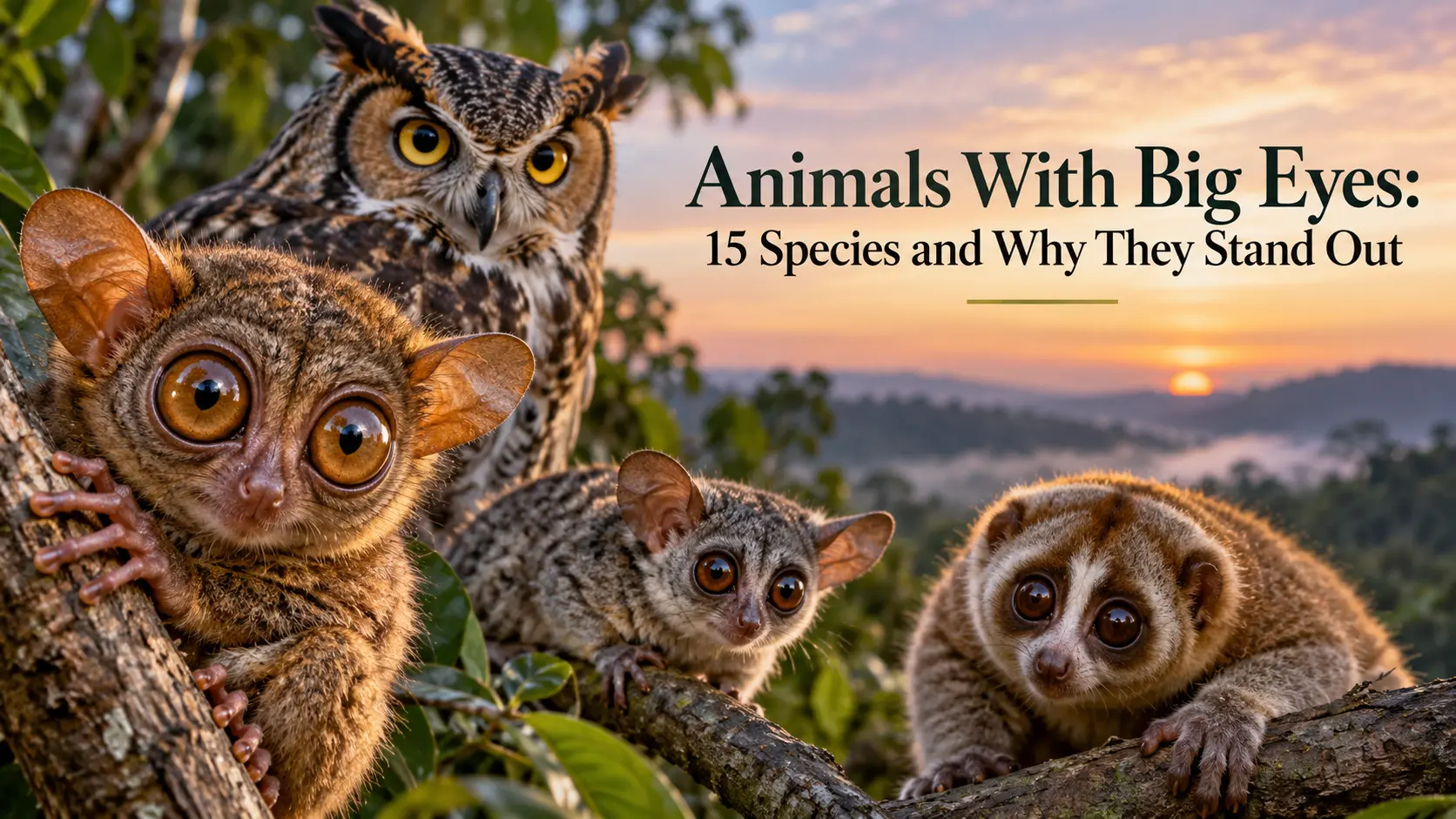
Animals with big eyes are found everywhere from tropical forests and African savannas to the darkest parts of the ocean. Yet “big eyes” can mean different things. A giant squid has enormous eyes in absolute size, while a tiny tarsier has remarkably large eyes compared with its body. In many species, prominent eyes also support low-light vision, prey detection, or environmental scanning. These 15 animals show just how varied large and specialized eyes can be.
Animals with big eyes include giant squid, tarsiers, ostriches, owls, slow lorises, bushbabies, vampire squid, and ogre-faced spiders. Some hold records for absolute or relative eye size, while others have prominent eyes adapted for dim light, wide visual fields, or specialized hunting. Bigger eyes, however, do not automatically mean better overall vision.
What Makes an Animal’s Eyes “Big”?
There is no single measurement that determines which animal has the “biggest” eyes. Scientists can compare actual eye diameter, eye size relative to body mass, or the proportion of the head occupied by the eyes. A species may also stand out because its eyes are unusually prominent or structurally specialized.
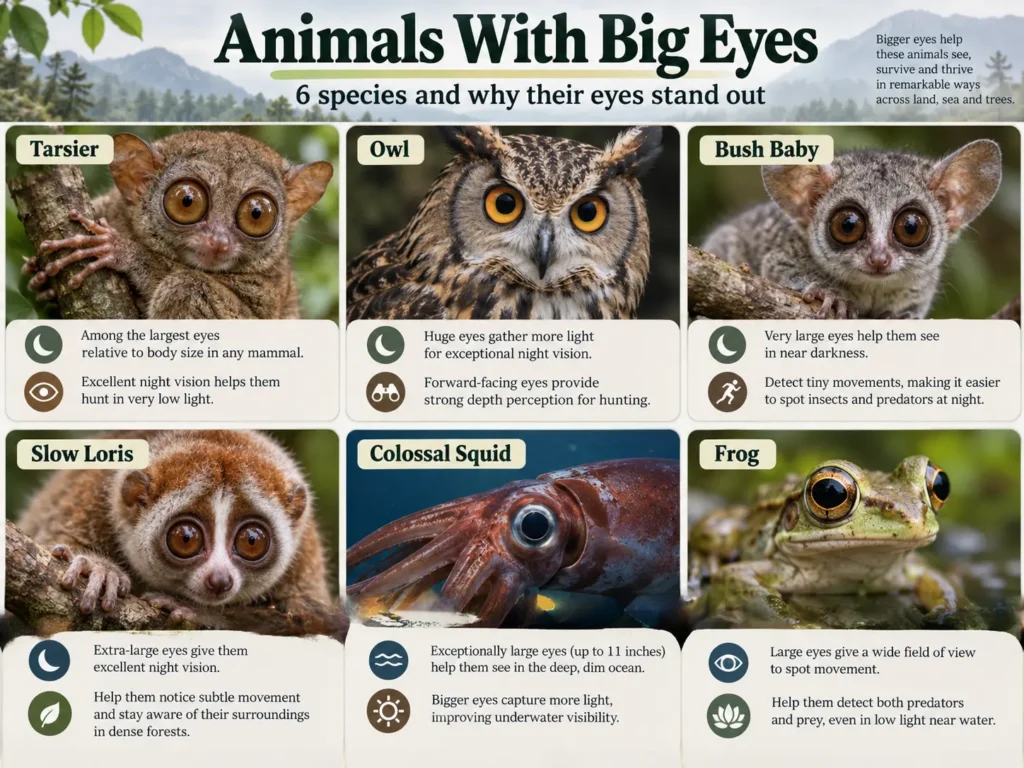
That distinction matters. Giant squid dominate when absolute eye diameter is considered, while tarsiers are exceptional among mammals when eye size is compared with body size. Ostriches hold an impressive record among birds, while animals such as owls and chameleons are notable because of how their unusually shaped eyes function.
Animals With Record-Breaking Eyes
1. Giant Squid
Giant squid possess some of the most extraordinary eyes in nature. Their eyes can approach about 10 inches, or 25 centimeters, across, making them the largest known animal eyes by absolute diameter. In the deep ocean, these huge visual organs help collect scarce light and detect large moving objects in an environment where visibility is extremely limited.
2. Tarsier
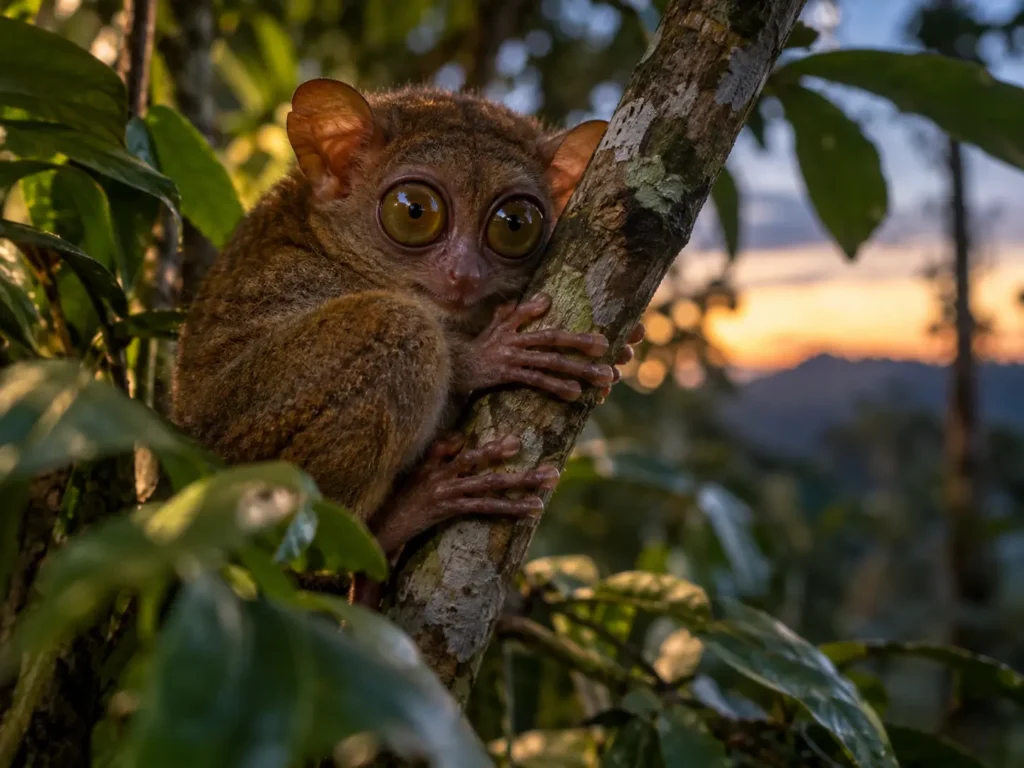
Few mammals look as dramatically big-eyed as a tarsier. Relative to body size, tarsier eyes are the largest among mammals, and each eye can even be larger than the animal’s brain. Because tarsiers are nocturnal, their enlarged eyes improve light gathering, allowing these small primates to function efficiently in dim forest conditions.
3. Ostrich
Ostriches show that large eyes are not exclusively a nocturnal adaptation. Their eyes measure roughly 2 inches, or 5 centimeters, across, making them the largest eyes among living birds. Good vision is important for these tall, ground-dwelling animals because spotting predators across open grasslands can provide valuable time to react and escape.
Nocturnal Animals With Big Eyes
4. Owl
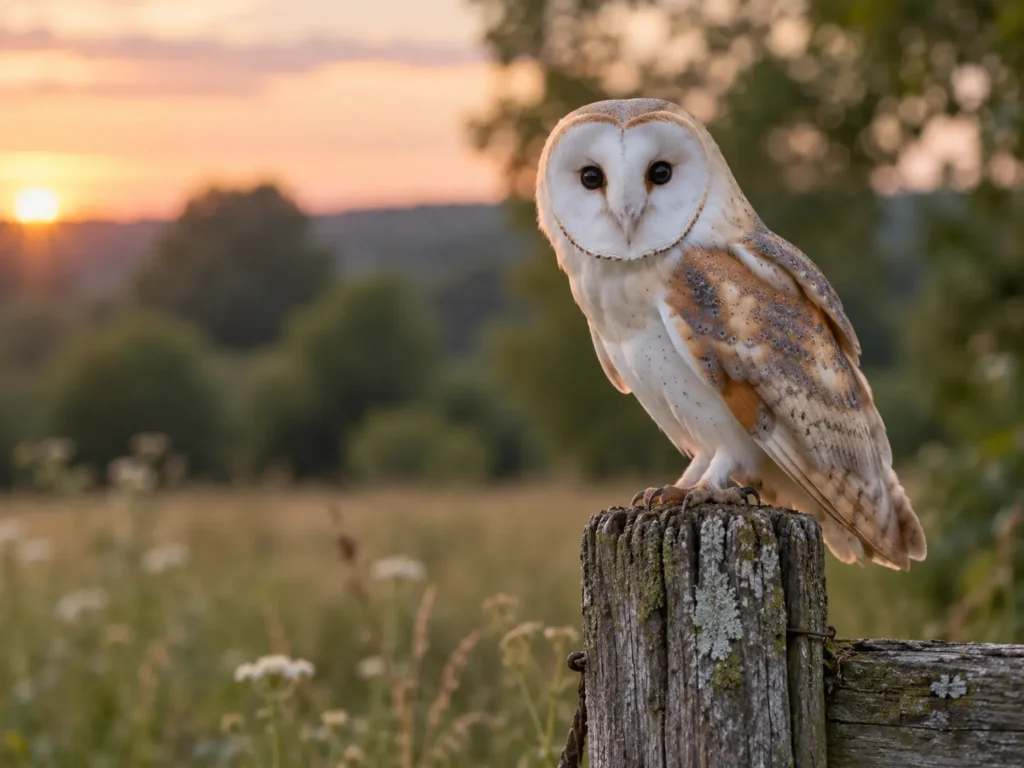
Owls have unusually large visual organs, but their eyes are not shaped like ordinary round human eyeballs. They are elongated or tubular and extend backward into the skull. Their retinas contain many light-sensitive rod cells, supporting vision under low-light conditions. Because the eyes are largely fixed in place, owls turn their heads to redirect their gaze.
5. Slow Loris
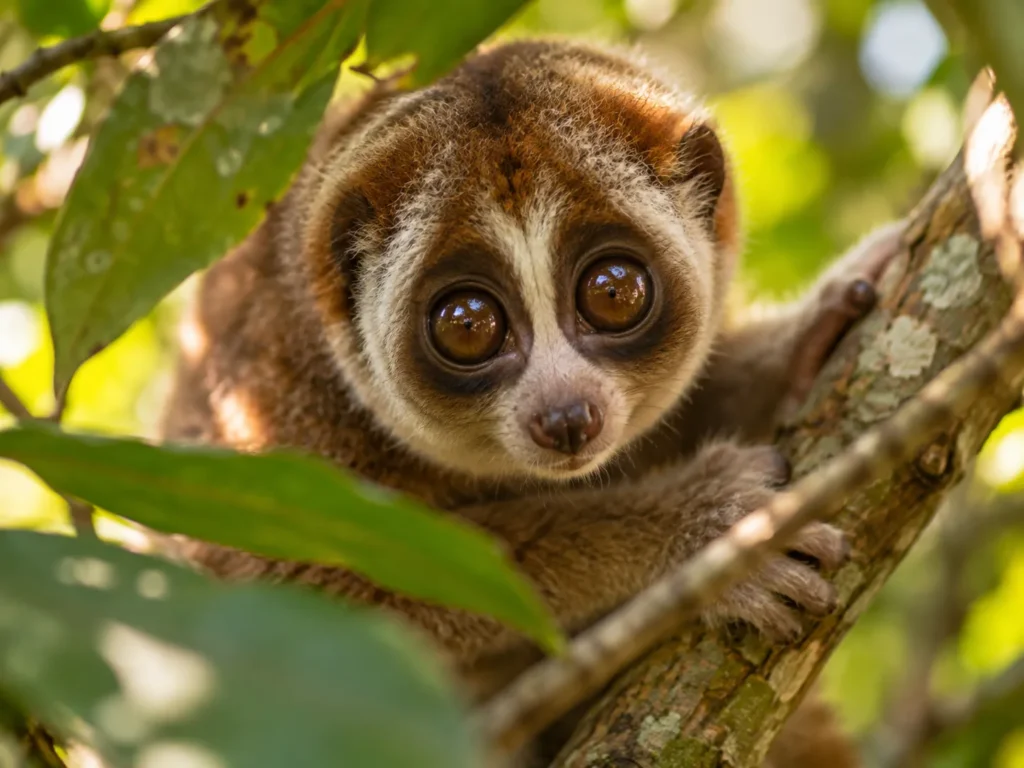
The round, forward-facing eyes of a slow loris dominate its small face. Pygmy slow lorises are nocturnal forest animals, and their large eyes are well suited to finding their way through branches under dim conditions. Forward-facing placement also produces overlapping visual fields, which can be useful when moving carefully through a complex three-dimensional environment.
6. Bushbaby
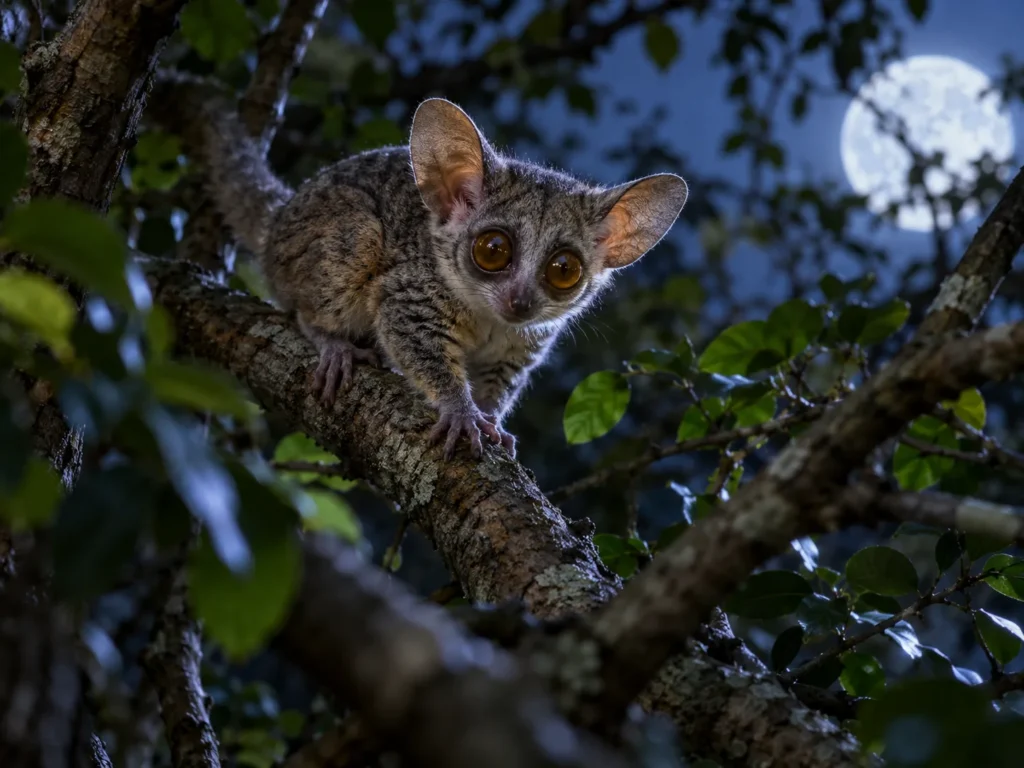
Bushbabies, also called galagos, are small African primates famous for their bright, oversized eyes. They become active after sunset and use their strong night vision to move through dense vegetation. Their large eyes work alongside sensitive hearing and powerful jumping abilities, helping them navigate branches and locate food while much of their habitat is dark.
7. Aye-Aye
The aye-aye of Madagascar has large, conspicuous eyes that fit its strongly nocturnal lifestyle. Its eyes are only one part of a remarkable sensory toolkit that also includes oversized mobile ears and highly specialized fingers. At night, good visual sensitivity helps the aye-aye move through forest canopies while searching for food and avoiding obstacles.
8. Giant Leaf-Tailed Gecko
Giant leaf-tailed geckos combine extraordinary camouflage with large, patterned eyes. These Madagascar reptiles are nocturnal, so prominent eyes are particularly useful when the forest becomes dark. Their broad heads and marbled eyes add to their unusual appearance, while their flattened bodies and leaf-like tails allow them to disappear visually against bark and vegetation.
9. Central American Woolly Opossum
Central American woolly opossums are nocturnal tree-dwelling marsupials with noticeably large, forward-oriented eyes. Their eye placement and prominence are associated with strong visual ability during nighttime activity. Moving among vines and branches after sunset requires accurate information about nearby surfaces, gaps, and possible threats, making vision especially valuable in their arboreal environment.
Deep-Sea and Aquatic Animals With Large Eyes
10. Vampire Squid
The vampire squid has exceptionally large eyes relative to its body. Its eyes can measure around an inch across even though the entire animal is relatively small. It lives in deep, dim waters where sunlight is scarce, so large visual organs help it make use of limited available light and detect important signals or movement in its surroundings.
11. Swordfish
Swordfish are powerful ocean predators with large eyes and specialized systems that support vision in cold, deep water. They can warm their eyes and brain through heat-producing tissues and heat-exchange mechanisms. This is different from simply having oversized nocturnal eyes, showing that successful vision depends on physiology as well as the physical dimensions of the eyeball.
Small Animals With Remarkable or Specialized Eyes
12. Ogre-Faced Spider
The ogre-faced spider has two enormous forward-facing eyes that immediately stand out from its other, much smaller eyes. These enlarged eyes are considered the largest among spiders and contain highly sensitive photoreceptors. That sensitivity is valuable because ogre-faced spiders hunt at night, using vision to detect prey before striking with their unusual net-casting hunting technique.
13. Chameleon
Chameleon eyes are notable less for record-breaking diameter and more for their prominent turret-like structure. Each eye can scan largely independently, allowing a chameleon to watch different parts of its surroundings at once. When prey is detected, the eyes can coordinate toward the same target, helping the animal judge distance before launching its rapidly extending tongue.
14. Red-Eyed Tree Frog
The red-eyed tree frog has large, bulging red eyes that contrast sharply with its bright green body. This Central American frog is primarily nocturnal, and its prominent eyes are an unmistakable physical feature. Its vivid eyes may also contribute to visual defensive displays when a resting frog suddenly exposes its bright coloration to a potential predator.
15. Dragonfly
A dragonfly’s head is dominated by two enormous compound eyes. Unlike a vertebrate eye with one lens, each compound eye consists of thousands of individual visual units. Their size and position provide extensive visual coverage, helping dragonflies detect moving insects and track targets during fast aerial pursuits. This makes them a very different kind of big-eyed animal.
Absolute vs Relative Eye Size
Calling one species the “animal with the biggest eyes” can be misleading because the answer depends on what is measured.
| Eye Category | Example Animal | Why It Stands Out |
| Largest absolute eyes | Giant squid | Eyes may approach 10 inches across |
| Largest relative eyes among mammals | Tarsier | Enormous eyes compared with body size |
| Largest bird eyes | Ostrich | Eyes about 2 inches across |
| Large tubular visual organs | Owl | Specialized for low-light vision |
| Largest spider eyes | Ogre-faced spider | Two extremely enlarged principal eyes |
| Large compound eyes | Dragonfly | Eyes dominate much of the head |
The giant squid therefore wins for absolute dimensions, while the tarsier represents a very different type of extreme. Eye comparisons are most accurate when the measurement category is clearly defined.
Why Do Some Nocturnal Animals Have Large Eyes?
Nighttime creates a fundamental visual problem: far fewer photons are available than during daylight. Enlarging parts of the visual system can help some animals capture more of that limited light. This is why conspicuous eyes occur in many nocturnal species, including tarsiers, bushbabies, slow lorises, owls, and ogre-faced spiders.
However, large eyes are only part of the solution. Pupil size, lens design, retinal structure, photoreceptor sensitivity, and neural processing also affect low-light performance. Different species have therefore evolved different combinations of adaptations rather than following one universal design for night vision.
Why Are Deep-Sea Eyes So Specialized?
Sunlight becomes dramatically weaker as ocean depth increases. Deep-water animals may have to detect extremely faint light, including bioluminescent signals produced by other organisms. In some species, larger eyes and pupils provide more surface area for capturing scarce photons.
Giant squid and vampire squid illustrate this strategy particularly well. Yet large eyes are not universal in the deep sea. Some animals rely heavily on other senses, while species living in environments where vision provides little benefit may have reduced eyes instead. Deep-sea eye evolution depends on how each animal finds food, avoids predators, and communicates.
Do Bigger Eyes Always Mean Better Vision?
No. Eye size can influence visual performance, but it does not determine vision by itself. An animal with large eyes is not automatically better at seeing fine detail, distinguishing colors, judging distance, or functioning in darkness. The retina’s rods and cones, pupil, lens, eye position, visual field, and brain all contribute. Owls emphasize sensitivity in dim light, chameleons have exceptional independent eye movement, and dragonflies use enormous compound eyes for broad visual coverage. Ostriches, meanwhile, demonstrate that extremely large eyes can also be valuable in a primarily daylight-active animal.
Common Misconceptions About Animals With Big Eyes
One common mistake is saying that tarsiers have the biggest eyes of any animal. Their real distinction is having extraordinarily large eyes relative to their small bodies; giant squid have much larger eyes in absolute terms. Similarly, ostriches have the largest eyes among birds but do not exceed giant squid.
Another misconception is that every animal with big eyes must be nocturnal. Ostriches and dragonflies quickly disprove that idea. Large eyes can support light gathering, but eye size may also relate to detecting distant threats, tracking moving prey, increasing visual coverage, or meeting other ecological demands.
Frequently Asked Questions
Which animal has the biggest eyes?
Giant squid have the largest known animal eyes by absolute diameter. Their eyes can reach roughly 10 inches, or 25 centimeters, across. These enormous organs are especially useful in the extremely dim conditions of the deep ocean.
Which animal has the biggest eyes relative to its body?
Among mammals, tarsiers are famous for having the largest eyes relative to body size. Their eyes occupy a remarkable amount of space in their small heads and help compensate for the limited light available during their nocturnal activity.
Why do nocturnal animals often have large eyes?
Large eyes can allow more light to enter the visual system, which is useful in dim conditions. However, night vision also depends on pupil size, retinal photoreceptors, lenses, reflective structures in some species, and how the brain processes visual signals.
Why are owl eyes so large?
Owls rely heavily on vision when hunting under low-light conditions. Their large, tubular eyes contain many light-sensitive rod cells and extend deep into the skull. Their unusual shape also means the eyeballs cannot rotate freely, so owls reposition their heads instead.
Do bigger eyes always mean better vision?
No. Larger eyes may offer advantages such as increased light collection, but overall vision depends on many anatomical and neurological features. An animal can have smaller eyes yet outperform a larger-eyed species in color detection, visual sharpness, motion detection, or another specific visual task.
Final Thoughts
Animals with big eyes demonstrate that a similar-looking trait can evolve for very different purposes. Giant squid stand out for absolute eye size, tarsiers for eye size relative to their bodies, ostriches among birds, and ogre-faced spiders among arachnids. Owls add yet another solution with their specialized tubular eyes. Rather than simply making an animal look unusual, large or prominent eyes can support low-light sensitivity, predator detection, hunting, navigation, or broad visual coverage. The most meaningful comparisons therefore consider not just how big the eyes look, but how they function.





One Comment