Animals Like Mongoose: 12 Relatives and Look-Alikes
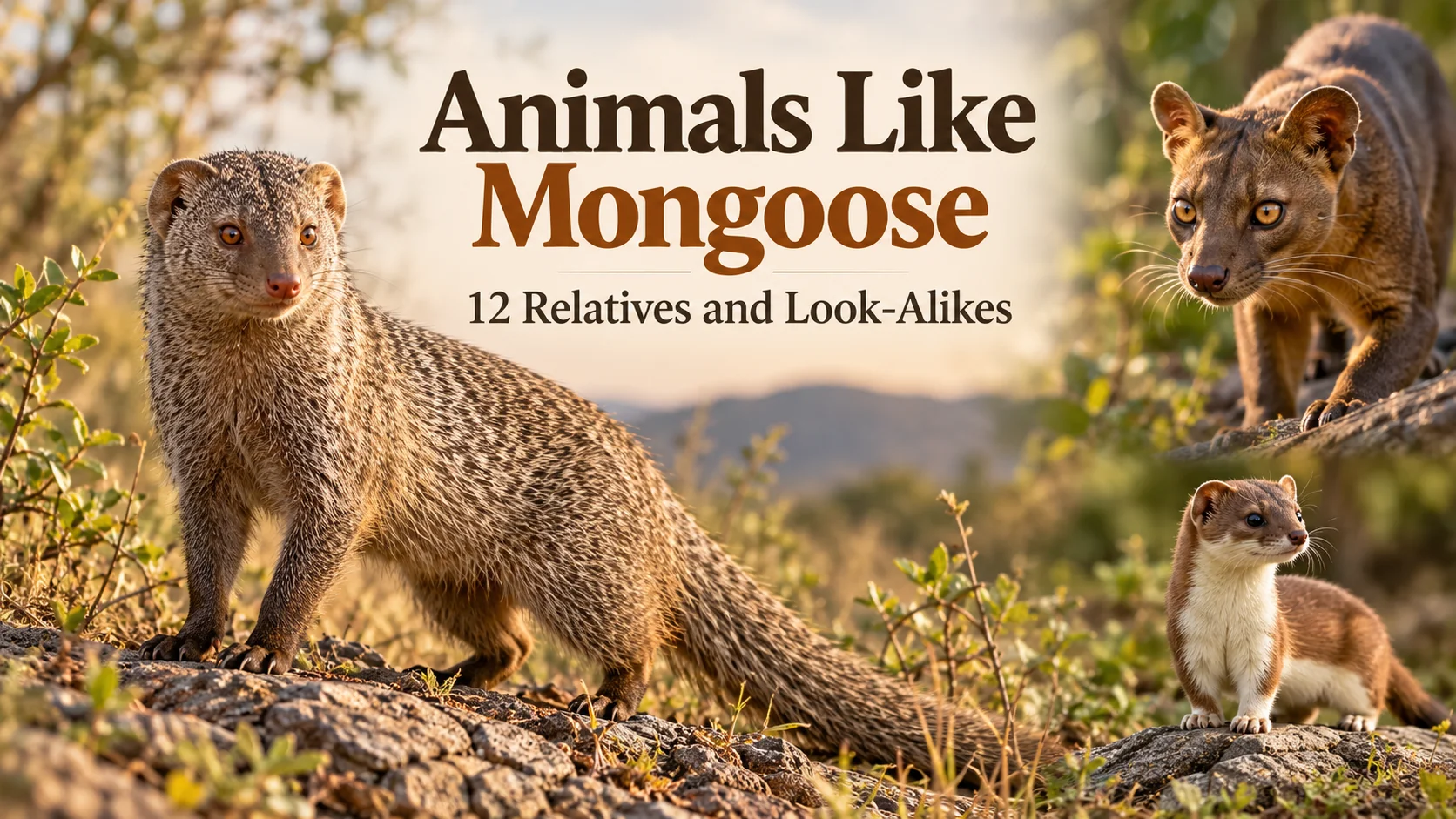
Mongooses have a distinctive build: long bodies, short legs, pointed faces, quick movements, and often long tails. That combination makes several other small carnivores look surprisingly mongoose-like. Some similarities reflect genuine family relationships, while others come from similar hunting lifestyles and body shapes. When comparing animals like mongooses, it helps to distinguish appearance from ancestry. Meerkats are true mongooses, for example, but weasels are not. These 12 animals show how taxonomy, appearance, behavior, and geography separate real mongoose relatives from convincing look-alikes.
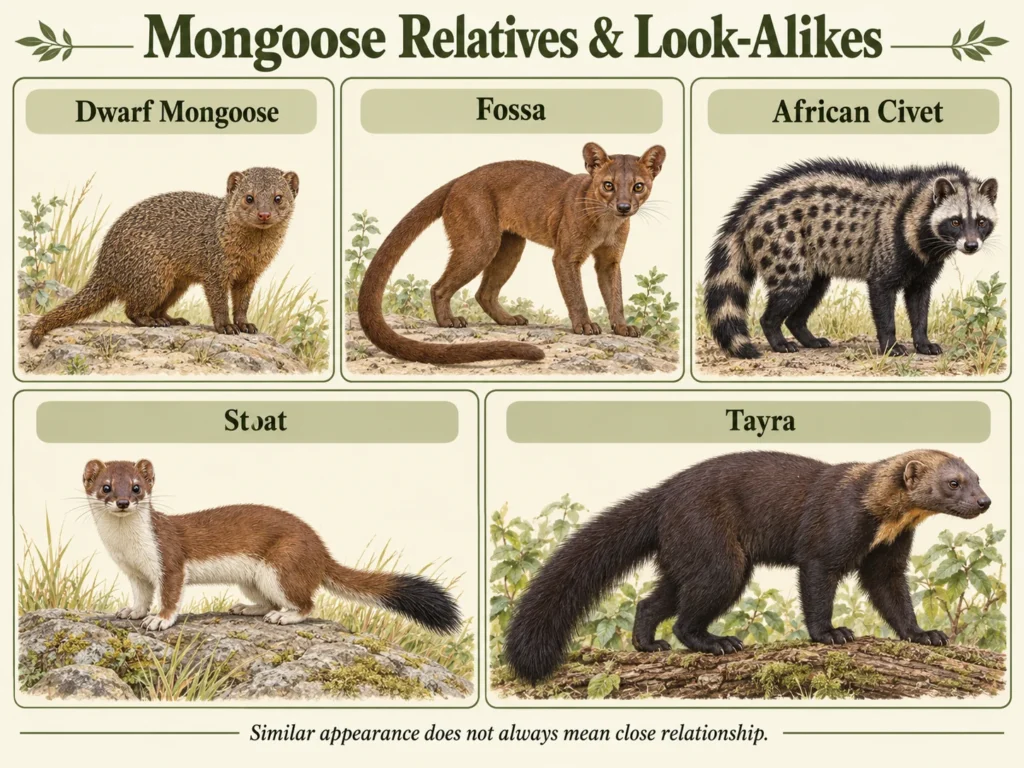
Animals like mongooses include meerkats, dwarf mongooses, kusimanses, ring-tailed vontsiras, fossas, genets, civets, linsangs, weasels, stoats, mink, and tayras. Meerkats and several others are true Herpestidae members, while many look-alikes belong to Eupleridae, Viverridae, Prionodontidae, or Mustelidae and only share similar body forms or hunting behavior.
What Makes an Animal Mongoose-Like?
A typical mongoose has an elongated body, short legs, a pointed muzzle, and a long tail. Many are fast terrestrial foragers that search for insects and small vertebrates, and their low build helps them move quickly through dense ground cover. Those features are not unique to Herpestidae. Weasels, genets, linsangs, and other carnivores independently evolved similarly narrow bodies and agile hunting styles. When identifying animals like mongooses, some comparisons are therefore based on true relationships, while others simply reflect similar ecological demands.
What Family Do Mongooses Belong To?
True mongooses belong to Herpestidae within the feliform branch of Carnivora. Meerkats, dwarf mongooses, and kusimanses are genuine members of this family. Several animals like mongooses belong elsewhere, just as Animals Like Skunks may resemble one another without being close relatives. Ring-tailed vontsiras and fossas are euplerids, genets and civets are viverrids, and Asiatic linsangs belong to Prionodontidae. Weasels, stoats, mink, and tayras are Mustelidae on the caniform side of Carnivora. That family-level split explains why resemblance alone can mislead.
True Mongooses and Their Closest Comparisons
1. Meerkat
A meerkat is not merely mongoose-like—it is a mongoose. This southern African species belongs to Herpestidae and shares the family’s pointed muzzle, compact build, and active foraging style. Among animals like mongooses, meerkats stand out for cooperative groups and sentinel behavior, with individuals often watching for danger while others forage.
2. Common Dwarf Mongoose
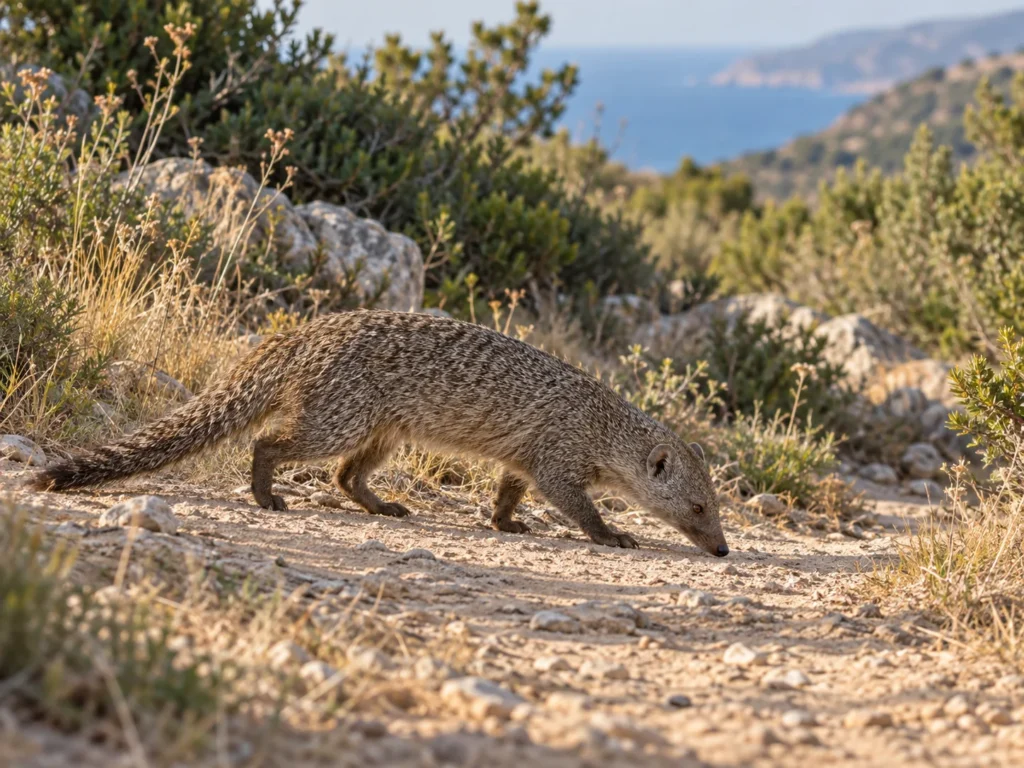
The common dwarf mongoose is another genuine herpestid and one of Africa’s smallest carnivores. Its narrow face, low body, and fast ground movements are classic mongoose traits. Dwarf mongooses are highly social and commonly forage for insects and other small prey.
3. Kusimanse
The common kusimanse, or long-nosed cusimanse, is a true West African mongoose. Its long muzzle, short legs, dark coat, and active ground foraging fit the family well, although it is more strongly associated with forest and dense vegetation than many familiar open-country mongooses.
Malagasy Animals That Resemble Mongooses
4. Ring-Tailed Vontsira
The ring-tailed vontsira was historically called the ring-tailed mongoose and certainly looks the part, with a long body, pointed face, short legs, and ringed tail. Modern classification places it in Eupleridae, Madagascar’s endemic carnivore family, rather than Herpestidae. Among Malagasy animals like mongooses, it is a particularly convincing example of resemblance without membership in the true mongoose family.
5. Fossa
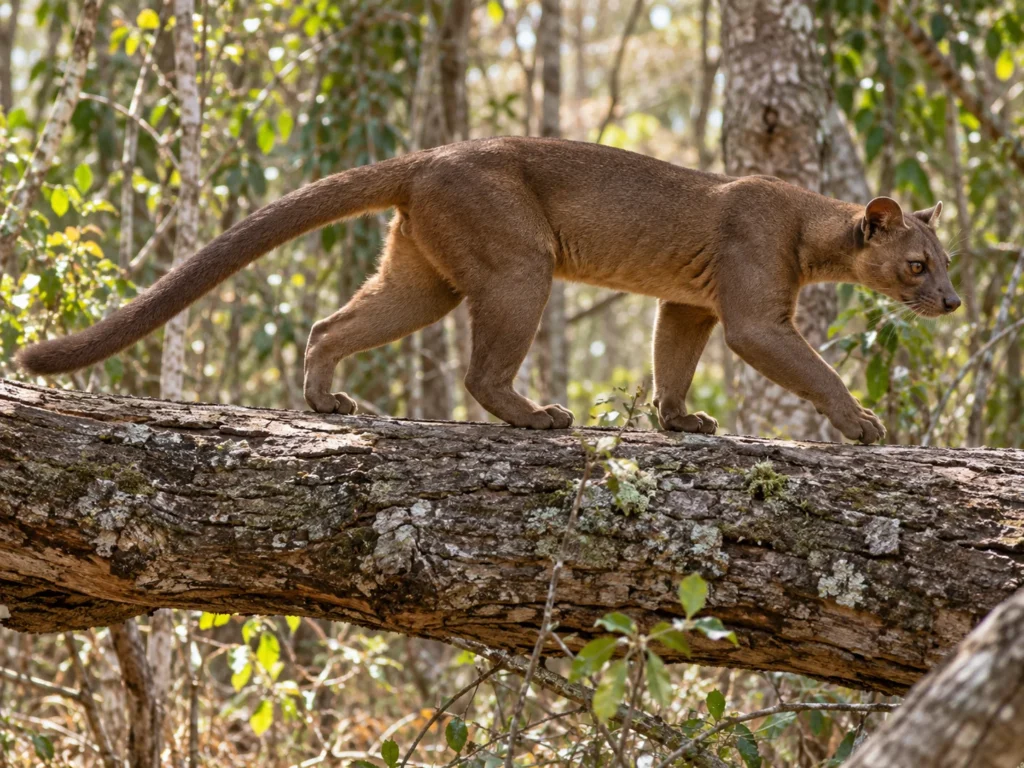
The fossa is another Malagasy euplerid, although it looks less like a classic mongoose. It is larger, more muscular, and more cat-like, with a long tail and strong climbing ability. Its relevance comes from its place within Madagascar’s endemic carnivore radiation, not from membership in Herpestidae.
Feliform Look-Alikes
6. Common Genet
The common genet is one of the strongest visual look-alikes. It has a narrow muzzle, elongated body, short legs, and a very long ringed tail. Its spotted coat and climbing ability help distinguish it. Among animals like mongooses, genets are especially interesting because they belong to Viverridae, making them feliform relatives at a broader level rather than true mongooses.
7. African Civet
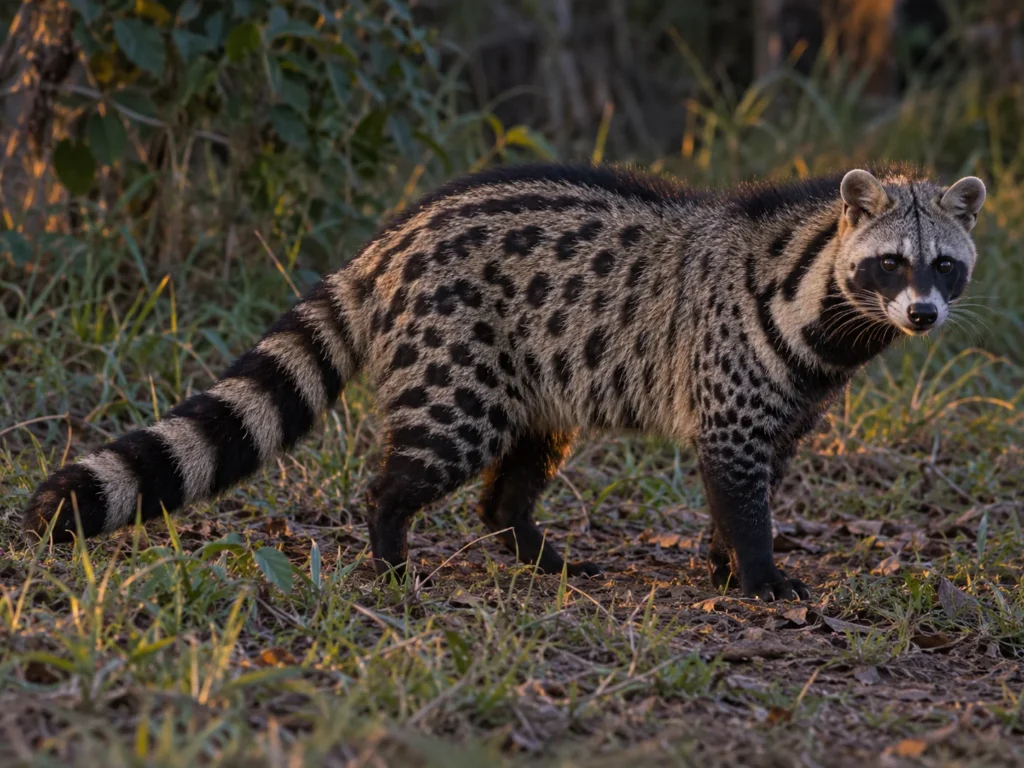
African civets also belong to Viverridae. Their elongated muzzle, long body, terrestrial foraging, and scent communication create a broad mongoose comparison. However, civets are usually bulkier and more heavily patterned, making them less convincing visual matches than genets.
8. Banded Linsang
Banded linsangs have extremely slender bodies, pointed faces, long tails, and agile predatory movements. Their dark bands and spots make them visually distinctive. Modern classification places Asiatic linsangs in Prionodontidae, showing again that a mongoose-like silhouette does not identify an animal’s family.
Mustelids That Look Like Mongooses
9. Least Weasel
The least weasel resembles a tiny mongoose through its elongated body, short legs, narrow head, and rapid hunting style. Yet it belongs to Mustelidae. Among animals like mongooses, weasels provide a clear example of convergent body shape. Similar confusion can occur with Animals Like Raccoons, where appearance may suggest a close relationship even when taxonomy says otherwise. Mongooses are feliforms and weasels are caniforms, so their similar bodies evolved in separate carnivore lineages.
10. Stoat
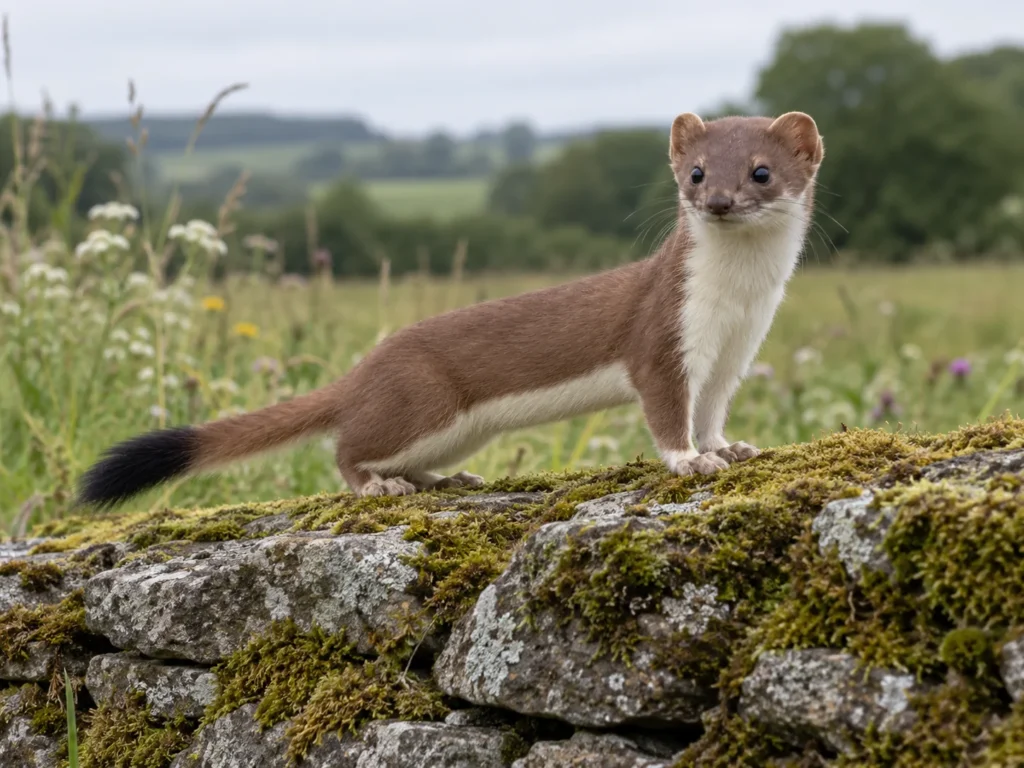
Stoats share the same flexible, low-slung outline as weasels and hunt small mammals with quick, agile movements. Their longer tail, usually with a black tip, helps with identification. Like the least weasel, a stoat is a mustelid rather than a member of the mongoose family.
11. American Mink
American mink combine an elongated mustelid body with short legs and fast predatory movement. Their semi-aquatic lifestyle is the clearest difference: mink commonly hunt around streams, wetlands, and shorelines. Their mongoose-like shape therefore occurs within a very different ecological specialization.
12. Tayra
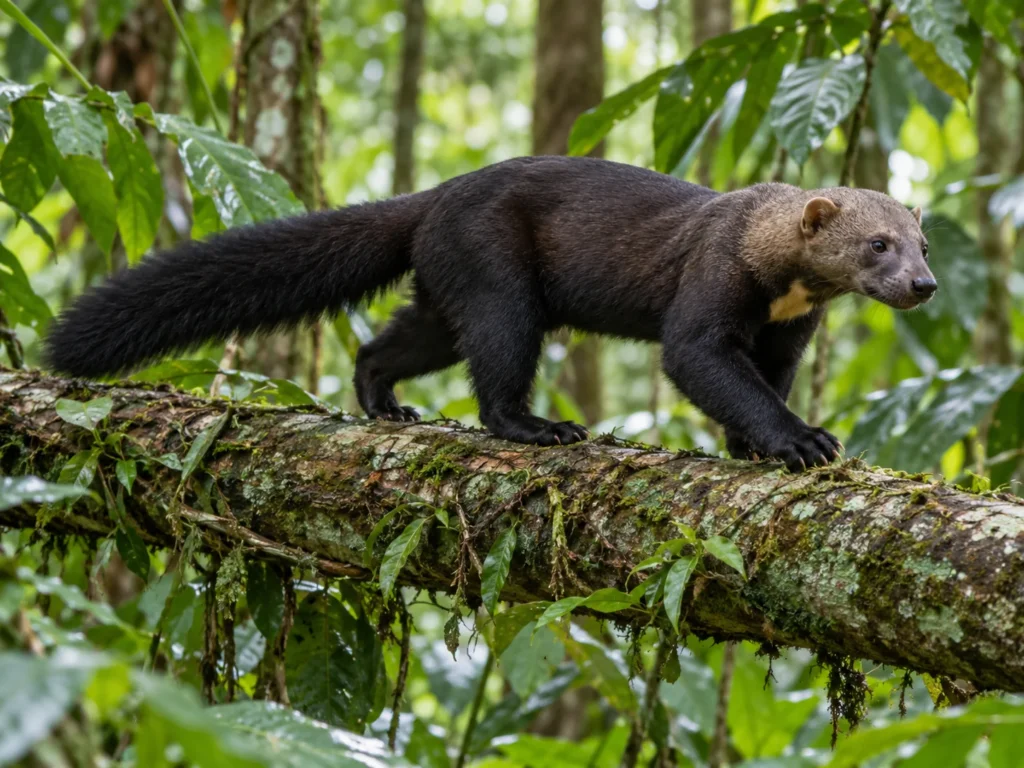
Tayras are larger tropical American mustelids with long bodies, long tails, and energetic movement. They forage on the ground and in trees and climb better than many familiar mongooses. Their size and ecology make them a broader look-alike, but their body plan still invites comparison.
Quick Comparison: Which Animals Are Actually Related to Mongooses?
| Animal | Family | True Mongoose? | Main Similarity |
| Meerkat | Herpestidae | Yes | Same family |
| Dwarf mongoose | Herpestidae | Yes | Same family |
| Kusimanse | Herpestidae | Yes | Same family |
| Ring-tailed vontsira | Eupleridae | No | Mongoose-like body |
| Fossa | Eupleridae | No | Malagasy carnivore relationship |
| Common genet | Viverridae | No | Slender body and long tail |
| African civet | Viverridae | No | Feliform body plan |
| Banded linsang | Prionodontidae | No | Long body and tail |
| Least weasel | Mustelidae | No | Shape and hunting style |
| Stoat | Mustelidae | No | Low predatory build |
| American mink | Mustelidae | No | Elongated body |
| Tayra | Mustelidae | No | Long body and active foraging |
Appearance alone is unreliable when comparing animals like mongooses. A least weasel may look more mongoose-like than a fossa, yet neither is a true mongoose. The key question is whether similarity comes from family membership, broader ancestry, or independently similar anatomy and behavior.
Is a Meerkat a Mongoose?
Yes. Meerkats belong to Herpestidae, so they are genuine mongooses rather than unrelated look-alikes. Their upright lookout posture makes them seem unusual, but their classification is clear.
Their social system is especially distinctive. Meerkats live cooperatively, use burrow networks, and employ sentinels that scan for threats. These are specializations within the mongoose family, not evidence that meerkats belong to a separate carnivore group. This distinction matters when separating true mongooses from animals like mongooses that belong to different families.
Mongoose vs Weasel: What’s the Difference?
Mongooses and weasels can look remarkably similar because both often have elongated bodies, short legs, narrow heads, and quick hunting movements.
Taxonomically, however, they are far apart. Mongooses belong to Herpestidae within Feliformia, while weasels belong to Mustelidae within Caniformia. Their resemblance is best understood as convergent body form: separate lineages evolved similar shapes while exploiting comparable small-prey hunting niches. This makes weasels useful comparisons when examining animals like mongooses that are not closely related.
Mongoose vs Civet
Mongooses and civets both belong to Feliformia, but they remain members of different families. Mongooses are herpestids, whereas true civets are viverrids.
Civets are often heavier-bodied and more conspicuously patterned, and scent communication is prominent in many species. Mongooses tend to have a slimmer, lower terrestrial profile. Genets, which are also viverrids, can look even more mongoose-like than large civets.
Are Malagasy “Mongooses” True Mongooses?
Not under modern family-level taxonomy. Several Malagasy carnivores historically received mongoose names because they looked similar and were once classified differently. Modern classifications place the ring-tailed vontsira and its close Malagasy relatives in Eupleridae.
The fossa also belongs to Eupleridae despite looking much more cat-like. Madagascar therefore shows why common names can preserve older taxonomic ideas long after scientific classification changes.
Why Do Weasels and Mongooses Look So Similar?
Their shared outline is a useful example of convergence. A long, flexible body on short legs can help a predator follow small prey through vegetation, burrows, and narrow spaces. Similar ecological pressures can therefore produce similar body forms in separate carnivore groups.
This explains why some animals like mongooses have nearly identical silhouettes despite belonging to different evolutionary branches. Herpestids and mustelids arrived at broadly comparable hunting shapes along different evolutionary paths.
Do All Mongooses Fight Snakes?
No. Some mongoose species prey on snakes, and speed, agility, and rapid reactions can help during dangerous encounters. Certain mongooses also possess molecular changes that reduce the effect of particular snake alpha-neurotoxins.
That resistance is not complete immunity to every snake venom. Venoms contain different toxin mixtures, and many mongooses spend far more time eating insects, small vertebrates, eggs, and other foods than fighting venomous snakes.
Common Misconceptions About Mongoose-Like Animals
One misconception about animals like mongooses is that similar body shapes automatically mean close family relationships. Meerkats are true mongooses, whereas weasels, stoats, mink, and tayras are mustelids. Civets and genets are viverrids, Asiatic linsangs belong to Prionodontidae, and fossas and ring-tailed vontsiras are Malagasy euplerids. Similar body shape does not prove close ancestry.
It is also inaccurate to say that all mongooses hunt cobras or that mongoose bodies are universally immune to snake venom. Both ideas oversimplify a much more diverse animal family.
Frequently Asked Questions
What animal looks most like a mongoose?
Genets and small mustelids such as weasels and stoats are among the strongest look-alikes because they share long bodies, short legs, pointed faces, and agile movement. Among animals like mongooses, meerkats are a special case because they actually belong to Herpestidae rather than being unrelated look-alikes.
Is a meerkat a mongoose?
Yes. A meerkat is a true member of the mongoose family, Herpestidae. Its cooperative groups, burrowing behavior, upright sentinel posture, and open-country lifestyle make it distinctive, but these are specializations within the mongoose family.
Are weasels related to mongooses?
They are both carnivorans, but not close family relatives. Weasels belong to Mustelidae within the caniform branch, whereas mongooses belong to Herpestidae within the feliform branch. Their similar elongated bodies developed independently.
Are civets and mongooses the same?
No. True civets belong to Viverridae, while mongooses belong to Herpestidae. Both are feliform carnivores, but they differ in family history, body proportions, markings, and other adaptations.
Are mongooses immune to snake venom?
No. Some mongooses show resistance to particular snake neurotoxins because of changes in their acetylcholine receptors, but resistance is not universal immunity. Mongooses can still be injured during snake encounters, and not every species regularly hunts venomous snakes.
Final Thoughts
Animals like mongooses range from genuine family members to distant predators that simply evolved similar shapes. Meerkats, dwarf mongooses, and kusimanses are true herpestids, while the ring-tailed vontsira and fossa belong to Madagascar’s Eupleridae, and genets belong to Viverridae.
Weasels, stoats, mink, and tayras show an even stronger case of resemblance without close family membership. Looking at taxonomy alongside body shape, behavior, and geography makes mongoose comparisons far clearer than appearance alone. The result is a better identification guide than relying on silhouette or common names alone.