
Animals With No Legs: 16 Examples and How They Move
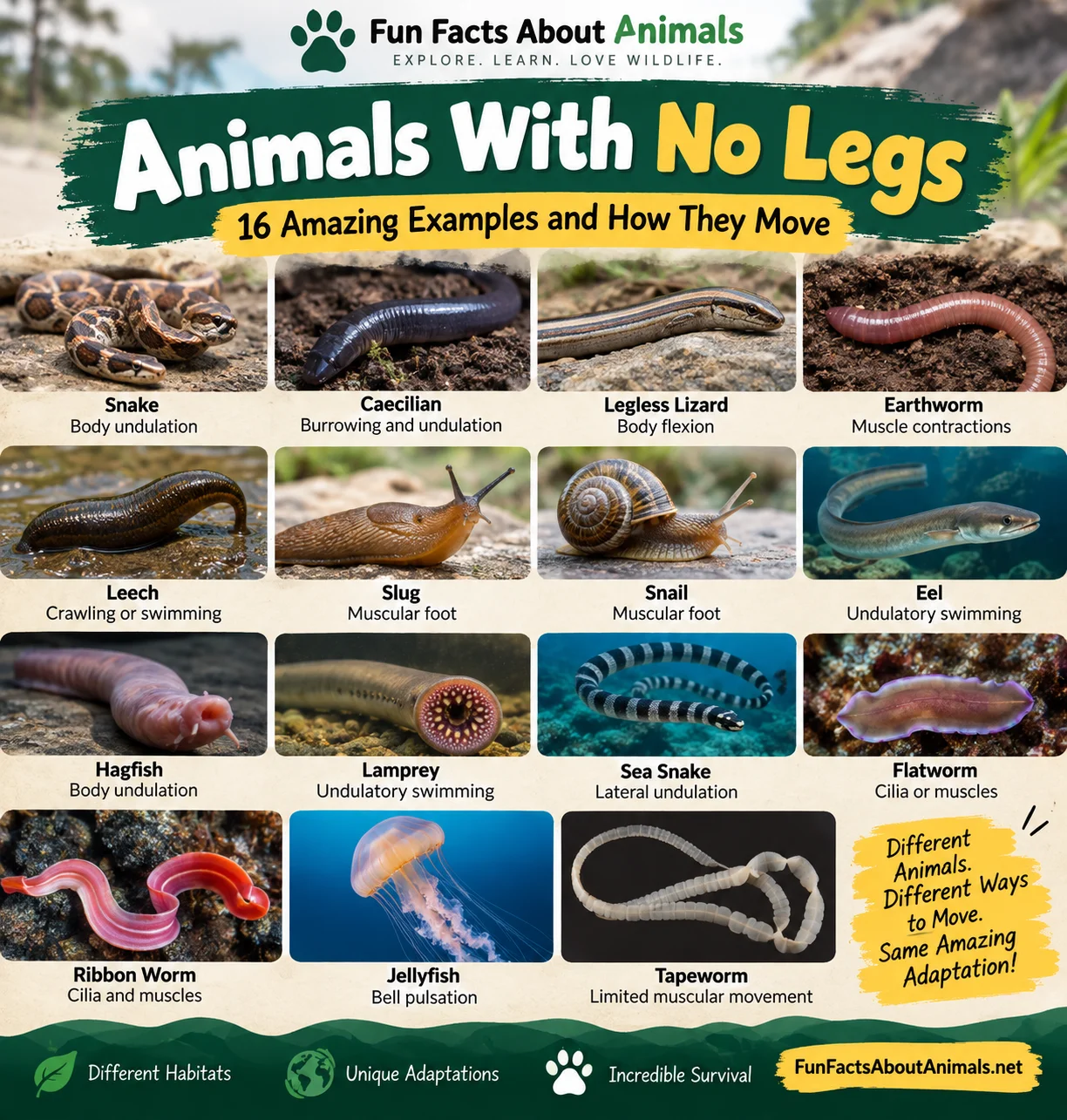
Animals with no legs are far more diverse than snakes. They include reptiles, amphibians, fish, molluscs, worms, and soft-bodied marine animals that move successfully without walking limbs. Some are truly limbless, while others have fins, muscular feet, or other structures instead of legs. Looking at how these animals move shows that no single “legless” body plan exists; different species have evolved different solutions for crawling, burrowing, swimming, and gliding.
Animals with no legs include snakes, caecilians, legless lizards, earthworms, leeches, slugs, eels, hagfish, lampreys, flatworms, and jellyfish. They move through body undulation, muscle contractions, burrowing, mucus-assisted gliding, or bell pulsation. Some, such as eels, have fins even though they lack legs.
What Does It Mean for an Animal to Have No Legs?
The phrase “animal with no legs” can describe very different body plans. Snakes and caecilians are limbless vertebrates, while many legless lizards belong to lineages in which limbs were lost or greatly reduced. Invertebrates such as earthworms and jellyfish come from entirely different evolutionary histories. It is also important not to confuse “no legs” with “no limbs.” Dolphins have no walking legs, but their front limbs are modified into flippers. Eels have no legs but do have fins. The clearest approach is to identify what structures each animal actually has rather than treating every long or smooth-bodied animal as anatomically identical.
Animals With No Legs at a Glance
| Animal | Group | Typical Habitat | Main Movement |
| Snake | Reptile | Land and water | Body undulation |
| Caecilian | Amphibian | Soil and freshwater | Burrowing and undulation |
| Legless lizard | Reptile | Mainly land | Body flexion |
| Glass lizard | Reptile | Grassland, scrub, woodland | Body undulation |
| Earthworm | Annelid | Soil | Muscle contractions |
| Leech | Annelid | Water and damp habitats | Crawling or swimming |
| Slug | Mollusk | Mainly land | Muscular foot |
| Snail | Mollusk | Land or water | Muscular foot |
| Eel | Fish | Freshwater and ocean | Undulatory swimming |
| Hagfish | Jawless fish | Marine | Body undulation |
| Lamprey | Jawless fish | Freshwater and ocean | Undulatory swimming |
| Sea snake | Reptile | Marine | Lateral undulation |
| Flatworm | Invertebrate | Water, moist habitats, hosts | Cilia or muscles |
| Ribbon worm | Invertebrate | Mostly marine | Cilia and muscles |
| Jellyfish | Cnidarian | Water | Bell pulsation |
| Tapeworm | Flatworm | Inside animal hosts | Limited muscular movement |
16 Animals With No Legs and How They Move
1. Snakes
Snakes are the best-known limbless reptiles. They coordinate muscles along the body and use belly scales to create traction against surfaces. Different species can use lateral undulation, concertina movement, sidewinding, and rectilinear locomotion depending on the terrain. Aquatic species modify these movements for swimming.
2. Caecilians
Caecilians are limbless amphibians, not worms or snakes. Most have elongated bodies suited to soil, leaf litter, or other concealed habitats, while some are aquatic. Their bodies move in muscular waves, and many burrow effectively. Despite their appearance, they are more closely related to frogs and salamanders than reptiles.
3. Legless Lizards
Several lizard lineages include species with greatly reduced limbs or no external limbs. The California legless lizard, for example, lacks limbs but remains a true lizard. Depending on the group, traits such as movable eyelids, external ear openings, or tail-shedding ability can help distinguish legless lizards from snakes.
4. Glass Lizards
Glass lizards are elongated lizards that often look like snakes. Species such as the eastern glass lizard lack forelegs and hind legs but retain lizard traits such as eyelids and external ear openings. Their long tails can break off when threatened, which gives them the name “glass lizard.”
5. Earthworms
Earthworms have no jointed legs, yet they move efficiently through soil. Their segmented bodies use circular and longitudinal muscles to lengthen and shorten body sections. Tiny bristles called setae help many species grip the soil while muscle contractions push them forward, making their flexible form well suited to burrowing.
6. Leeches
Leeches are segmented worms related to earthworms. Many have suckers at both ends of their bodies and use them as attachment points while moving in a looping pattern. Aquatic species may also swim by producing waves along the body. Not all leeches feed on blood; many are predators or use other feeding strategies.
7. Slugs
Slugs have no legs but move on a muscular foot along the underside of the body. Waves of muscular contraction pass across this surface while mucus reduces friction and helps the animal glide over leaves, soil, bark, and other surfaces. The method is slow but effective on uneven ground.
8. Snails
Snails use the same basic gastropod solution as slugs: a broad muscular foot rather than legs. Coordinated muscular waves move across the foot, usually assisted by mucus. Most familiar snails also carry an external shell, but their method of locomotion shows that paired walking limbs are not necessary for controlled movement.
9. Eels
Eels have long bodies and no legs, but they are fish rather than limbless reptiles. The American eel, for example, has pectoral fins and a long dorsal fin while pelvic fins are absent. Eels propel themselves mainly by passing waves along the body, creating their characteristic snake-like swimming motion.
10. Hagfish
Hagfish are elongated jawless marine fish that lack paired fins. Their flexible bodies support undulating movement, and they are also famous for tying themselves into knots. Knotting can help them respond to difficult situations and remove slime from the body, making them one of the more unusual examples on this list.
11. Lampreys
Lampreys are elongated jawless fish without paired fins. They swim by sending waves along the body rather than using legs or paired appendages for propulsion. Some species move between freshwater and the ocean during their life cycle, while others remain in freshwater. Their round, jawless mouths also make them easy to distinguish from eels.
12. Sea Snakes
Sea snakes are true snakes, so they are genuinely limbless reptiles rather than fish that merely lack legs. They swim by producing lateral waves along the body, and many have tails adapted for efficient movement through water. Their marine lifestyle shows how the snake body plan can function in a fully aquatic environment.
13. Flatworms
Flatworms are soft-bodied invertebrates without legs. The group includes both free-living and parasitic species. Small free-living flatworms may glide using tiny hair-like cilia together with muscular contractions, while parasitic species can have very different lifestyles. Their movement differs completely from that of snakes, despite the shared absence of legs.
14. Ribbon Worms
Ribbon worms, or nemerteans, are usually long, soft-bodied invertebrates, and many species are marine. They have no legs and often move using a combination of muscular contractions and ciliary action along the body surface. Their worm-like appearance can be misleading because ribbon worms belong to their own distinct animal phylum.
15. Jellyfish
Jellyfish have neither legs nor a rigid skeleton. Many move by rhythmically contracting the bell, pushing water backwards and propelling the animal forward, although currents also influence where they travel. Their locomotion is completely different from worm crawling or snake undulation and shows how broad the idea of a legless animal can be.
16. Tapeworms
Tapeworms are parasitic flatworms that live inside vertebrate hosts. They have no legs and do not need the active locomotion used by many free-living animals. Their bodies are specialized for attachment and nutrient absorption inside a host, showing that some animals can survive without legs because their lifestyle makes walking or swimming unnecessary.
How Do Animals Move Without Legs?
No single method of legless movement exists. Snakes, eels, lampreys, and other elongated animals generate waves along the body, although those waves interact differently with land and water. Snakes also use belly scales and several specialized locomotor patterns to gain traction on different surfaces.
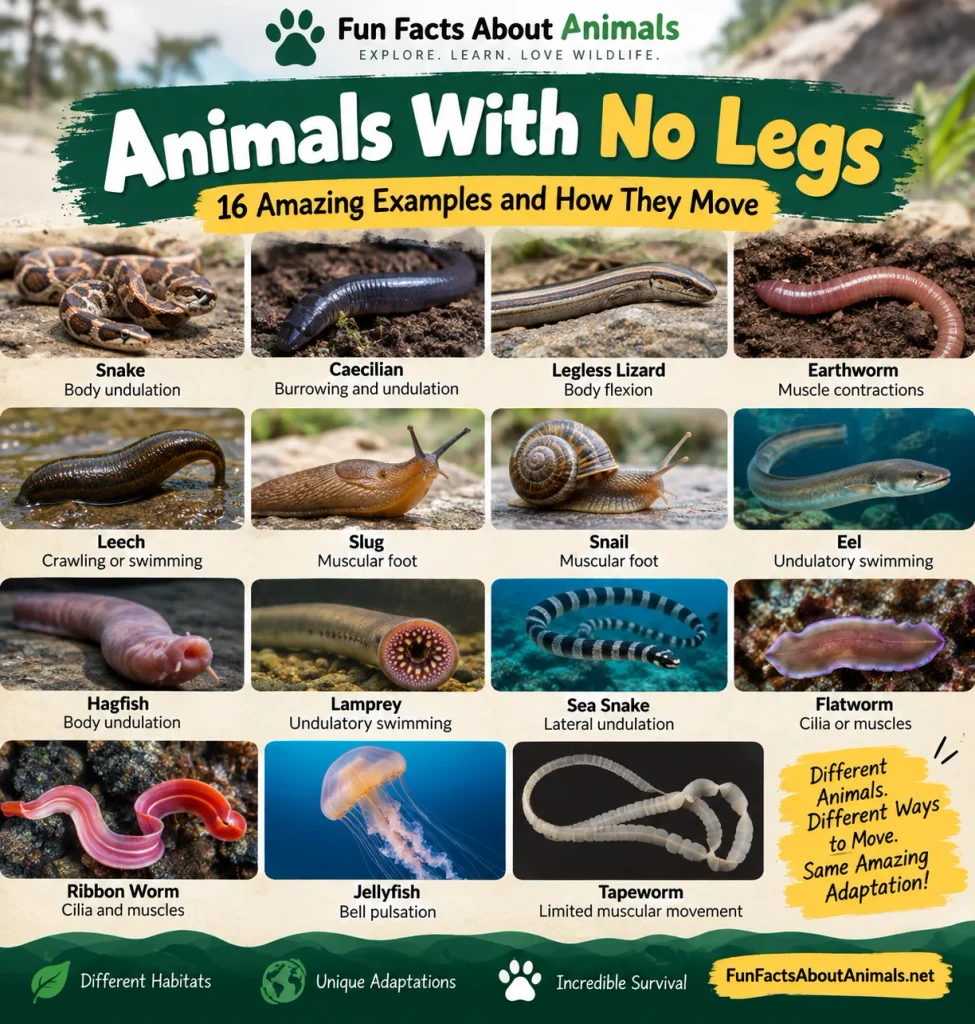
Earthworms rely on alternating muscle contractions and anchoring, while slugs and snails glide on a muscular foot. Burrowing animals such as caecilians use elongated bodies to move through soil. Jellyfish take another approach: coordinated bell contractions push water and provide propulsion. The shared feature is not anatomy but adaptation. Different animals use muscles, scales, cilia, mucus, fins, or pulsating body structures to generate movement without conventional walking legs.
Why Have Some Animals Evolved Without Legs?
Leglessness has appeared independently in multiple animal lineages, so no single explanation applies universally. In some reptiles, elongated bodies and limb reduction are linked to burrowing or moving through narrow spaces. Aquatic animals may rely more heavily on body waves or fins than on limbs suited to walking. Other examples never evolved vertebrate-style legs in the first place. Earthworms, molluscs, cnidarians, and many other invertebrates have body plans shaped by entirely different evolutionary histories. When we compare them, “no legs” is therefore a visible similarity, not evidence that every animal followed the same evolutionary path.
Are Whales and Dolphins Animals With No Legs?
Whales and dolphins are sometimes included in lists of animals without legs because they cannot walk and lack external hind legs. However, calling them completely limbless is misleading. Their forelimbs are modified into flippers, so animals with modified flippers still possess limbs in an anatomical sense. The same caution applies to seals, sea lions, and walruses. They may not have conventional walking legs like a dog or deer, but they possess modified limbs. It is more accurate to separate them from genuinely limbless vertebrates such as snakes and caecilians.
Frequently Asked Questions
What animals have no legs?
Examples include snakes, caecilians, legless lizards, earthworms, leeches, slugs, snails, eels, hagfish, lampreys, flatworms, ribbon worms, jellyfish, and tapeworms. They belong to very different biological groups, so the reason they lack walking legs differs in each case.
Are snakes the only animals without legs?
No. Caecilians are limbless amphibians, several lizard groups have lost their limbs, and many invertebrates, including worms, slugs, and jellyfish, also have no legs.
How do animals move without legs?
They use several methods. Snakes and eels move through body undulation, earthworms use coordinated muscle contractions, slugs and snails glide on a muscular foot, and jellyfish propel themselves by contracting their bells. Habitat and anatomy determine which movement method works best.
Are legless lizards actually lizards?
Yes. Legless lizards belong to lizard lineages even when visible limbs are absent. Features such as eyelids, ear openings, body structure, and tail anatomy distinguish many of them from snakes. Glass lizards, for example, can also shed part of the tail when threatened.
Are eels animals without legs?
Eels have no legs, so they fit the phrase’s everyday meaning. Anatomically, however, they are fish and possess fins. They should not be described as truly limbless in the same sense as a snake or caecilian.
Final Thoughts
Animals with no legs clearly show how differently species can adapt for movement and survival. Snakes rely on coordinated muscles and body scales, worms use contractions to move through soil, slugs glide on a muscular foot. In contrast, aquatic animals such as eels and jellyfish use entirely different forms of propulsion. These animals may share the visible trait of having no conventional legs, but biologically they belong to very different groups and did not all become legless for the same reason. Understanding those differences makes them far more interesting than simply seeing them as animals that crawl or swim without limbs.


One Comment