
Animals With Flippers: 20 Examples and How They Swim
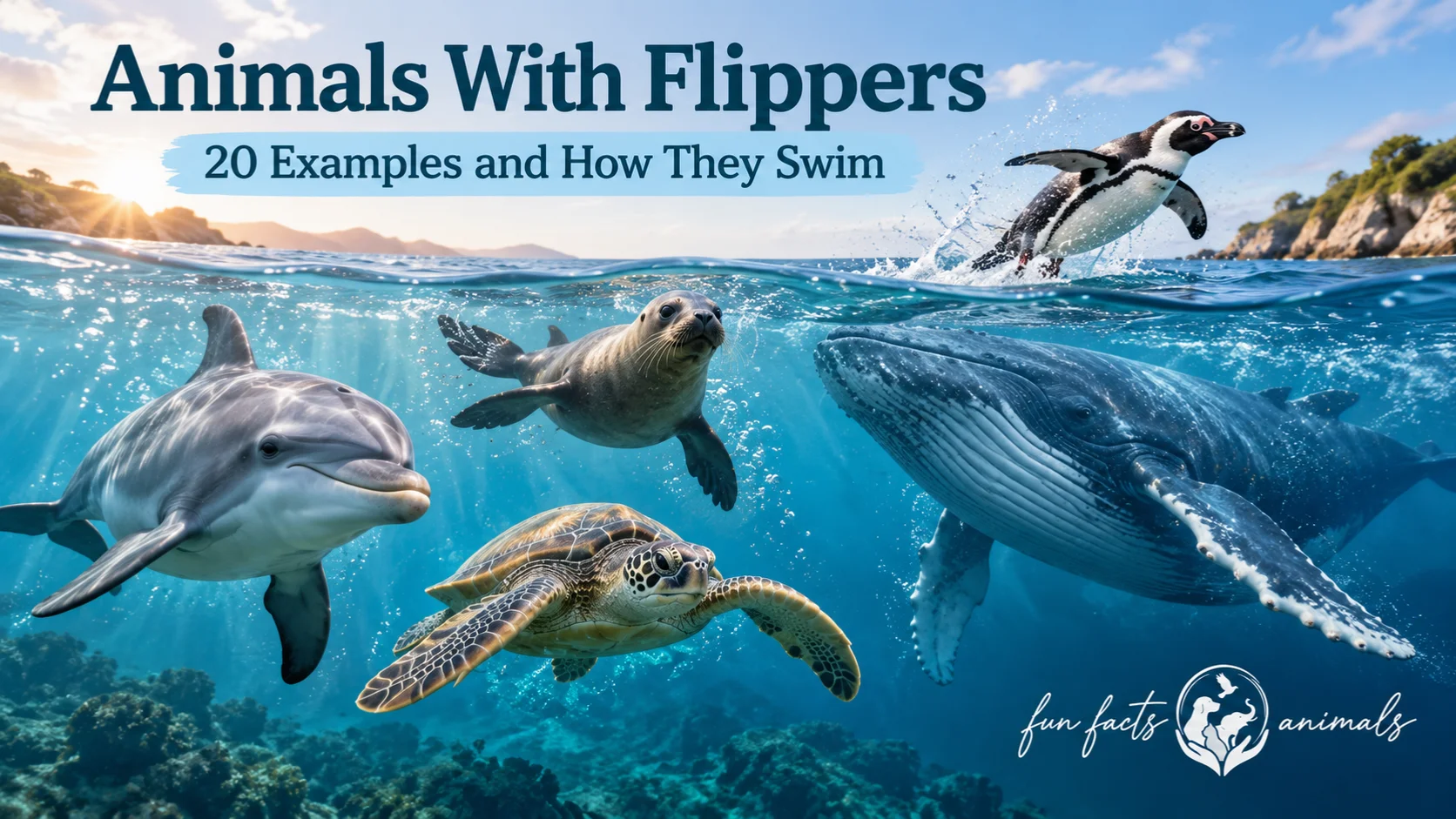
Animals with flippers include some of the most specialized swimmers in the animal world, from whales and dolphins to sea turtles, seals, and penguins. Although these animals come from very different groups, their flattened limbs help them move efficiently through water. Some use flippers mainly for propulsion, while others rely on them for steering, balance, or tight turns. Below are 20 animals with flippers, with a closer look at how each uses them while swimming.
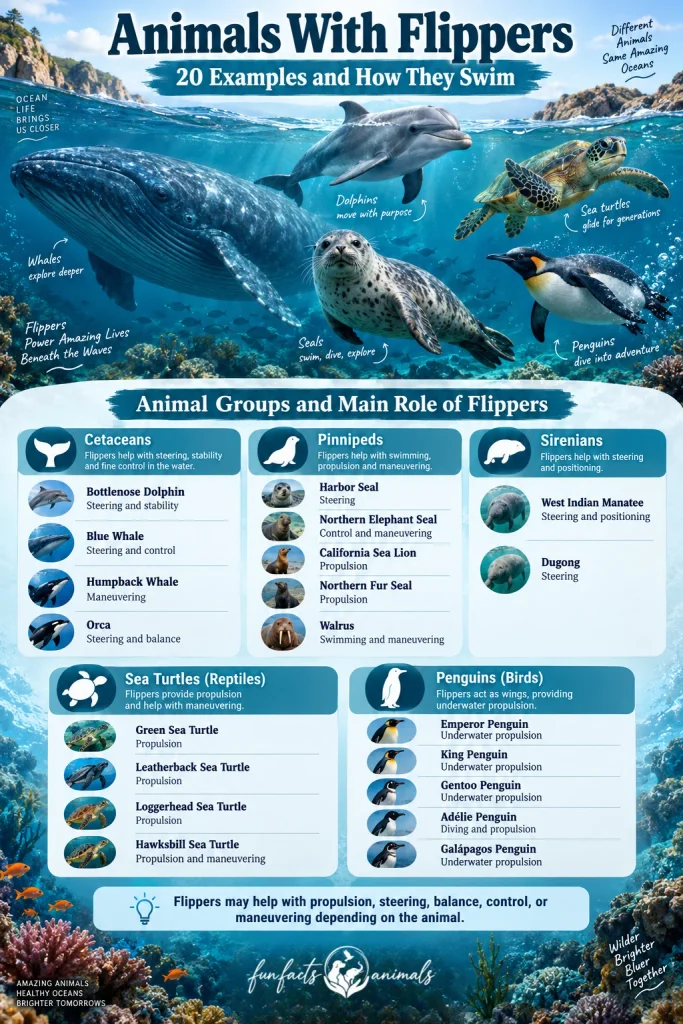
Animals with flippers include whales, dolphins, seals, sea lions, walruses, manatees, dugongs, sea turtles, and penguins. Flippers are flattened limbs adapted for movement in water. Depending on the animal, they may generate propulsion, control direction, maintain stability, or help the body manoeuvre efficiently underwater.
What Is a Flipper?
A flipper is a flattened limb adapted for aquatic movement. In many marine mammals, reptiles, and birds, these structures evolved from limbs that their ancestors once used differently on land or in the air. Not all flippers perform the same job. Sea lions and penguins generate much of their swimming power with their front flippers, while whales and dolphins rely mainly on their tail flukes for propulsion and use their pectoral flippers for steering. Sea turtles use two large front flippers for propulsion and smaller rear flippers to control direction.
20 Animals With Flippers
Here is a quick comparison of how different flipper-bearing animals move through water.
| Animal | Group | Main Role of Flippers |
| Bottlenose Dolphin | Cetacean | Steering and stability |
| Blue Whale | Cetacean | Steering and control |
| Humpback Whale | Cetacean | Maneuvering |
| Orca | Cetacean | Steering and balance |
| Harbor Seal | Pinniped | Steering |
| Northern Elephant Seal | Pinniped | Control and maneuvering |
| California Sea Lion | Pinniped | Propulsion |
| Northern Fur Seal | Pinniped | Propulsion |
| Walrus | Pinniped | Swimming and maneuvering |
| West Indian Manatee | Sirenian | Steering and positioning |
| Dugong | Sirenian | Steering |
| Green Sea Turtle | Reptile | Propulsion |
| Leatherback Sea Turtle | Reptile | Propulsion |
| Loggerhead Sea Turtle | Reptile | Propulsion |
| Hawksbill Sea Turtle | Reptile | Propulsion and maneuvering |
| Emperor Penguin | Bird | Underwater propulsion |
| King Penguin | Bird | Underwater propulsion |
| Gentoo Penguin | Bird | Underwater propulsion |
| Adélie Penguin | Bird | Diving and propulsion |
| Galápagos Penguin | Bird | Underwater propulsion |
1. Bottlenose Dolphin
The bottlenose dolphin (Tursiops truncatus) has a pair of pectoral flippers on the sides of its streamlined body. These help the dolphin steer, turn, and maintain stability. Most forward propulsion comes from powerful up-and-down movements of the tail flukes rather than from the flippers themselves.
2. Blue Whale
Blue whales (Balaenoptera musculus) have relatively narrow pectoral flippers that help control their enormous bodies underwater. Their tail flukes produce the main forward thrust, while the flippers assist with steering, balance, and changes in direction as these whales travel through the ocean.
3. Humpback Whale
The humpback whale (Megaptera novaeangliae) is especially noticeable for its unusually long pectoral flippers. They can provide considerable control and manoeuvrability despite the whale’s large body. Humpbacks can angle and rotate these flippers while swimming, turning, and performing complex underwater movements.
4. Orca
Orcas (Orcinus orca), also known as killer whales, are actually the largest members of the dolphin family. Their broad pectoral flippers help with steering, balance, and precise body control. Like other cetaceans, however, orcas generate most of their forward power with their muscular tail and flukes.
5. Harbor Seal
The harbor seal (Phoca vitulina) has four flippers, but the front and rear pairs perform different roles. Its relatively short foreflippers are useful for steering, while side-to-side movements of the hind flippers and rear body generate much of the thrust needed to swim.
6. Northern Elephant Seal
Northern elephant seals (Mirounga angustirostris) have short front flippers and powerful hindquarters adapted for life at sea. Like other true seals, they depend heavily on movement of the rear body and hind flippers for propulsion. Their foreflippers provide additional control during swimming and diving.
7. California Sea Lion
California sea lions (Zalophus californianus) swim very differently from true seals. Their long, strong front flippers generate much of their propulsion through broad sweeping strokes. Their flexible bodies and rear flippers, used for steering, also let sea lions make controlled turns while pursuing prey underwater.
8. Northern Fur Seal
Northern fur seals (Callorhinus ursinus) belong to the eared-seal family and have long foreflippers well suited to propulsion. They use these large front limbs to power themselves through the water. Their hind flippers can also rotate beneath the body, allowing them to move more effectively on land than true seals.
9. Walrus
Walruses (Odobenus rosmarus) have broad front and rear flippers that support movement both in water and on land. Their swimming mechanics differ from those of sea lions, with the hind portion of the body contributing substantially to movement. Their flexible rear flippers can also rotate forward when moving ashore.
10. West Indian Manatee
The West Indian manatee (Trichechus manatus) has two paddle-shaped foreflippers and a large rounded tail. The tail supplies most of the power for swimming, while the flippers help with steering and body positioning. Manatees can also use their flexible flippers when handling vegetation while feeding.
11. Dugong
Dugongs (Dugong dugon) are close relatives of manatees and also have paddle-like front flippers. The flippers help the animal steer and maintain its position as it moves through shallow coastal waters. Unlike a manatee’s rounded paddle tail, a dugong has a whale-like fluked tail used for propulsion.
12. Green Sea Turtle
Green sea turtles (Chelonia mydas) have two large front flippers that produce powerful swimming strokes. Their smaller rear flippers are used more like rudders for steering and control. This combination lets them travel efficiently through open water and manoeuvre around coastal feeding areas.
13. Leatherback Sea Turtle
The leatherback (Dermochelys coriacea) has exceptionally large front flippers suited to long-distance ocean travel. Strong, sweeping strokes generate propulsion while its streamlined body reduces resistance through the water. The rear flippers help steer as the turtle travels, dives, and changes direction.
14. Loggerhead Sea Turtle
Loggerhead sea turtles (Caretta caretta) use their large foreflippers to push themselves through the ocean. Alternating, coordinated strokes provide the power needed for swimming, while the smaller rear flippers help with direction and stability. These same rear flippers are also important to females when preparing nests on beaches.
15. Hawksbill Sea Turtle
Hawksbill sea turtles (Eretmochelys imbricata) have strong front flippers for propulsion and rear flippers for control. They are often associated with complex coral-reef environments, where effective manoeuvring helps them move around reef structures and search for food.
16. Emperor Penguin
The emperor penguin (Aptenodytes forsteri) cannot fly through the air, but its modified wings function as powerful flippers underwater. Penguins generate thrust during both parts of the flipper stroke, producing a swimming motion often described as underwater flight. Their feet also help with steering.
17. King Penguin
King penguins (Aptenodytes patagonicus) use stiff, wing-derived flippers to propel themselves during underwater dives. Strong muscles move the flippers through the dense water while the penguin’s streamlined body reduces drag. This swimming system allows them to travel and hunt efficiently below the surface.
18. Gentoo Penguin
Gentoo penguins (Pygoscelis papua) are agile underwater swimmers. Their flattened wings function as rigid flippers, creating thrust with repeated strokes rather than simply paddling backwards through the water. Their streamlined body, tail, and feet work together with the flippers to control underwater movement.
19. Adélie Penguin
The Adélie penguin (Pygoscelis adeliae) uses its short, powerful flippers for underwater propulsion while searching for food. Although the structure began as the wing of a flying ancestor, it has become specialized for swimming. The bird’s feet and tail contribute additional control during turns and dives.
20. Galápagos Penguin
Galápagos penguins (Spheniscus mendiculus) show that flipper-equipped penguins are not restricted to icy Antarctic environments. Their stiff wings act as underwater flippers and supply the thrust needed to chase prey. This species lives around the Galápagos Islands, close to the equator.
How Do Animals Use Their Flippers?
Flippers can perform several different jobs depending on the animal’s swimming style. Sea lions, sea turtles, and penguins use their front flippers as major sources of propulsion, pushing against the water to move forward. Whales and dolphins use a different system. Their tail flukes provide most of the thrust, while the pectoral flippers act mainly as control surfaces for steering and stability. True seals depend heavily on their hind flippers and rear-body movement, while their foreflippers help direct them. These differences show why simply having flippers does not mean two animals swim in the same way.
Flippers vs Fins: What Is the Difference?
The words flipper and fin are sometimes used inconsistently, especially when describing whales and dolphins. Their pectoral appendages may be called either pectoral flippers or pectoral fins, but anatomically they are modified forelimbs containing limb bones inherited from land-dwelling ancestors. Fish fins have a different evolutionary and skeletal structure. Sharks, for example, have pectoral fins rather than flippers. Cetaceans also have a dorsal fin on the back and tail flukes at the rear, neither of which is a modified limb. So the safest distinction is that a flipper usually refers to a limb that has become flattened and specialized for aquatic movement.
Why Did So Many Animals Develop Flippers?
Water demands different movement than land or air. A broad, flattened limb can create thrust, lift, or directional control while reducing unnecessary resistance. Flipper-like structures evolved independently in several groups, including marine mammals, sea turtles, and penguins. This is an example of convergent evolution: unrelated animals face similar environmental challenges and independently develop similar functional adaptations. Their anatomy is not identical, but the overall flipper shape provides an effective way to move through water.
Frequently Asked Questions
What animals have flippers?
Whales, dolphins, seals, sea lions, walruses, manatees, dugongs, sea turtles, and penguins are common examples of animals with flippers. They belong to very different groups, including mammals, reptiles, and birds, and the exact function of their flippers varies.
Do dolphins have fins or flippers?
Dolphins have both structures described using different terms. Their paired pectoral appendages are modified forelimbs and are commonly called pectoral flippers or pectoral fins. They also have a dorsal fin on the back. Their tail ends in two horizontal flukes that provide most of the propulsion.
Do penguins have flippers?
Yes. Penguin wings are highly modified for underwater swimming and are commonly called flippers. Unlike the flexible wings of flying birds, penguin flippers are comparatively stiff and flattened. They generate thrust on both the upstroke and downstroke as the bird moves through the water.
What animals have four flippers?
Sea turtles, true seals, sea lions, fur seals, and walruses have four flipper-like limbs. However, the four limbs do not necessarily perform the same function. Sea turtles mainly use their larger front flippers for propulsion, while true seals rely heavily on their hind flippers to generate thrust.
Are flippers and webbed feet the same?
No. Webbed feet usually retain clearly separated toes joined by skin, allowing the foot to create a larger surface for paddling. A flipper is generally a more extensively modified, flattened limb specialized for aquatic movement. Ducks have webbed feet, while sea turtles and seals have flippers.
Final Thoughts
Animals with flippers come from several very different groups, including mammals, reptiles, and birds, yet all have developed specialized limbs that move water more efficiently. Dolphins and whales mainly use their flippers for steering, while sea lions, sea turtles, and penguins depend on them much more for propulsion. These differences show that a flipper is not simply a paddle-like body part. Its shape and function reflect how each animal has adapted to swim, dive, hunt, and control its body underwater.





4 Comments