
Animals Like Raccoons: 15 Relatives and Lookalikes
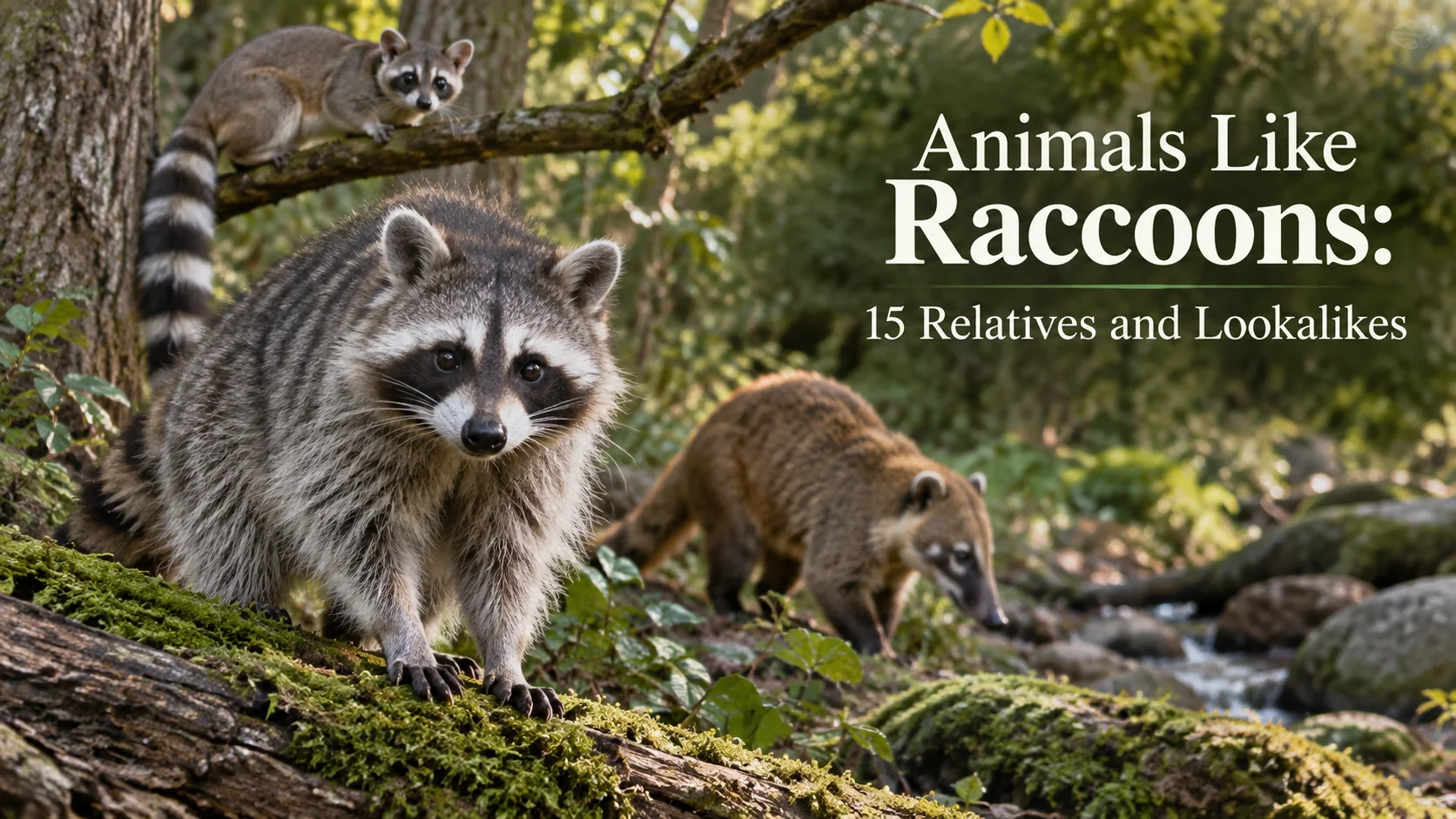
Raccoons are easy to recognize by their dark facial masks, ringed tails, dexterous front paws, and curious foraging habits. Yet several animals around the world share at least some of these traits. Some are genuine members of the raccoon family, while others simply look similar or behave in comparable ways. These 15 animals like raccoons show why appearance, behavior, and biological relationship are not always the same thing.
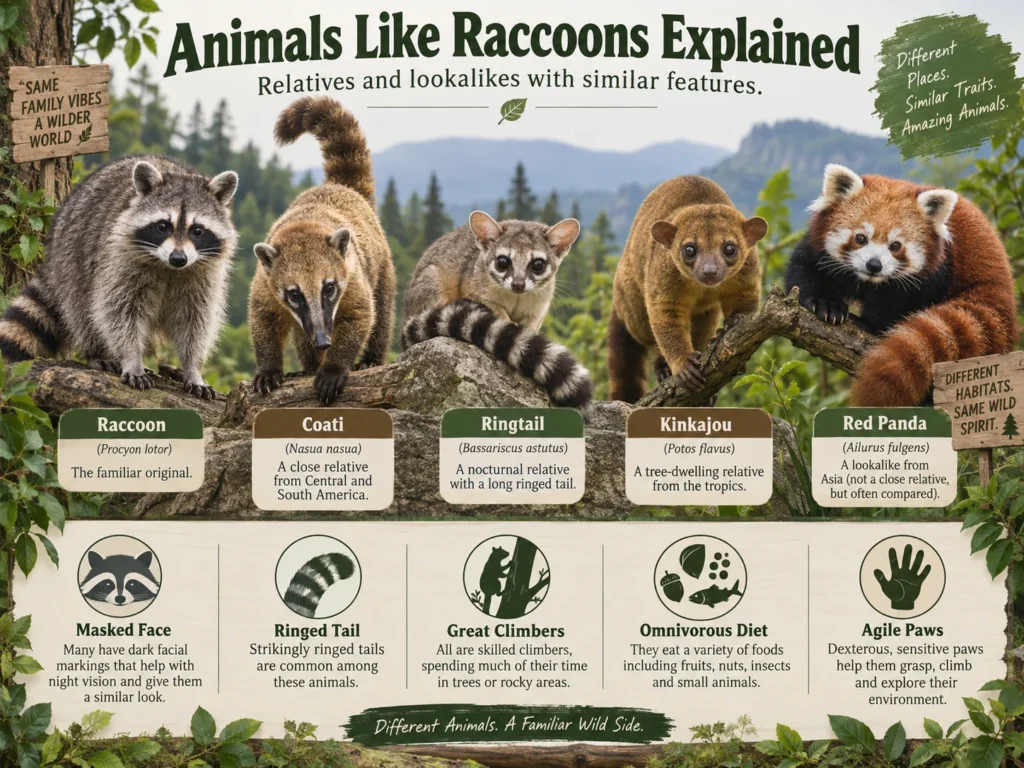
Animals like raccoons include true relatives such as coatis, ringtails, kinkajous, olingos, and crab-eating raccoons, along with unrelated lookalikes such as raccoon dogs and red pandas. Other mammals resemble raccoons mainly through nocturnal activity, climbing, omnivory, or opportunistic feeding. Similar appearance does not necessarily indicate close ancestry.
What Makes an Animal Raccoon-Like?
The common raccoon, Procyon lotor, combines several memorable traits. It has a stocky medium-sized body, a dark mask around the eyes, a ringed tail, highly sensitive front paws, strong climbing ability, and a broad omnivorous diet. Raccoons are also often active at night and readily exploit whatever food resources are available. An animal can therefore seem raccoon-like in several different ways.
A true relative belongs to the same family, Procyonidae. A lookalike may share a facial mask, ringed tail, or similar body shape while belonging to a completely different family. A behavioral match may resemble a raccoon mainly through climbing, opportunistic feeding, or nocturnal activity. Two animals can look remarkably similar without being close relatives, and close relatives can sometimes look surprisingly different.
Quick Comparison of 15 Animals Like Raccoons
| Animal | Main Similarity | True Raccoon Relative? |
| Coati | Tail, climbing, omnivory | Yes |
| Ringtail | Ringed tail, nocturnal climbing | Yes |
| Cacomistle | Tail and arboreal lifestyle | Yes |
| Kinkajou | Tree-dwelling habits | Yes |
| Northern olingo | Nocturnal, arboreal behavior | Yes |
| Olinguito | Taxonomy and tree-dwelling lifestyle | Yes |
| Crab-eating raccoon | Appearance and same genus | Yes |
| Raccoon dog | Facial mask | No |
| Red panda | Ringed tail and facial pattern | No |
| Asian palm civet | Nocturnal climbing and foraging | No |
| Virginia opossum | Opportunistic nighttime lifestyle | No |
| Striped skunk | Omnivory and nocturnal activity | No |
| European badger | Facial markings and stocky build | No |
| Ring-tailed lemur | Boldly ringed tail | No |
| Gray fox | Climbing and omnivory | No |
True Raccoon Relatives
The first seven animals genuinely belong to Procyonidae, the raccoon family. Some look very similar to common raccoons, while others demonstrate that being closely related does not always produce the same appearance.
1. Coati — The Long-Nosed Raccoon Relative
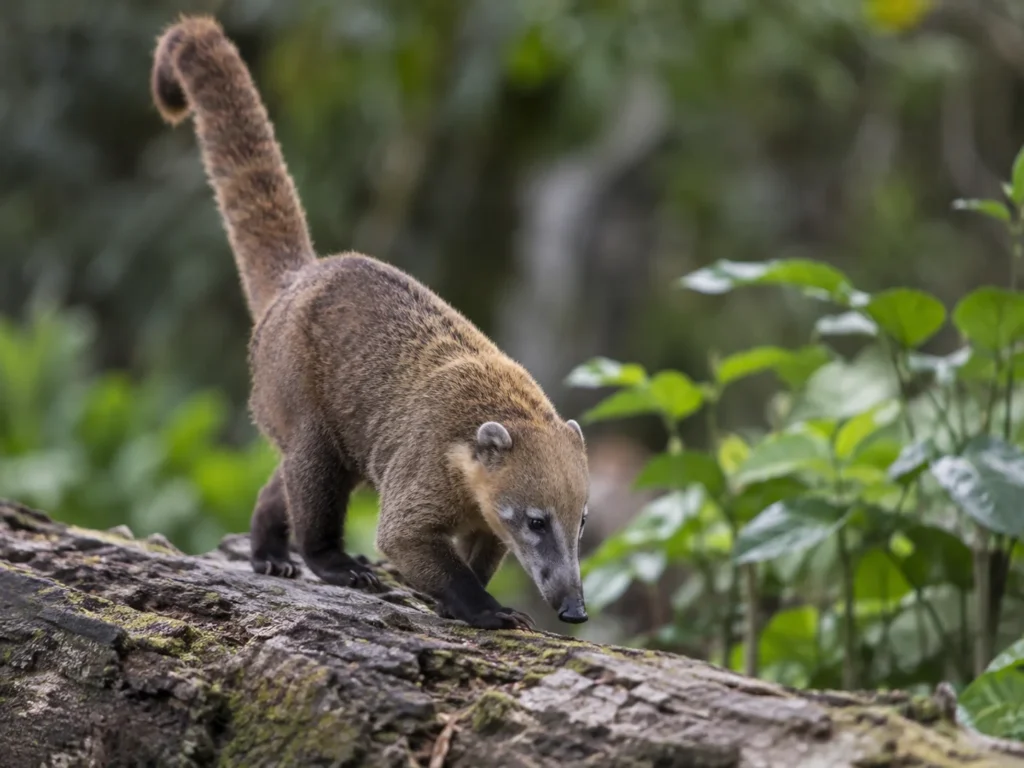
Coatis are among the most recognizable raccoon relatives. Like raccoons, they are capable climbers, have long tails, and eat a flexible omnivorous diet. Their body plan also has a familiar procyonid appearance. The easiest difference is the face. A coati has a much longer, highly mobile snout that it uses while searching through soil, leaf litter, and vegetation for food. Coatis also tend to look more elongated than the stockier common raccoon.
2. Ringtail — A Relative With an Even Bolder Tail
Ringtails have one of the clearest visual similarities to raccoons: a long tail covered in striking dark and pale bands. They are mainly nocturnal, agile climbers, and genuine members of the raccoon family. Their bodies, however, are much slimmer and more cat-like than a raccoon’s. The animal is sometimes called a “ringtail cat,” but that nickname is misleading because ringtails are not cats. Their taxonomy places them alongside raccoons and other procyonids.
3. Cacomistle — The Slender Forest Relative
The cacomistle is closely related to the ringtail and also belongs to Procyonidae. It has a long, banded tail, large eyes, and a narrow body well suited to moving through forest vegetation and trees. Compared with a common raccoon, a cacomistle looks much lighter and more elongated. It is also strongly associated with forest habitats from Mexico into Central America. Its appearance may seem more weasel-like or cat-like at first glance, but biologically it is a true raccoon relative.
4. Kinkajou — Related Despite Looking Very Different
A kinkajou may not be the first animal that comes to mind when thinking about raccoons. It has a rounded face, golden-brown fur, and a long prehensile tail that can grip branches while it moves through tropical forest canopies. Taxonomically, however, it belongs to Procyonidae. Kinkajous are strongly arboreal and mostly active at night, creating some behavioral overlap with raccoons. Their unusual prehensile tail and more specialized tree-dwelling lifestyle make them look quite different despite the genuine family connection.
5. Northern Olingo — A Tree-Dwelling Raccoon Relative
Northern olingos are another tropical member of the raccoon family. They have long tails, relatively narrow bodies, and spend much of their time in trees within Central and northern South American forests. Like several other procyonids, they are largely nocturnal. Their appearance is less obviously raccoon-like because they lack the common raccoon’s bold dark eye mask and stockier proportions. Still, taxonomy places them firmly within the same family, making them true relatives rather than superficial lookalikes.
6. Olinguito — The Small Cloud-Forest Relative
The olinguito is a small procyonid native to high-elevation cloud forests of Colombia and Ecuador. Its thick fur, compact face, and tree-dwelling lifestyle can make it look more like a small teddy bear than a typical raccoon. Despite that appearance, it belongs to the same family as raccoons, coatis, kinkajous, and olingos. The olinguito is a useful reminder that biological relationship is determined by evolutionary history and taxonomy, not simply by whether two animals have matching facial markings.
7. Crab-Eating Raccoon — The Closest Match
The crab-eating raccoon is one of the closest comparisons to the common raccoon because both belong to the genus Procyon. It has the familiar masked face, banded tail, flexible forefeet, and overall raccoon-like body shape. It is a separate species, however, and occurs mainly in Central and South America. Despite its name, it does not eat only crabs; it has a broader omnivorous diet. Among the animals on this list, this species provides one of the strongest combinations of visual and taxonomic similarity.
Raccoon Lookalikes That Are Not Close Relatives
The remaining animals either resemble raccoons physically or share parts of their lifestyle, but they do not belong to Procyonidae.
8. Raccoon Dog — A Raccoon Face on a Canid
The raccoon dog is probably one of the most confusingly named animals on this list. Its dark facial markings and thick fur create a distinctly raccoon-like appearance, especially when seen from the front. Despite the name, it belongs to Canidae, the dog family. It is therefore a true canid rather than a raccoon relative. Raccoon dogs are also opportunistic feeders, which adds some behavioral similarity, but the resemblance is mainly superficial rather than evidence of close ancestry.
9. Red Panda — The Ring-Tailed Lookalike
Red pandas share several visual features with raccoons, including a bushy ringed tail, contrasting facial markings, and strong climbing ability. These similarities once contributed to uncertainty about how red pandas should be classified. Modern taxonomy places the red panda in its own family, Ailuridae, rather than Procyonidae. Red pandas also have a much more specialized diet and lifestyle than common raccoons. Their similarity is therefore interesting historically and visually, but they are not simply Asian raccoons.
10. Asian Palm Civet — Similar Lifestyle, Different Family
Asian palm civets can resemble raccoons more through behavior than direct appearance. They are frequently active at night, climb well, eat a varied diet, and can live in forests, agricultural landscapes, and some human-modified environments. Their bodies are generally longer and more slender than those of raccoons, and they belong to a different carnivoran family. The comparison works best ecologically: both animals can be flexible, opportunistic foragers that take advantage of a wide range of available resources.
11. Virginia Opossum — The Nighttime Opportunist
Virginia opossums and raccoons frequently occupy similar North American environments, especially woodlands, suburban areas, gardens, and places where human food or refuse is available. Both are commonly active at night and have flexible diets. The resemblance ends quickly at taxonomy. Opossums are marsupials, meaning they belong to an entirely different branch of mammalian evolution. Their long, nearly hairless tails and pointed faces also make them visually distinct once seen clearly.
12. Striped Skunk — Another Nocturnal Omnivore
Striped skunks share several ecological traits with raccoons. They are often nocturnal, consume both plant and animal foods, and can adapt well to rural, suburban, and other human-modified environments. Visually, however, the bold black-and-white coat and large bushy tail make a striped skunk easy to distinguish. Its famous scent-based defense is another major difference. The similarity is therefore mostly about feeding habits, activity patterns, and habitat overlap rather than close appearance or relationship.
13. European Badger — A Familiar Facial Lookalike
European badgers provide an especially useful comparison for UK readers. They have sturdy bodies, strong black-and-white facial markings, nocturnal tendencies, and broad omnivorous diets. Their facial pattern differs noticeably from a raccoon’s mask. Instead of a dark band concentrated around the eyes, European badgers have long dark stripes running along the sides of the head. They also belong to Mustelidae, the weasel family, so their similarity to raccoons is primarily visual and ecological.
14. Ring-Tailed Lemur — Similar Tail, Very Different Animal
Few animals have a tail as boldly patterned as the ring-tailed lemur. Its alternating black-and-white bands immediately invite comparison with a raccoon’s ringed tail. Beyond that feature, however, the animals are extremely different. Ring-tailed lemurs are primates native to Madagascar and have their own distinctive social behavior, anatomy, and ecology. They are not raccoon relatives. Their inclusion shows why one striking visual feature, such as a ringed tail, tells us very little about evolutionary relationship.
15. Gray Fox — The Climbing Canid
Gray foxes resemble raccoons mainly through behavior and ecological flexibility. They are omnivorous, eat both animal and plant foods, can live in woodland and human-modified environments, and are unusually capable climbers for members of the dog family. They may even climb trees to rest, escape danger, or search for food. Unlike raccoons, however, gray foxes have the unmistakable body shape and muzzle of a fox. They belong to Canidae and are not members of the raccoon family.
Which Animals Are Actually Closest to Raccoons?
The animals most closely related to common raccoons are other members of Procyonidae. These include coatis, ringtails, cacomistles, kinkajous, olingos, and olinguitos. The crab-eating raccoon is an especially close comparison because it belongs to the same genus, Procyon, as the common raccoon. That makes its similarity much more than superficial. Raccoon dogs, red pandas, civets, opossums, skunks, badgers, lemurs, and gray foxes may share certain traits, but they belong to other families or even entirely different branches of mammalian evolution. Looking alike does not automatically mean being closely related.
Why Do Unrelated Animals Sometimes Look Like Raccoons?
Nature often produces similar-looking features in unrelated animals. Ringed tails, dark facial markings, bushy fur, climbing ability, and nocturnal activity are not unique to raccoons. Different animals may independently benefit from similar ecological strategies. A civet and raccoon can both become skilled nighttime foragers without being close relatives. A lemur can have a ringed tail even though it belongs to the primate lineage. This is why appearance should be treated as only one part of a comparison. Taxonomy, anatomy, behavior, and evolutionary history provide a much clearer picture of how two species are actually connected.
Key Takeaways
- True raccoon relatives belong to the family Procyonidae.
- Coatis, ringtails, cacomistles, kinkajous, olingos, and olinguitos are genuine raccoon-family animals.
- The crab-eating raccoon is especially close because it shares the genus Procyon with the common raccoon.
- Raccoon dogs are canids despite their raccoon-like faces.
- Red pandas, badgers, lemurs, civets, opossums, skunks, and foxes are not close raccoon relatives.
Frequently Asked Questions
What Animal Is Most Closely Related to a Raccoon?
Other species in Procyonidae are the raccoon’s genuine relatives. The crab-eating raccoon is particularly close because it belongs to the same genus, Procyon. Coatis, ringtails, cacomistles, kinkajous, olingos, and olinguitos are also true members of the broader raccoon family.
Is a Coati Related to a Raccoon?
Yes. Coatis and raccoons both belong to Procyonidae. They share traits such as climbing ability, flexible diets, and long tails, although coatis have much longer, more mobile snouts and generally more elongated bodies.
Is a Raccoon Dog Actually a Raccoon?
No. The raccoon dog belongs to Canidae, the dog family. Its name comes from its raccoon-like facial pattern rather than a close biological relationship. It is therefore more closely related to other canids than to common raccoons.
Are Red Pandas Related to Raccoons?
Red pandas were historically compared with and sometimes grouped near raccoons because of similarities such as their ringed tails and facial features. Modern taxonomy places red pandas in their own family, Ailuridae. They are therefore not members of the raccoon family.
What Animals Look Most Like Raccoons?
The crab-eating raccoon is one of the closest overall matches because it is both visually similar and closely related. Raccoon dogs have particularly raccoon-like faces, while ringtails share strongly banded tails. Red pandas, coatis, and some civets can also remind people of raccoons for different reasons.
Final Thoughts
Animals like raccoons range from genuine relatives such as coatis and kinkajous to unrelated lookalikes such as raccoon dogs and red pandas. The most useful comparison is not simply how similar two animals look, but whether they share ancestry, behavior, or only a few visual features such as a mask or ringed tail.
One Comment