Animals With Long Tails: 15 Species and How They Use Them
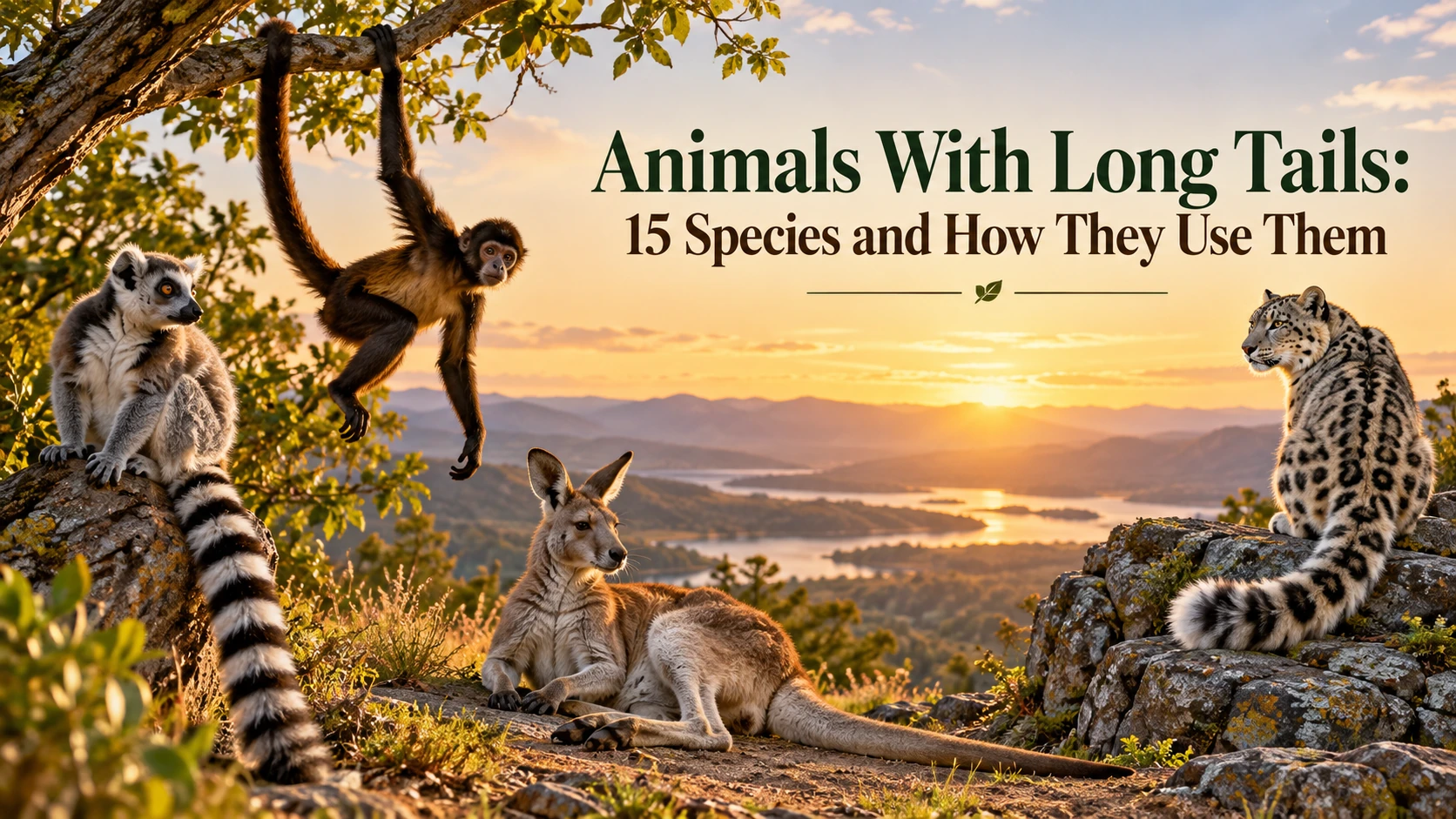
Animals with long tails range from tiny desert rodents and tree-dwelling primates to giraffes, reptiles, birds, sharks, and rays. A tail may be considered long because of its actual measurement or because it greatly exceeds the animal’s body length. These impressive structures are not simply decorative. Depending on the species, a long tail may provide balance, improve movement, grip branches, attract mates, communicate with companions, provide insulation, defend against threats, or even help capture prey.
Animals with long tails include giraffes, grass lizards, spider monkeys, ring-tailed lemurs, snow leopards, cheetahs, widowbirds, ribbon-tailed astrapias, thresher sharks, and whiprays. Some have remarkable absolute tail lengths, while others have extreme tail-to-body proportions or specialized tails used for grasping, balancing, courtship, defense, communication, or hunting.
What Makes an Animal’s Tail “Long”?
There is no single perfect way to decide which animal has the longest tail. Actual Animal with log tails length is one measure, but proportion is another. A giraffe can have an exceptionally long tail in absolute terms, while a small grass lizard may have a tail more than three times as long as its body. Anatomy also complicates comparisons. The spectacular tails of many birds consist largely of elongated feathers, whereas mammals and reptiles have muscular, vertebrate tails. Sharks have caudal fins, and rays may have extremely slender whip-like tails. A useful comparison therefore considers absolute length, body proportion, anatomy, and function rather than forcing every species into one ranking.
Animals With Exceptionally Long Tails
1. Giraffe
Giraffes have exceptionally long tails, reaching about 8 feet (2.4 meters) in some individuals and giving them the longest reported tails among land mammals. A dark tuft of hair extends from the end. Rather than gripping or balancing with it, giraffes primarily use this sweeping tail to help drive flies and other irritating insects away.
2. Long-Tailed Grass Lizard
The long-tailed grass lizard is tiny compared with a giraffe, but its proportions are even more extreme. Its tail can grow to more than three times its body length. This makes the lizard a standout example when tails are compared relative to body size rather than by absolute measurements alone.
3. Long-Eared Jerboa
Long-eared jerboas are small desert rodents with bodies only about 7 to 9 centimeters long, yet their tails commonly reach around 15 to 16 centimeters. Their extraordinary tail-to-body ratio accompanies a body designed for bipedal hopping, where a long tail can contribute to balance and control as the animal moves rapidly across open ground.
Primates With Long Tails
4. Spider Monkey
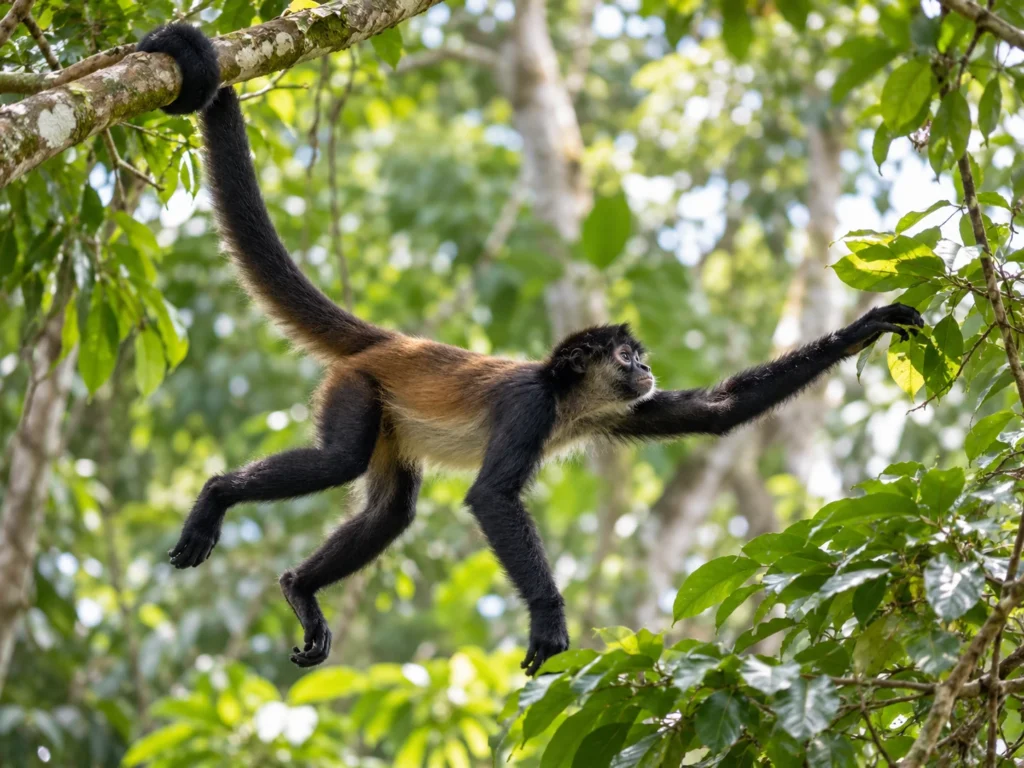
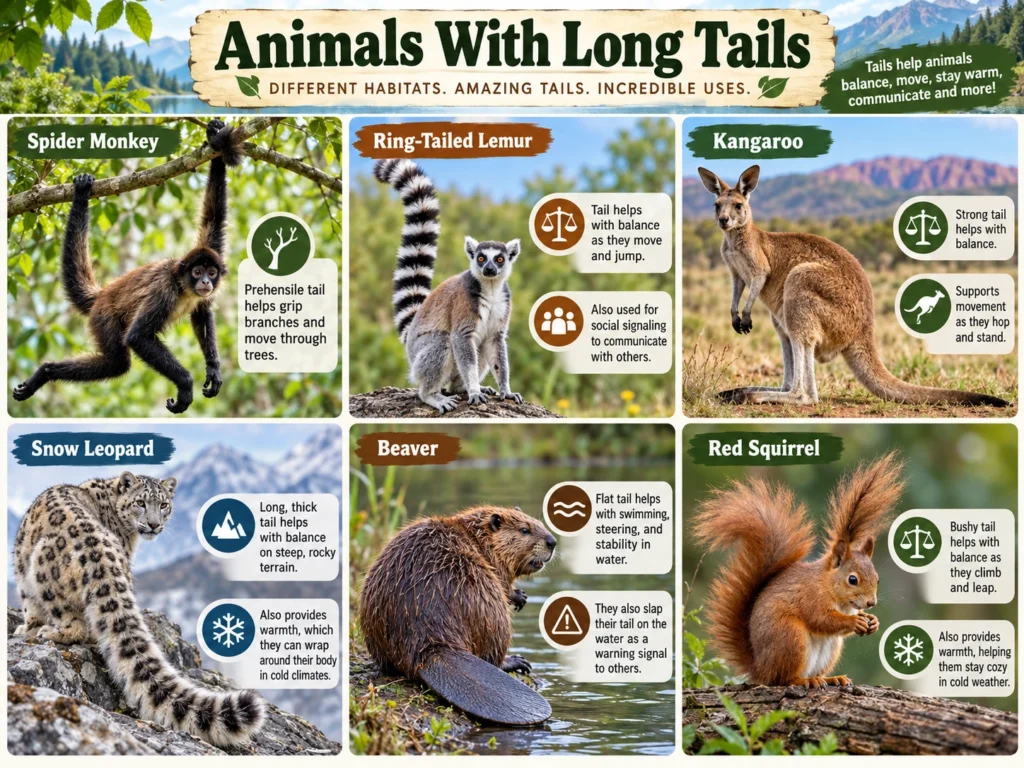
Spider monkeys have long prehensile tails capable of wrapping securely around branches. In several species, the tail is longer than the head and body combined. Specialized gripping skin near the tip improves contact with branches, allowing the tail to support climbing, suspension, and feeding while the hands remain available for other movements.
5. Howler Monkey
Howler monkeys also possess prehensile tails adapted for life high in Central and South American forests. The underside near the end of the tail is hairless and provides a better gripping surface. Howlers rely heavily on this fifth point of contact while moving slowly among branches and positioning themselves securely while feeding.
6. Ring-Tailed Lemur
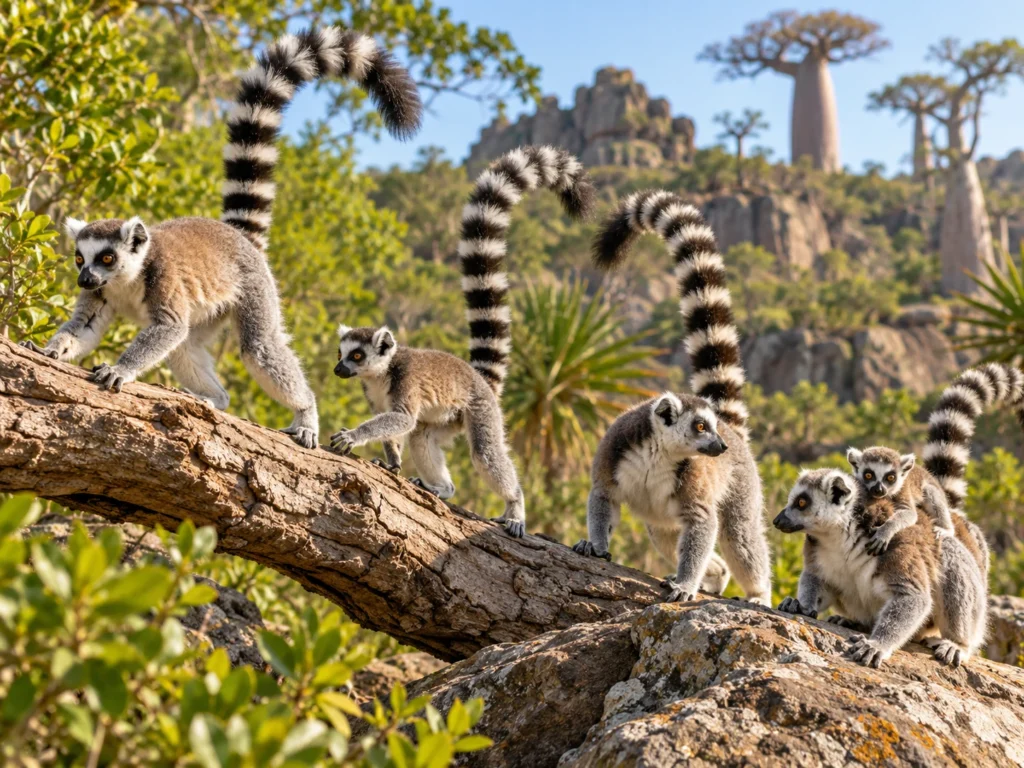
Ring-tailed lemurs have striking tails measuring up to about 2 feet (61 centimeters), decorated with 13 alternating black-and-white bands. Their tails are not prehensile, so they cannot grip branches like spider monkeys. Instead, ring-tailed lemurs often raise their tails while traveling, making them useful visual signals that help group members stay together.
Predators With Long Tails
7. Snow Leopard
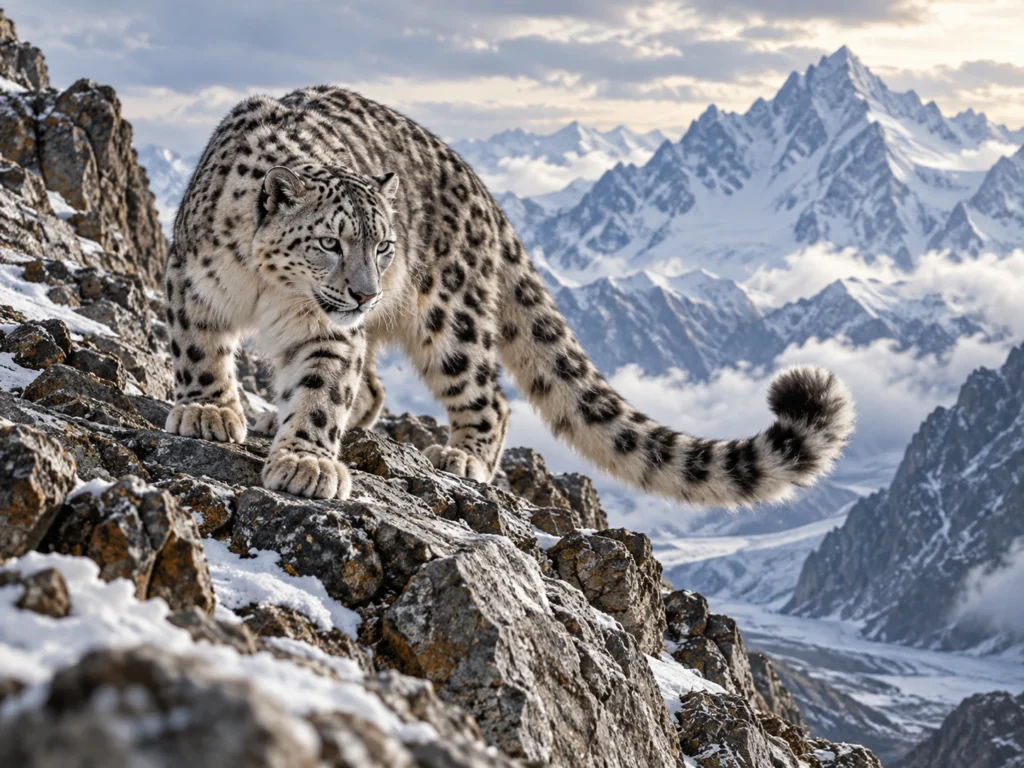
A snow leopard carries an unusually long, thick tail that can approach 1 meter in length and may nearly match the cat’s body. It functions as a counterbalance while the animal jumps and travels across steep mountain terrain. Its dense fur provides another advantage: the leopard can wrap the tail around its face and body for warmth.
8. Cheetah
Cheetahs rely on their long tails during explosive high-speed pursuits. As a cheetah makes a sharp turn, its tail helps counteract body movement and maintain stability. It is often compared with a rudder, although the tail works together with the cat’s flexible spine, limbs, claws, and rapid changes in body position.
Birds With Long Tail Feathers
9. Long-Tailed Widowbird
Male long-tailed widowbirds develop extraordinary tail feathers during the breeding season. These feathers are a famous example of sexual selection. Experiments have shown that males given artificially lengthened tails achieved greater mating success, providing strong evidence that female preferences helped drive the evolution and maintenance of this exaggerated ornament.
10. Ribbon-Tailed Astrapia
Male ribbon-tailed astrapias carry two spectacular white tail feathers that can reach about 3 feet long—roughly three times the bird’s body length. These feathers can interfere with flying and foraging, but their value lies in courtship. Their extraordinary development reflects sexual selection rather than an obvious survival advantage.
11. Fork-Tailed Flycatcher
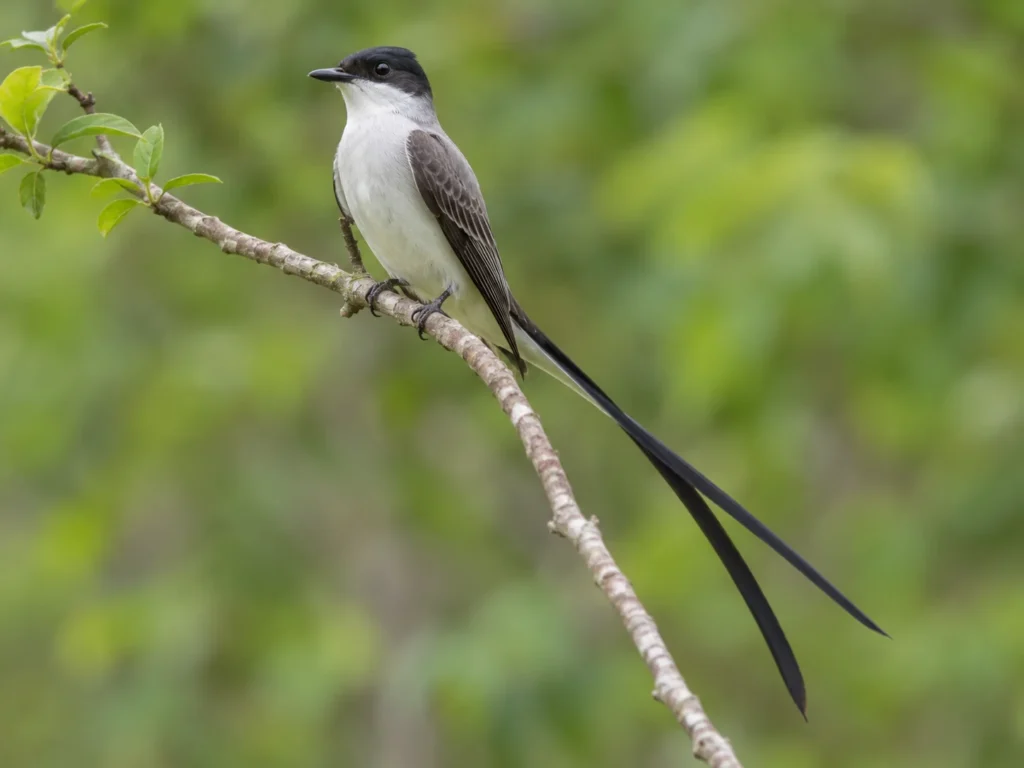
The fork-tailed flycatcher earns its name from its deeply divided, elongated tail. Adult males are noticeably longer than females because their outer tail feathers grow especially long, producing an unmistakable silhouette in flight. The species demonstrates how elongated feathers can dramatically increase a bird’s apparent total length without increasing body size.
Reptiles With Long Tails
12. Common Basilisk
The common Animal with long tail basilisk has a tail that typically accounts for about 70 to 75 percent of its total length. Adults may approach 80 centimeters overall, meaning much of that measurement is tail. The elongated structure contributes to balance during movement and complements the basilisk’s long hind limbs, climbing ability, and rapid terrestrial locomotion.
13. Eastern Glass Lizard
Despite its snake-like appearance, the eastern glass lizard is a legless lizard with an exceptionally long tail. In individuals with complete tails, it may account for roughly two-thirds of total length and can be about twice the body length. The animal can also shed part of its tail as a defensive response when threatened.
Aquatic Animals With Remarkably Long Tails
14. Thresher Shark
The thresher shark has one of the ocean’s most distinctive tails. The upper lobe of its caudal fin can be almost as long as the rest of the shark. More importantly, this elongated structure is an active hunting tool: thresher sharks use powerful tail strikes to stun or disable schooling fish before feeding.
15. Reticulate Whipray
The reticulate whipray has an extremely slender tail that may reach around three times the length of its body disc. A defensive spine occurs near the base of the tail. Its extraordinary proportions create the characteristic whip-like appearance and make this species a particularly strong aquatic example of extreme relative tail length.
Absolute vs Relative Tail Length
Asking which animal has the longest tail requires defining what is being measured.
| Tail Category | Example Animal | Why It Stands Out |
| Long absolute land-mammal tail | Giraffe | May reach about 8 feet |
| Extreme tail-to-body ratio | Long-tailed grass lizard | Tail can exceed three times body length |
| Prehensile long tail | Spider monkey | Grips branches during movement |
| Balance and insulation | Snow leopard | Thick multifunctional tail |
| Ornamental tail feathers | Long-tailed widowbird | Exaggerated through sexual selection |
| Elongated hunting tail | Thresher shark | Caudal fin used against prey |
A giraffe therefore does not automatically have the longest tail under every definition. Comparing actual length with body proportion—or bird feathers with shark fins—without explaining the measurement can create misleading rankings.
Why Do Some Animals Have Long Tails?
Animal with Long tails have evolved repeatedly because they can solve many different biological challenges. Tree-dwelling spiders and howler monkeys use prehensile tails to grip branches, while snow leopards rely on their tails for balance on steep mountains. Cheetahs benefit from extra stability when changing direction at high speed. Other species use their tails very differently. Giraffes sweep insects away, while long-tailed widowbirds and ribbon-tailed astrapias carry conspicuous feathers associated with courtship. Thresher sharks use elongated caudal fins during hunting, and whiprays combine extremely long tails with defensive spines. This diversity shows why saying that animals simply have long tails “for balance” is inaccurate. Tail function depends on anatomy, habitat, movement, social behavior, and evolutionary history.
Are All Long Primate Tails Prehensile?
No. Prehensile means adapted to grasp an object, and simply having a long tail does not provide that ability. Spider monkeys and howler monkeys have specialized tails capable of wrapping around branches and assisting with arboreal locomotion. Ring-tailed lemurs offer an easy contrast. Their tails are long and visually striking but cannot grip branches. They instead contribute to communication and movement. Lemurs generally lack the specialized prehensile tails found in several New World monkey groups, so describing every long primate tail as a “fifth hand” is incorrect.
Why Do Some Birds Have Extremely Long Tail Feathers?
Bird tails can become elongated through several evolutionary pressures, but some of the most spectacular examples are courtship ornaments produced through sexual selection. Long-tailed widowbirds provide especially strong evidence because experiments demonstrated greater mating success in males whose tails were artificially lengthened. Ribbon-tailed astrapias take ornamental length even further. Their extremely long feathers may hinder ordinary movement, yet they remain valuable during courtship. These are elongated feathers, not the same anatomical structure as a mammal’s muscular tail, so direct length comparisons should always explain the difference.
Common Misconceptions About Long-Tailed Animals
A common mistake is declaring the giraffe the universal winner for longest tail. Giraffes have remarkably long tails among land mammals, but grass lizards, whiprays, and birds with exaggerated feathers can be more extreme when proportion or different structures are considered. Long tails also do not all perform the same job. Not every primate tail is prehensile, not every long reptile tail regenerates identically after damage, and balance is only one possible function. Depending on the species, a tail may grip, signal, attract mates, provide warmth, defend the animal, remove insects, or help capture prey.
Frequently Asked Questions
Which animal has the longest tail?
There is no single answer unless the measurement is defined. Giraffes have exceptionally long Animal with long tails among land mammals, reaching around 8 feet. Grass lizards, whiprays, birds with elongated feathers, and thresher sharks may be more extreme when body proportions or different tail structures are considered.
Which animal has the longest tail relative to its body?
Asian long-tailed grass lizards are among the most striking proportional examples because their tails can exceed three times their body length. Reticulate whiprays and some birds with greatly elongated tail feathers can also reach extraordinary proportions.
Why do some animals have long tails?
Long tails can provide balance, grasping ability, stability, communication, courtship displays, insulation, defense, insect control, or hunting advantages. Their purpose depends entirely on the species and the evolutionary pressures that shaped its anatomy.
Which monkeys have prehensile tails?
Several New World monkeys have prehensile tails, including spider monkeys and howler monkeys. These specialized tails can wrap around branches and assist movement through trees. Lemurs and most Old World monkeys do not possess comparable truly prehensile tails.
Why do snow leopards have such long tails?
Snow leopards live on steep mountain terrain, where their long tails help counterbalance the body during jumps and turns. The tail is also exceptionally thick and furry, allowing a resting snow leopard to wrap it around its body or face for additional insulation.
Final Thoughts
Animals with long tails demonstrate how one visible physical trait can evolve for completely different purposes. Giraffes stand out for absolute length, grass lizards for extreme proportions, spider monkeys for grasping ability, and widowbirds for elaborate courtship feathers. Looking beyond length reveals even more diversity. Snow leopards use furry tails as counterbalances and insulation, while thresher sharks turn an elongated caudal fin into hunting equipment. The most useful comparisons therefore consider anatomy, proportion, and function together.